Why My First Solar Statement Felt Like a Complete Betrayal
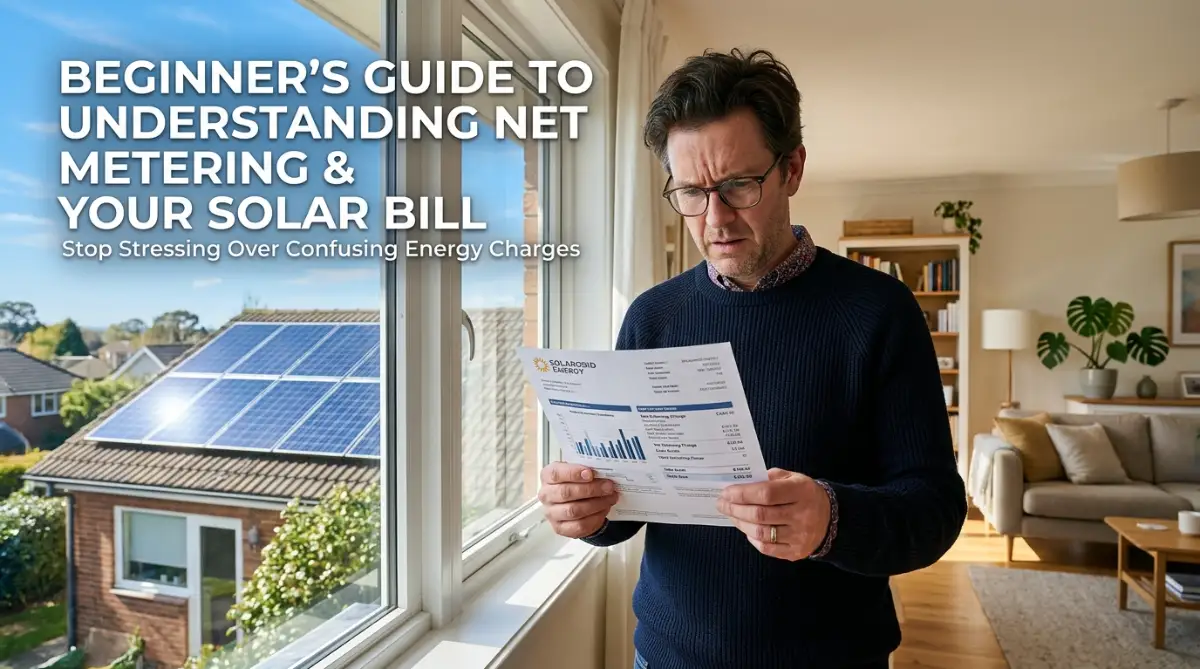
I still remember the exact moment I ripped open the envelope containing my very first electric bill after installing solar panels. I was so excited to finally see a big, beautiful zero at the bottom of the page. Instead, my eyes widened as I stared at a confusing jumble of numbers, negative signs, and a balance that definitely was not zero. I felt this heavy knot in my stomach almost immediately. Did I just make the biggest financial mistake of my life? I honestly thought the solar company had lied to me about how much money I would actually save.
This is a terrible and overwhelming feeling that so many new solar owners face every single day. You invest a huge amount of your hard-earned money expecting financial freedom. But instead, you just get hit with extreme anxiety and confusion.
The mental peace you hoped for gets completely replaced by late-night panic searches on the internet. You look up at your roof, knowing the bright sun is shining down, but your monthly statement makes absolutely no sense at all.
Friends and family members ask how the new panels are doing, and you just force a smile. You do this because you are too embarrassed to admit you do not understand the complex billing process. It feels like a massive weight on your shoulders, constantly making you second-guess your big investment.
The truth is, the big energy companies do not make these paper statements easy to read on purpose. They use complicated industry jargon that makes everyday homeowners feel completely powerless and uneducated.
You are definitely not alone in this highly frustrating struggle, and your beautiful panels are likely working perfectly fine. The real enemy here is just a simple lack of plain-English information about how utility companies actually calculate your daily usage.
The Invisible Battery: How the Grid Manages Your Sunshine
To truly understand what is happening on that piece of paper, we need to talk about the basic concept of how your home interacts with the city power lines. Most people think that once they get panels, their house becomes an isolated island.
This is a very common misunderstanding. Unless you spent tens of thousands of dollars on massive off-grid storage batteries, you are still very much connected to the local power company. Your home is essentially in a constant, invisible dance with the city power lines.
During a bright, sunny afternoon, your roof is likely producing way more power than your television and refrigerator can consume. Your home cannot just hold onto this extra power. It has to go somewhere immediately.
This is where the magic of the connection happens. Your house automatically pushes all that excess, unused power out of your home and straight into the public power lines. Your neighbors end up using the clean sunshine you collected.
In return for giving them this amazing power, the utility company gives you digital credits. You can think of these credits exactly like money sitting in a bank account. You are depositing energy during the day to build up your savings.
Then, when the sun goes down and your family turns on all the lights and the oven, your panels go to sleep. Your house reaches out to the city power lines and pulls electricity back in to keep your home running.
Instead of charging you cash for this nighttime usage, the company simply deducts the digital credits you banked earlier in the day. This simple swapping system is the entire foundation of how you save money.
The Myth vs Reality of Going Solar
The Myth: My solar panels directly power my lights at night because they store the sun's energy inside them.
The Reality: Standard panels have no storage capacity at all. At night, you are buying power from the city, hoping your daytime credits cover the cost.
Decoding the Two-Way Smart Meter on Your Wall
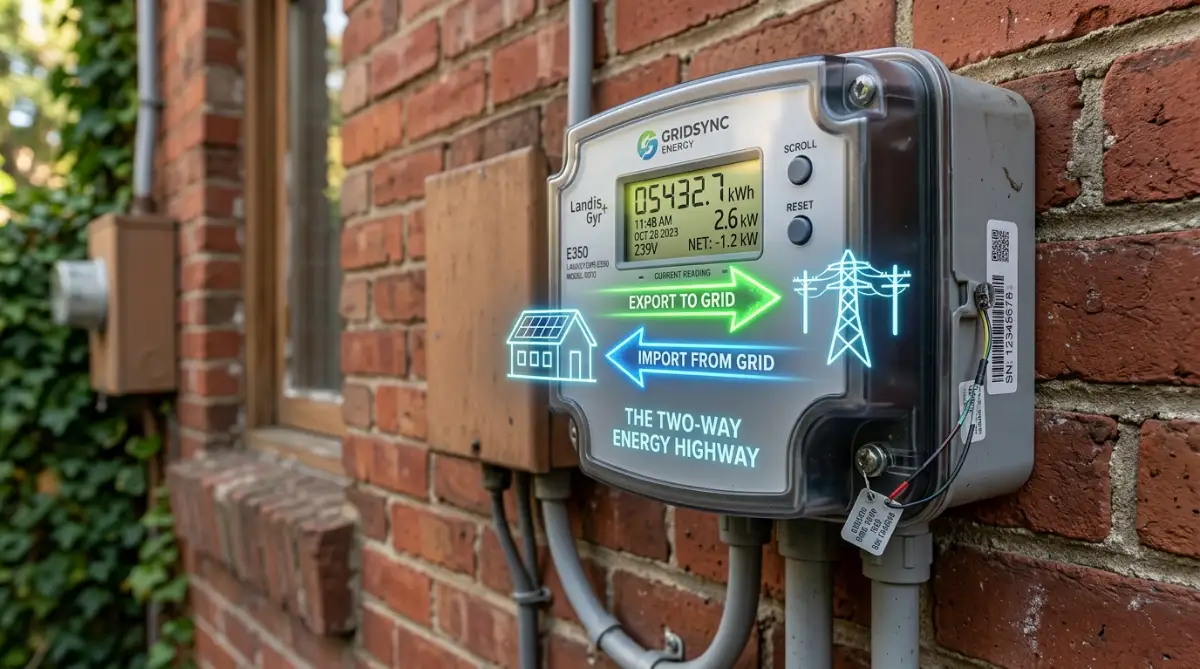
Before you ever try to read the confusing paperwork, you should take a walk outside and look at the side of your house. When your solar system was approved, the city likely swapped out your old electrical meter for a brand new, digital bi-directional meter.
This specific device is the ultimate judge of your monthly bill. Your old meter only knew how to do one thing: count upward as you bought power. The new one is much smarter.
It reads the electricity flowing in both directions. It tracks exactly how much power you take from the street, and exactly how much power you push back to the street.
If you look closely at the digital screen during a sunny day, you might see a small arrow pointing to the left, or the numbers might literally be counting backward. This is a beautiful sight because it means you are actively acting as a mini power plant for your neighborhood.
However, it is highly important to understand that this meter does not measure the total amount of energy your panels create. It only measures what crosses the boundary between your house and the street. Your home consumes a lot of the solar juice before the meter ever gets a chance to see it.
My embarrassing mistake when I first got solar is something I want to share so you can avoid it. I used to run my heavy dryer and dishwasher very late at night, thinking I had securely stored up 'free' energy in my panels. I quickly realized that without a physical home battery, doing heavy chores in the dark was just pulling expensive power right back from the grid, basically wiping out the hard-earned credits I made during the sunny day.
Watch This Video to See Exactly How Net Metering Saves You Money!
If you are still a bit confused about how the power company tracks your energy swapping, do not worry at all. I have found an incredibly helpful visual breakdown that shows exactly how this energy exchange happens in real-time, making it super easy to understand before you look at your next bill.
Translating the Confusing Jargon on Your Statement
Now that we know how the physical swap works, let us look at the actual terminology they use to confuse us. Energy companies love to use abbreviations.
The most common term you will see everywhere is kWh, which stands for Kilowatt-hour. This is simply the unit of measurement they use to sell electricity. Think of it exactly like gallons of gas for your car, but for your home appliances.
When you get your statement, you will notice they split your usage into a few different categories. Let us look at a simple breakdown to make things crystal clear.
If your export number is larger than your import number, you had a fantastic month. You successfully produced more than you consumed. You will not owe anything for the actual energy that month.
Why Your Balance is Never Truly Zero
This is usually the biggest shock for new system owners. Even if you cover 100% of your energy needs with the sun, you will still receive a bill every single month with a small dollar amount owed.
You might aggressively wonder why you have to pay anything if you gave them extra power. The answer lies in something called Non-Bypassable Charges or Customer Interconnection Fees.
Maintaining the massive network of wooden poles, thick wires, and neighborhood transformers costs a lot of money. Because you are using their wires to act as your giant temporary battery, they charge you a monthly rental fee for that privilege.
This fee is usually pretty small, often between ten and twenty dollars a month depending on where you live. It also includes mandatory state taxes and public purpose programs that everyone tied to the system has to pay by law.
You cannot offset these specific administrative fees with your extra sunshine credits. Think of it like a mandatory subscription fee just to keep your house attached to the network.
The Secret Trap of Time-of-Use (TOU) Billing
This next section is where many homeowners accidentally lose a massive amount of their potential savings. The concept of net metering sounds perfectly equal on the surface, but power companies have added a sneaky layer of complexity called Time-of-Use rates.
In the old days, a unit of power cost the exact same amount whether you used it at three in the morning or three in the afternoon. A simple one-for-one trade. Those days are mostly gone.
Now, the price of power changes drastically depending on what time of day it is. The utility companies look at when the entire city is using the most power, usually between four in the afternoon and nine at night when everyone gets home from work. They call this the Peak Time.
During Peak Time, they charge you the absolute highest premium price for energy. The problem for solar owners is that the sun usually starts going down exactly when Peak Time begins.
So, during the bright morning and early afternoon, you are exporting massive amounts of power to the city. But the city labels this as Off-Peak time. They give you a much lower credit value for the amazing energy you are giving them.
Then, when the sun sets, your family turns on the oven and the air conditioning. You are now buying power from them during their highly expensive Peak Time.
You are essentially selling your sunshine to them at a massive discount during the day, and then buying their power at a premium luxury price at night. This uneven exchange rate means you need to produce significantly more power than you use just to break even financially.
To fight back against this unfair pricing, you have to drastically change your daily habits. You must start treating your most power-hungry appliances completely differently.
You should always run your heavy pool pumps, electric car chargers, and electric water heaters right in the middle of the day. By using the power exactly when it is being created on your roof, you block the power company from stealing your cheap energy and overcharging you later.
The Annual Heartbreak: The True-Up Statement
If you thought the monthly statements were confusing, you need to mentally prepare yourself for the ultimate billing event that happens once a year. Depending on your local provider, this is often called the True-Up Bill or the Annual Settlement.
Throughout the regular year, your power company is mostly just keeping a running tally of your usage. During the long, sunny summer months, you will likely build up a massive bank of extra credits.
During the dark, short days of winter, your panels will struggle to keep up with your heating demands. You will start eating heavily into that bank of saved summer credits.
For twelve straight months, the company just lets this math problem roll over month after month. You only pay those small mandatory connection fees we talked about earlier. Everything feels great, and you feel like a financial genius.
But at the end of your 12-month cycle, the utility company forcefully stops the clock. They look at your grand total for the entire year.
If you ended the year in the negative, meaning you pulled more power from the street than you pushed back over 365 days, they will send you a massive, one-time bill for that total difference. Homeowners who were paying ten dollars a month suddenly get a surprise bill for hundreds of dollars, causing immense stress.
On the other hand, if you were super careful and ended the year with a huge surplus of extra credits, you might expect a big fat check in the mail. Unfortunately, the system is designed to heavily favor the big companies.
When they settle your extra positive credits, they do not pay you the retail price they usually charge. They pay you a drastically reduced Wholesale Generation Rate.
This means that hundreds of dollars worth of beautiful extra sunshine might only turn into a tiny thirty-dollar credit on your account. They get to keep and sell your extra power for a massive profit.
This harsh reality proves that over-sizing your system just to sell power back to the city is a terrible financial strategy. The true goal of a perfectly designed home solar setup is simply to hit zero net usage by the end of the year, not to try and become a rich energy tycoon.
Insider Strategies for Maximizing Your Solar Savings
If you want to truly win the energy game, you have to stop treating your home like a passive energy consumer. You need to start thinking of your house as an active, smart energy manager. The people who see the biggest financial returns on their panels are the ones who slightly adjust their daily routines.
You do not need to drastically change your entire life or sit in the dark to save money. You simply need to match your heaviest power usage with the natural rhythm of the sun. This simple behavioral shift is the greatest secret to getting a tiny monthly statement.
I always tell new solar owners to practice the art of Load Shifting. This simply means moving your most power-hungry chores from the dark evening to the bright afternoon. It sounds incredibly basic, but this one habit can literally save you hundreds of dollars over a 12-month period.
Let us look at a very common weekend scenario that drains your potential savings. Many people wait until Sunday night to do five huge loads of laundry and run their dishwasher. Since the sun has already gone down, you are buying highly expensive electricity directly from the city grid for hours.
Instead, you should take advantage of modern technology to do the hard work for you. Most new washing machines and dishwashers have a simple delay-start timer built right into the control panel.
Before you leave for work in the morning, load up your machines and set the timer to start at exactly noon. While you are sitting at your desk at the office, your appliances will wake up and run completely on the free sunshine hitting your roof. You are essentially doing your chores for zero cost.
Mastering Your Smart Home Thermostat
Heating and cooling your house takes up more energy than almost everything else combined. If you run your air conditioner heavily at night, your energy credits will disappear faster than you can blink.
The smartest strategy is to pre-cool or pre-heat your home while your panels are producing maximum power in the mid-afternoon. You can set your smart thermostat to drop the temperature aggressively at two o'clock in the afternoon.
By the time you get home from work at six o'clock, your house will feel like an icebox. The physical structure of your home holds onto that cold air for several hours. You can then completely turn off the air conditioner during the highly expensive evening hours while staying perfectly comfortable.
According to the experts at the Department of Energy's guide on home heating and cooling, taking advantage of your home's natural thermal mass is one of the most effective ways to lower your daily energy demands.
Securing Your Solar Data App
Your installation company definitely gave you a smart phone app to track your daily solar production. This app is your best friend when it comes to understanding how your house breathes in and out. You should make it a habit to check this app at least once a week to spot any strange patterns.
You will definitely need to connect your new solar monitoring system to your home internet network to track this daily production accurately. Since this app collects highly sensitive data about your daily habits, home address, and vacation schedule, it is highly recommended to secure your home network properly. Taking basic security steps is just as important as knowing how a reliable tool can protect your online privacy on public networks when you travel.
If you eventually invest in a physical home battery system to store your extra sunshine safely, you need to manage its charge cycles with extreme care. Consistently draining an expensive home battery completely dry will aggressively shorten its total lifespan. Taking care of these massive wall batteries is very similar to following proven steps to stop ruining your laptop battery during daily use.
The Hidden Pitfalls That Destroy Your Investment
Even with the best intentions, I see highly intelligent homeowners make terrible mistakes that cost them a fortune. The biggest trap is what I call the Infinite Energy Myth.
Just because you have beautiful panels on your roof does not mean you have an unlimited supply of free power. I have seen families install solar and suddenly start leaving all their televisions on all night and running their pool heater constantly.
They completely abandon all their basic energy conservation habits because they feel invincible. When their annual true-up statement arrives twelve months later, they are hit with a massive, soul-crushing bill.
Your solar system was carefully designed and sized based on your previous historical energy usage. If you suddenly double your energy consumption after the panels are installed, your roof will never be able to keep up with your new wasteful habits.
To fully understand how local regulations affect your actual payout rates when you overproduce, you should always check the Database of State Incentives for Renewables & Efficiency (DSIRE) for your specific zip code. Different states have completely different rules on how they punish or reward excess energy creation.
The Phantom Power Drain
Another massive mistake is ignoring the silent energy vampires living in your living room and home office. We call these Phantom Loads.
Many modern electronics never truly turn off when you press the power button. Your smart television, gaming consoles, and microwave display are constantly pulling a slow, steady trickle of power from the wall 24 hours a day.
You might love spending hours in immersive digital worlds on your days off. However, running high-end entertainment gear constantly pulls a lot of hidden power. So while you learn how to stop VR motion sickness and enjoy gaming longer, you must remember to unplug these massive consoles when you are not actively using them.
A single device pulling phantom power might only cost you a few pennies a day. But when you add up fifteen different smart devices across your entire house, it turns into a massive drain on your carefully banked solar credits. I highly recommend plugging your entertainment centers into simple smart power strips that completely cut the electricity when you turn the main device off.
Neglecting Your Hardware Environment
People often forget that a solar setup is a highly complex electrical system that needs to breathe. Your solar inverter works incredibly hard during peak sunlight hours to convert raw sun energy into usable power for your home appliances.
If this heavy equipment is installed inside a poorly ventilated, blazing hot summer garage, it will absolutely suffer from severe thermal throttling. Keeping your physical solar equipment cool is exactly like figuring out how to diagnose and fix overheating issues in high-performance laptops so they do not crash.
When your inverter gets too hot, it automatically slows down its performance to protect itself from melting. This means you are losing out on precious energy production right in the middle of a beautiful sunny day. Always make sure your equipment has plenty of clear airflow around it and is kept free from thick layers of dust.
If you ever notice a sudden, massive drop in your daily energy production, do not just ignore it and hope it fixes itself. According to the national guidelines published by the Solar Energy Industries Association (SEIA), monitoring your system actively is the only way to ensure your utility company is honoring your fair compensation rates. A sudden drop in production usually means a physical part needs to be looked at by a professional technician immediately.
Your Personal Roadmap to Energy Freedom
Understanding your energy statement does not have to be a miserable, anxiety-filled chore every single month. Once you crack the secret code of how the power companies measure your sunshine, the entire system becomes highly predictable.
You now possess the exact knowledge needed to flip the script on the big utility companies. You know exactly how the digital smart meter reads your two-way power flow. You also know exactly why your monthly balance is never truly a perfectly flat zero.
Most importantly, you understand the extreme importance of shifting your heavy energy loads to the bright afternoon hours. You are no longer flying blind when you open that paper envelope.
Your solar panels are a fantastic financial investment that will quietly generate clean, beautiful power for decades to come. You just need to be a slightly more active participant in how that generated power gets used inside your walls.
Take a few minutes tomorrow morning to look at your smart thermostat schedule and check your delay-timers on your heavy appliances. A few tiny button presses today will literally secure your financial peace of mind for the rest of the year.
My Personal Promise to You:
I know exactly how overwhelming all these technical terms and negative numbers feel at the very beginning of your journey. But I promise you, once you develop these simple load-shifting habits, checking your energy app actually becomes a highly addictive and fun game. You have totally got this under control, and your future bank account will heavily thank you for taking the time to learn the rules today!
Questions Homeowners Always Ask Me About Net Metering
What happens to my extra solar credits at the very end of the year?
At the end of your 12-month billing cycle, your utility company performs a massive final calculation called a true-up. If you have extra credits left over, they usually wipe your balance clean and pay you out at a severely reduced wholesale rate. You rarely get the full retail value for your extra power, which is why hoarding credits is not a great strategy.
Will my solar panels keep my house running during a neighborhood blackout?
No, standard grid-tied panels will automatically shut down the second the city grid loses power. This is a strict safety feature designed to stop your roof from pushing live electricity into the broken street wires while repair workers are fixing them. You will only have power during a blackout if you paid for a dedicated off-grid home battery system.
Why did my electric bill suddenly go up during the winter months?
During the short winter months, the sun sits much lower in the sky and sets significantly earlier in the afternoon. Your panels are simply producing a lot less energy, while your home is likely pulling more power from the grid to run electric heaters and indoor lighting. This is completely normal, and you are supposed to use the extra credits you banked during the long summer days to offset this winter dip.
Do I still need to pay standard utility taxes if I make all my own power?
Yes, you absolutely do. Even if your panels cover every single drop of energy your family uses, you are still physically connected to the city power poles. The utility company will always charge you a small mandatory monthly connection fee to help maintain the public wires, meters, and local transformers.
Can I completely disconnect from the city grid to avoid all monthly fees?
Technically you can, but it is an incredibly expensive and highly stressful lifestyle choice for an average family. To survive completely off the grid, you would need to buy a massive, expensive bank of storage batteries and a backup gas generator for cloudy weeks. Remaining connected to the city grid and using their wires as your free virtual battery is almost always the smarter financial move.
Disclaimer: The information provided in this article is for general educational and informational purposes only and does not constitute professional financial, tax, or legal advice. Utility rates, net metering policies, and billing structures vary wildly depending on your local municipality and specific power provider. Always consult directly with your local utility company and a certified solar professional to understand the exact terms, fees, and regulations applying to your personal home installation.