
The Hidden Nightmare of Guessing Your Backup Needs
I still clearly remember sitting in absolute darkness during a massive evening storm, staring blankly at my expensive new solar inverter on the wall. I had recently spent a small fortune on what I confidently thought was the perfect home backup system. My installer assured me I had plenty of storage to run my house through the night. But just three hours after the local grid went down, my entire house suddenly went completely black.
My refrigerator immediately started defrosting, and my kids were terrified of the pitch-black hallways. I felt completely embarrassed because I had spent weeks bragging to my neighbors about my newfound energy independence. That night, sitting there with a tiny flashlight, I realized I had completely miscalculated my actual power appetite. I simply trusted a random package deal instead of doing the basic math for my own family's lifestyle.
This exact nightmare is a silent struggle thousands of homeowners face every single day. You make the massive decision to invest in renewable energy, expecting total peace of mind during grid failures. Instead, you end up trapped in a cycle of endless anxiety, terrified to turn on the microwave because it might drain your entire setup.
The mental peace you thought you were buying completely vanishes into thin air. You start constantly checking your phone app, obsessing over battery percentages like a teenager worried about a dying phone. You yell at your family for leaving the bathroom exhaust fan running, even though the whole point of buying storage was to live comfortably.
The absolute worst part is the feeling of helplessness and wasted money. Buying a unit that is too small means you will still suffer through frustrating blackouts when you need power the most. On the flip side, buying a unit that is way too big means you threw away thousands of dollars on expensive cells that just sit there doing absolutely nothing.
The truth is, finding the perfect size is actually quite simple once you understand how to count your appliances. You do not need an engineering degree to figure out exactly what your house requires to run smoothly. Let us break down the exact technical math that will save your family from sitting in the dark ever again.
Decoding Your True Daily Power Appetite
You do not have to live with a poorly planned backup system. By understanding the simple mechanics of how your household actually consumes electricity, you can easily identify your perfect storage size. Let us look closely at the step-by-step logic that ensures your lights stay on when everything else goes dark.
The Foundation: Tracking Down Your Essentials
The very first thing you need to do is stop looking at your entire house as one massive problem. If you try to run your entire property during an outage, including the air conditioning and the hot tub, you will need a storage unit the size of a shipping container. The secret to an affordable system is separating your absolute essentials from your luxury items.
Grab a notepad and walk through your home, writing down only the things you absolutely cannot survive without. For most people, this list includes the kitchen refrigerator, a few LED room lights, the internet router, and a charging station for phones. If you rely on well water, your well pump is a non-negotiable item that must go on the priority list.
Once you have this list, you are already halfway to finding your magic number. Everything else in your house, like the massive flat-screen television or the electric clothes dryer, belongs on a secondary list. You will only power those items directly from the sun during the bright daytime, never from your expensive storage unit at night.
Ready to see exactly how professionals track down these sneaky home energy loads? Watch this incredible breakdown to see how simple it is to measure every single appliance in your house.
The Difference Between Starting Surge and Running Watts
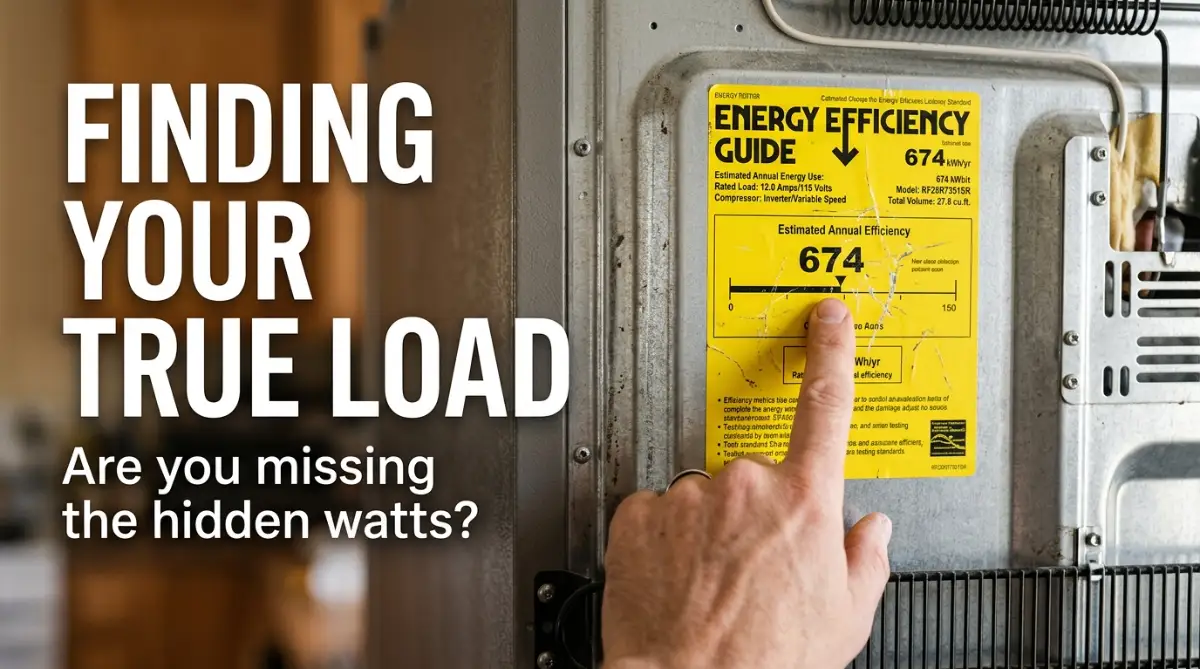
Here is where most ordinary buyers make a massive, expensive mistake. They look at the sticker on the back of their refrigerator, see a number like 200 watts, and build their whole plan around that tiny number. What they do not realize is that motors have a secret, hidden power demand called a starting surge.
Whenever an appliance with a motor turns on, it requires a massive gulp of electricity just to get the internal parts moving. Your simple 200-watt refrigerator might suddenly demand 1,200 watts for exactly three seconds every time the compressor kicks in. If your system is not big enough to handle that sudden, heavy gulp, your whole home setup will instantly crash and shut down.
Think of it like pushing a heavy broken-down car on the side of the road. It takes a massive amount of physical strength to get the heavy tires rolling for the first few inches. But once the car is slowly moving, you can keep it rolling with just a gentle, steady push.
Writing Down the Magic Numbers
To correctly build your math, you need to find two specific numbers for every item on your essential list. You need the continuous running wattage, which is the steady push, and you need the starting surge wattage, which is the heavy initial push. You can usually find both of these numbers printed on the shiny yellow energy sticker attached to the appliance.
If the sticker is missing, do not panic at all. You can easily find these exact ratings by searching the model number of your appliance on the internet. Another highly accurate method is buying a cheap plug-in energy monitor from a local hardware store.
You simply plug this tiny monitor into the wall, and then plug your freezer into the monitor. Leave it there for twenty-four hours, and the digital screen will tell you exactly how much juice that specific machine drinks in a single day. This removes all the stressful guesswork from your planning phase.
Creating Your Daily Watt-Hour Total
Now it is time to do some extremely simple middle-school math. To find your daily power appetite, you need to multiply the running watts of an item by the number of hours you plan to use it. The final number you get is called Watt-Hours (Wh), and this is the true language of home storage.
Let us imagine your living room has four LED light bulbs, and each bulb uses 10 watts of power. Together, those lights demand 40 watts of continuous energy to stay bright. If you plan to leave those lights on for 5 hours every single evening, you simply multiply 40 watts by 5 hours.
That means your lights will eat exactly 200 Watt-Hours from your total storage unit every single night. You simply repeat this incredibly easy multiplication process for everything on your notepad list. When you finally add all those small numbers together, you get your total daily energy requirement.
I originally thought I just needed to look at my monthly utility bill and divide it by thirty. I quickly learned that an average number completely ignores the massive power spikes that happen when you run the microwave and the AC at the exact same time! Make sure you plan for your highest usage hours, not just the daily average.
The Invisible Tax of Inverter Efficiency
Many people finally get their daily total and immediately run out to buy a unit that matches that exact number. Sadly, they are forgetting about the invisible energy tax that happens inside the electronic wires. Your storage unit holds power in a format called Direct Current (DC), but your household machines demand Alternating Current (AC).
To change the DC juice into usable AC juice, the power must travel through the inverter box mounted on your wall. This translation process is hard work, and the machine naturally generates a lot of physical heat while doing it. That heat is actually your precious stored electricity leaking away into thin air.
Most standard inverters are only about ninety percent efficient at doing this translation job. This means you automatically lose about ten percent of your stored energy just by turning the system on. To keep yourself safe, always take your total daily Watt-Hour number and multiply it by 1.15 to add a healthy buffer for these invisible losses.
The Secret Trap of Depth of Discharge (DoD)
This next concept is the absolute biggest reason why people end up sitting in the dark unexpectedly. When a manufacturer sells you a 10-kilowatt storage unit, you assume you can use all 10 kilowatts. Unfortunately, draining a chemical cell completely to zero is the fastest way to permanently destroy the expensive internal materials.
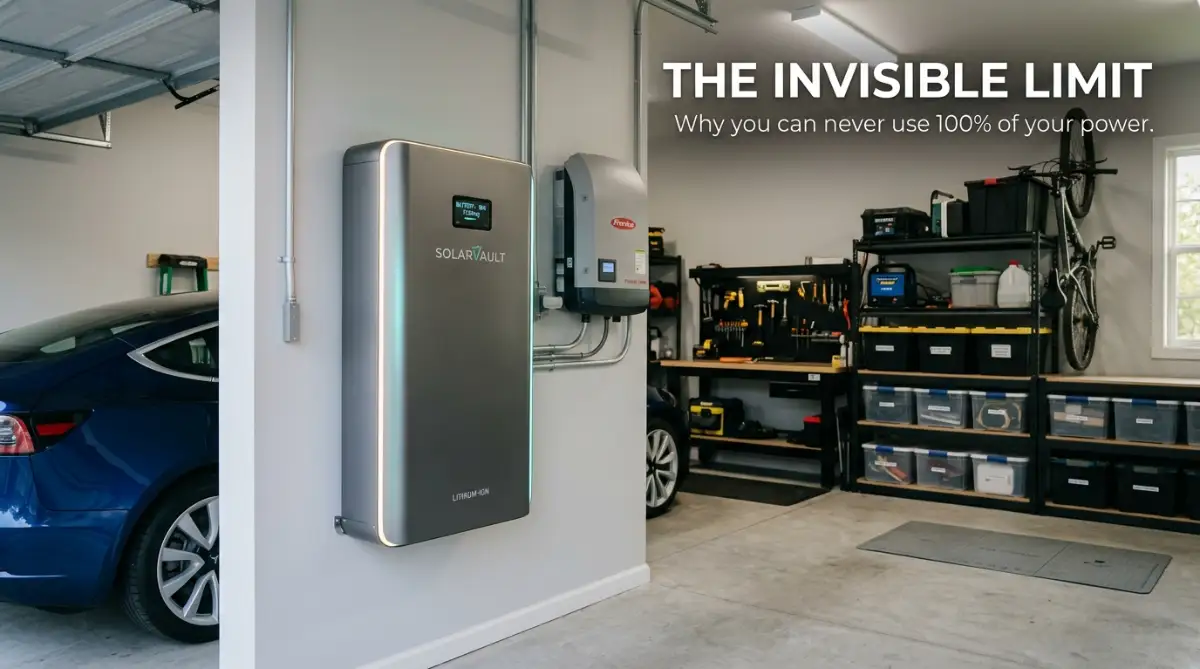
Because of this danger, every unit comes with a strict invisible boundary line called the Depth of Discharge limit. This limit tells you exactly how much of the total capacity you are actually allowed to touch before the machine shuts itself off to prevent permanent damage. If you try to force the machine past this boundary line, the warranty will completely void itself.
For older, cheaper lead-acid setups, this invisible limit is usually right in the middle at fifty percent. That means if you buy a massive 10-kilowatt lead unit, you are only allowed to use 5 kilowatts before the system forcefully turns off your lights. Buying lead acid looks incredibly cheap upfront, but you have to buy twice as many physical boxes just to get the power you actually need.
Quick Look: How Different Chemistries Compare
To make this invisible limit completely clear, let us look at how the common market options handle this exact problem. Making the wrong choice here will secretly double your installation costs.
Modern lithium units are vastly superior because they let you safely drain them almost all the way to the absolute bottom. While they cost a little more at the cash register, they require half the physical wall space in your garage. Always check the official DoD rating before you ever hand over your credit card.
Understanding the "Days of Autonomy" Rule
Now that you know how much usable energy you need for a single night, you have to look at the sky. A solar setup is amazing, but it relies entirely on bright sunshine to refill your tanks the next morning. What happens if a massive, dark hurricane parks over your neighborhood for three straight days?
Off-grid professionals use a safety concept known as "Days of Autonomy." This fancy term simply means how many consecutive days your house can survive strictly on stored juice without seeing a single ray of sunlight. If you live in a sunny desert area, aiming for just one day of autonomy might be perfectly safe.
However, if you live in an area famous for long winter storms, one single day of backup will leave you freezing. You will need to take your daily total and multiply it by two or even three to guarantee your safety. This heavily increases your budget, which is why choosing only your absolute essential appliances earlier was so incredibly important.
The Deflating Balloon of Cold Weather
There is one more sneaky environmental factor that easily ruins perfect mathematical calculations. Chemical energy cells are incredibly sensitive to extreme temperature drops. They absolutely hate freezing cold winter nights.
When the physical temperature inside your garage drops down toward freezing, the chemical reactions inside the boxes dramatically slow down. The total available energy literally shrinks away like a leaky party balloon left out in the cold. A unit that performs flawlessly in the warm summer might lose twenty percent of its holding capacity in the dead of January.
If you plan to install your expensive hardware in an unheated outdoor shed, you must manually adjust your math to compensate for this winter shrinkage. You will need to buy a slightly oversized system to guarantee the remaining eighty percent is still enough to run your heating system. Alternatively, you can save a ton of money by simply installing the hardware inside a climate-controlled basement instead of out in the snow.
Smart Planning Secrets the Installers Rarely Share
Now that you understand the basic math of your daily power appetite, it is time to look at how you can actually shrink that number down. You do not always need to buy a massive, expensive storage unit to keep your lights on. Sometimes, the smartest solution is simply changing how your house consumes energy throughout the day.
One of my absolute favorite strategies is something off-grid experts call load shifting. This simply means moving your heaviest electrical chores to the middle of the bright afternoon. If you run your electric clothes dryer while the sun is blasting your rooftop panels, the power goes straight from the roof to the machine.
By completely avoiding the laundry during the dark evening, you save all your precious stored juice for things that actually matter overnight. You can easily cut your required storage size in half just by changing your daily habits. For deeper insights into managing household energy, checking the U.S. Department of Energy guidelines on load management can give you incredible ideas on timing your daily chores.
Another amazing trick is investing in a smart electrical panel instead of buying more storage cells. A smart breaker box constantly talks to your phone and automatically shuts off power hogs when the grid goes down. If a sudden blackout hits while you are asleep, the smart panel will instantly disconnect the electric water heater and the air conditioner.
This guarantees your backup energy only flows to the refrigerator and your essential safety lights until morning. You never have to wake up in a panic and run to the garage to flip heavy mechanical switches in the dark. It puts the entire emergency process on complete autopilot.
If you are worried about the massive upfront cost, you should definitely consider an expandable storage setup. Many modern lithium systems are designed like building blocks, allowing you to start incredibly small. You can easily buy just one single unit today to cover your basic emergency needs and keep your budget happy.
Next summer, when you have saved up a little more cash, you can simply hang a second matching unit on the wall right next to it. They automatically connect and share the workload without needing a massive system overhaul. Just remember that extreme heat is a silent killer for these expandable units.
If you install your shiny new hardware in a boiling hot, unventilated garage, the internal cells will suffer terribly. Similar to how you must actively work on how to diagnose and fix overheating issues in high-performance laptops, you must keep your wall units cool. Installing a simple garage exhaust fan can easily add five extra years of healthy life to your expensive investment.
You also need to think carefully about the hidden phantom loads scattered around your living room. Even when your modern television and gaming consoles are turned off, they are secretly sipping power while waiting for a remote control signal. During a prolonged blackout, these tiny phantom loads slowly bleed your backup unit completely dry.
To solve this, put your entertainment centers on heavy-duty smart power strips. When the grid fails, you can physically click one single switch to kill the phantom drain completely. If you have a massive computer setup and want to enjoy gaming longer during a blackout, cutting power to secondary monitors and unused speakers is an absolute must.
Finally, always keep an eye on how your entire system connects to your home internet router. Most modern inverters require a constant Wi-Fi connection to send helpful diagnostic data to your smartphone app. While setting up these amazing monitoring tools, it is a great time to think about what is a vpn and how it protects your online privacy on public networks when you check your solar app away from home.
The Heartbreaking Traps of DIY Solar Sizing
Even with the best intentions, I see homeowners making terrible mistakes that end up costing them a small fortune. Planning a home energy system is a deeply emotional journey because you are spending hard-earned money to protect your family. When that protection suddenly fails during a winter storm, the feeling of betrayal and frustration is completely overwhelming.
The absolute most common trap people fall into is completely ignoring the natural aging process of chemical cells. People do all their complex math based on what the hardware can hold on the very first day it leaves the factory. They completely forget that, just like a mobile phone, a wall unit loses a tiny bit of its total capacity every single year.
If you design a setup that barely covers your needs on day one, you are walking straight into a disaster. By year three, the natural degradation of the internal chemistry will shrink your available power pool. You will suddenly find yourself sitting in the dark again because your aging unit can no longer last until sunrise.
According to a detailed National Renewable Energy Laboratory research on battery lifespan, planning for this exact capacity fade is non-negotiable for serious off-grid setups. You must deliberately oversize your initial purchase by at least fifteen to twenty percent right from the start. This smart buffer guarantees that even when the equipment is ten years old, it still holds enough juice to get you through the night.
In many ways, treating a massive household unit requires the exact same logic as treating smaller portable devices. If you want to dive deeper into this concept, learning proven steps for maximum life for standard electronics translates perfectly to massive off-grid storage. Small daily charging habits have a massive impact on how many years your system will actually survive.
Another devastating pitfall is blindly trusting the aggressive marketing brochures handed out by local salespeople. They love to advertise massive peak power numbers in giant bold letters to make the product look incredibly powerful. However, those giant numbers usually only represent what the machine can handle for about ten seconds before crashing.
When you are trying to run a heavy air conditioner or a deep freezer, you care mostly about the continuous rating. If your central air conditioner pulls 4,000 watts continuously, but your inverter can only sustain 3,500 watts, the system will instantly shut down. The peak rating might say 7,000 watts, but that does not help you run a heavy motor for three straight hours.
I have also watched people ruin perfectly good hardware by trying to save money on cheap installation cables. The wires connecting your storage unit to your main breaker box carry an unbelievable amount of physical current. If those specific copper wires are too thin, they act like a tiny clogged pipe trying to move a massive ocean of water.
The wires will heat up dangerously, wasting massive amounts of your precious stored energy as literal heat. In the absolute worst cases, thin cables can actually melt the plastic insulation and start a terrifying wall fire. Always force your installer to use excessively thick, premium copper wiring, even if it adds a few hundred dollars to the final bill.
For those looking into the deep science of power flow, reviewing the IEEE guidelines on solar inverter efficiency shows exactly why wire thickness matters so heavily. It is a tiny detail that completely dictates the overall safety of your family's home.
Finally, please stop assuming that throwing more money at the problem automatically fixes everything. Buying three massive units when your math clearly shows you only need one is an incredible waste of resources. Those extra units will simply sit on your wall slowly aging, losing their valuable lifespan without ever doing any real work.
Taking Control of Your Home Energy Future
Finding the perfect balance for your home does not have to feel like studying for a complex physics exam. Once you sit down and truly look at how your family consumes electricity, the scary mystery completely disappears. You realize that keeping the lights on is just a matter of matching your required daily habits with the right size box.
Start small by walking around your house with a simple notepad and a cheap energy monitor. Find out exactly how much juice that old basement freezer is silently stealing from you every single day. Make a firm, realistic decision about what appliances you can easily live without during a temporary emergency blackout.
Remember to factor in those heavy starting surges, and always leave a healthy buffer for cold weather and natural aging. If you follow this exact logical path, you will design a customized system that works perfectly for your unique lifestyle. You will finally experience that incredible feeling of total peace of mind when the neighborhood grid suddenly goes dark.
I honestly wish I had known all of this before writing my first massive check to a solar company. You now hold the exact blueprint to protect your family, save your hard-earned money, and finally build the reliable energy backup you truly deserve.
Straight Answers to Your Biggest Backup Power Questions
Can I run my whole house on just one single storage unit?
Running an entire modern home on one standard unit is nearly impossible if you include heavy items like air conditioning. A single unit is generally designed to handle essential loads like your refrigerator, lights, internet, and a few small outlets. If you want to power the whole house effortlessly, you will need to stack multiple heavy-duty units together.
How long will a 10kW battery actually last during a blackout?
The timeline depends entirely on how many things you turn on simultaneously. If you only run a few LED lights and an efficient refrigerator, a 10kW unit can easily last over twenty-four hours. However, if you try to bake a cake in an electric oven while running the dryer, you could drain that exact same unit in less than two hours.
Do my rooftop panels still work when the local grid goes down?
If you do not have any physical storage units installed, your panels will automatically shut completely off during a blackout. This is a built-in safety feature designed to stop your roof from sending live electricity into the street while repair workers are fixing the broken lines. Adding a storage unit is the only way to keep using your rooftop power when the neighborhood goes dark.
Can I mix different brands or chemistries together later?
Mixing different brands, sizes, or internal chemistries (like putting a lithium unit next to a lead-acid unit) is a terrible idea. They operate at completely different voltages and will actively confuse the main computer, leading to massive system failures. If you plan to expand your setup in the future, always buy the exact same brand and model to ensure they communicate perfectly.
Does cold winter weather really shrink my available capacity?
Yes, extreme freezing temperatures dramatically slow down the internal chemical reactions needed to release energy. If your setup is sitting in a freezing outdoor shed, you might temporarily lose up to twenty percent of your usable power pool. Once the weather warms back up, the total capacity naturally returns to normal.
Disclaimer: The information provided in this article is for educational and informational purposes only and should not be considered professional electrical or financial advice. Every home has unique wiring, appliance loads, and local safety codes. Always consult with a licensed, certified solar installer and a qualified electrician before purchasing or installing any high-voltage energy storage systems. We are not responsible for any personal injury, equipment damage, or financial losses resulting from DIY installations.