The Hidden Risk of Unsecured Portable Data
I know the exact feeling. You toss your external hard drive into your backpack, head out to a local coffee shop, and do not think twice about it. But what happens if that drive slips out of your pocket? Suddenly, anyone who picks it up has full access to your private photos, tax returns, and sensitive work files. Today, I am going to show you exactly how to lock down your portable drives so you never have to worry about your personal information ending up in the wrong hands.
This reality makes relying entirely on physical safety a flawed strategy. Physical devices are small, easy to misplace, and highly prone to slipping out of pockets. The actual solution lies in making sure that even if the physical device falls into the wrong hands, the data inside remains completely unreadable. When you encrypt external hard drive systems properly, you transform your plain files into complex mathematical puzzles. Without the correct digital key, your drive simply looks like a blank, unformatted disk to unauthorized users.
Many people hesitate to secure their portable storage because they worry the process will require an IT degree or slow down their daily work. Let us clarify exactly how this technology impacts your daily routine.
Q: Will adding a security lock slow down my daily file transfers?
A: Modern computers handle background encryption seamlessly. While copying extremely large files might take a few seconds longer, you will rarely notice any significant speed drop during standard daily use.

What You Need to Know Before We Start:
- Backup first: Always copy your files to your main computer before adding a digital lock to your portable drive to prevent accidental data loss.
- Free tools work great: Built-in options like BitLocker (Windows) and FileVault (Mac) are completely free and offer all the protection most people will ever need.
- Keep your keys safe: If you lose your recovery password, your files are gone for good. Always print it out and hide it somewhere safe offline.
Hardware vs. Software Protection: Understanding Your Options
Before making any changes to your files, you should understand the two main categories of digital protection. You can either buy a device that does the heavy lifting internally, or you can use your computer to lock a standard drive. Both methods effectively password protect external drive files, but they operate very differently behind the scenes.
Here is a clear breakdown of how these two methods compare when you need to secure portable hard drive data:
Hardware-based devices often feature physical keypads or fingerprint scanners directly on the casing. Software-based options rely entirely on typing a password into your computer screen. For most home users and freelance professionals, software options provide excellent security without requiring a premium hardware purchase.
Here is a quick breakdown of the most popular tools I recommend you check out first:
Step 1: Preparing Your Storage for a Safe Lockdown
You cannot simply push a button and expect a drive full of disorganized files to secure itself flawlessly. Preparation prevents catastrophic file corruption. When a computer begins applying USB drive encryption software, it has to read, scramble, and rewrite every single piece of data on that disk. If your drive has physical damage or a corrupted file system, this intense reading and writing process can fail midway.
First, you must create a temporary backup. Move all the files currently sitting on your portable drive to your computer's main internal storage, or upload them temporarily to a cloud service. Start with a completely empty external drive. This dramatically speeds up the initial setup because the computer does not have to spend hours scrambling existing data.
Next, you need to check the file system format. If you format the drive as NTFS, it will work perfectly on Windows but will be read-only on a Mac. If you format it as APFS, your Mac will love it, but a Windows computer will not even recognize it exists. If you plan to move your secure portable hard drive between different operating systems, you might need specific third-party tools that handle cross-platform compatibility.
Myth vs Reality on Data Recovery
Myth: Adding a digital lock guarantees you will never lose your files.
Reality: A secure lock only prevents unauthorized access. If you forget your master password, your files become permanently inaccessible even to you. No customer service team can bypass true encryption to recover your lost password.
Step 2: Activating Native Operating System Shields
Most modern computers come with highly effective defense systems built right into the operating system. You do not always need to download confusing third-party applications to achieve professional-grade security.
If you use a Windows computer, the built-in tool is called BitLocker. Available on Professional and Enterprise editions, BitLocker allows you to right-click any connected USB stick or portable SSD and select "Turn on BitLocker." The system will guide you through setting up a strong password. It will also generate a long string of numbers known as a recovery key. You must save this recovery key in a secure location, preferably printed on paper and stored in a physical safe, or saved in a secure cloud account.
If you use an Apple computer, the built-in tool is Disk Utility, utilizing a system called FileVault technology. You can open Disk Utility, select your external storage, and click "Erase." During this erase process, you can choose an encrypted format. Your Mac will ask you to create a password right then and there. From that moment on, anytime you plug that drive into a Mac, a small prompt will appear asking for your password before the drive mounts to your desktop.
Pro Tip: For organizations requiring strict compliance, utilizing specialized hardware offers a distinct advantage over native software tools. A hardware-encrypted device like the Samsung T7 Touch utilizes a dedicated AES 256-bit chip, processing security completely independently from the host computer's processor. This physical separation prevents software-based brute-force attacks because the internal chip automatically locks down the drive entirely after a specific number of incorrect password attempts.
Here is a helpful visual guide explaining how these native systems protect your information from unauthorized users.
Watch this quick demonstration on setting up native drive security:
Step 3: Implementing Open-Source Defense Systems
Sometimes built-in tools are not enough, especially if you need your external SSD security to function flawlessly across both Windows and Mac computers. Native tools heavily favor their own ecosystems. This is exactly why open-source solutions remain incredibly popular among tech enthusiasts and privacy advocates.
Open-source applications are publicly verifiable. Security experts around the world can inspect the underlying code to ensure there are no hidden backdoors that hackers could exploit. VeraCrypt stands out as the most widely respected open-source application for this exact purpose.
Using VeraCrypt gives you the ability to create an encrypted container file on your regular drive. Think of this container as a highly secure digital safe sitting inside a normal room. You can plug your drive into any computer, and it will look like a normal drive with regular files. However, one of those files will be your VeraCrypt container. When you open the VeraCrypt application and provide the correct password, that container mounts as a completely separate, secure virtual drive on your computer.
This container method offers massive flexibility. You can store public files on the main partition of your portable storage, while keeping your sensitive client documents hidden safely inside the container file. Setting this up requires a bit more patience than simply right-clicking a drive, but the cross-platform compatibility and extreme privacy benefits make the extra effort highly rewarding.
My Personal Cross-Platform Setup:
If you use both a Mac and a Windows computer every single day like I do, things can get tricky. I like to format my main drive to ExFAT so both systems can read it. Then, I use VeraCrypt to create a secure hidden folder inside that drive. This way, I can drop normal files in the main area, while keeping my sensitive client contracts locked inside the VeraCrypt folder. It takes about 10 minutes to set up, but it saves me from massive headaches later!
Step 4: Advanced Hedging Against Catastrophic Data Loss
Securing a portable drive with a heavy digital lock creates a highly effective defense barrier against external theft. However, this exact same barrier can easily trap you outside of your own files if you fail to plan for hardware malfunctions. Financial experts use hedging techniques to protect their investment portfolios from sudden market crashes. You must apply this exact same hedging philosophy to your digital files.
When you scramble data on a physical disk, you are putting massive trust into the health of that specific piece of hardware. If a small sector of the drive gets damaged by a static shock or a physical drop, standard files might just suffer minor corruption. However, a damaged sector on an encrypted drive can sometimes break the entire decryption sequence, rendering the whole drive completely unreadable. This is why seasoned IT professionals never rely on a single physical device.
Your best defense is maintaining a strict 3-2-1 backup strategy. This means keeping three total copies of your data, stored on two different types of media, with one copy kept in an entirely separate physical location. For instance, your active work might live on your secured portable SSD, while a secondary copy rests on your home desktop computer. The third copy should exist off-site, perhaps utilizing end-to-end encrypted cloud storage.
According to guidelines published by the Cybersecurity and Infrastructure Security Agency on data backup methods, treating a single portable drive as your only storage vault guarantees eventual data loss. Hardware fails entirely on its own timeline. If your primary computer suddenly fails while transferring locked files, understanding how to recover data from a dead laptop becomes an immediate priority to prevent permanent file loss.
Step 5: Establishing a Secure Recovery Buffer
This creates an incredibly dangerous single point of failure. You need a highly secure liquidity buffer—a safe, accessible place where your backup credentials live completely isolated from your daily devices. Storing your BitLocker or FileVault recovery key as a plain text file on your computer desktop defeats the entire purpose of file security. If someone gains access to your computer, they immediately gain access to your locked portable drives.
The smartest approach involves utilizing an offline physical buffer. Print your recovery string on a piece of high-quality paper. Place that paper inside a waterproof envelope and store it in a physical fireproof safe or a bank deposit box. Alternatively, you can use a dedicated, offline password manager.
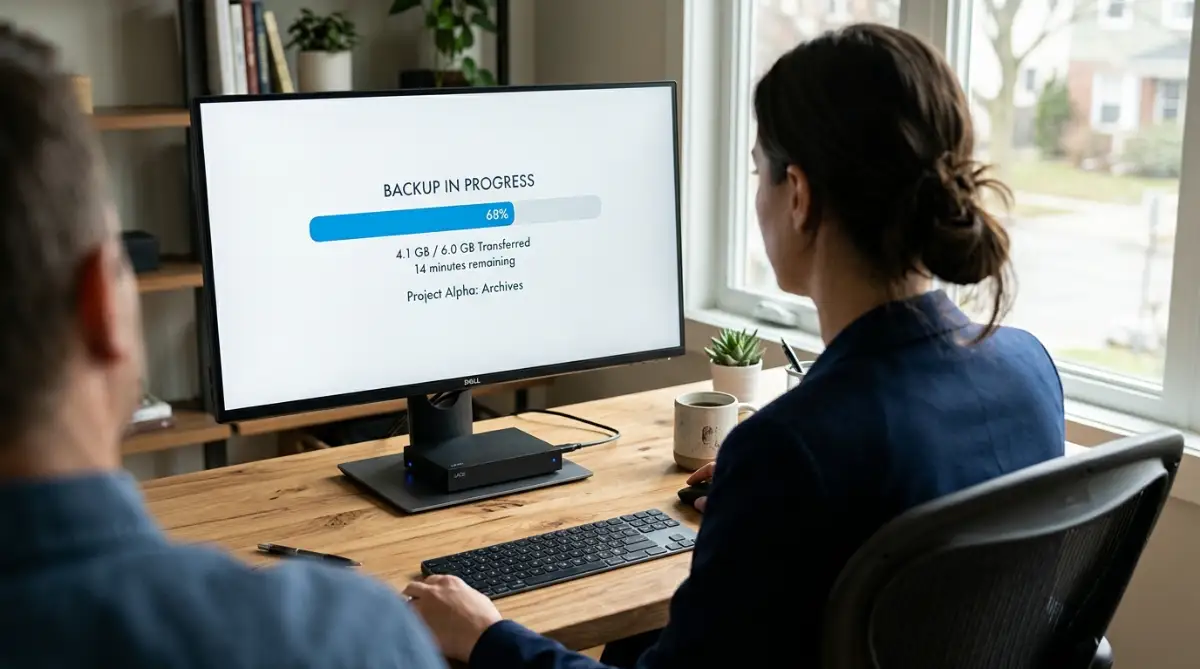
If your backup transfer process takes several hours, a sudden power loss can corrupt the entire drive partition. Taking proven steps for maximum battery life ensures your laptop will not shut down unexpectedly right in the middle of a massive file lock.
Do's vs. Don'ts: Pro-Level Drive Management
Do: Memorize a passphrase consisting of completely unrelated words (like "HorseBatteryStapleCoffee") instead of a complex string of random symbols. It is much harder for computers to guess and much easier for human brains to recall.
Do: Safely eject your portable storage through your operating system menus every single time before pulling the physical cable. Pulling the cable during a background security check will instantly corrupt the file directory.
Don't: Connect your highly sensitive drive to public computers at libraries, hotels, or print shops. Keylogging software on public machines can easily steal your master password the moment you type it.
Don't: Assume your data is safe just because the hardware looks rugged. A heavy-duty rubber casing protects the physical chips from drops, but it does absolutely nothing to prevent unauthorized software access.
The Most Expensive Psychological Pitfalls
Human emotion remains the weakest link in any security system. When unexpected technical errors occur, people tend to panic and make impulsive decisions that permanently destroy their own data. Understanding these common behavioral traps will save you from making catastrophic mistakes under pressure.
The most common trap is the Panic Formatting Response. When you plug a Windows-encrypted BitLocker drive into an Apple Mac, the Apple system will not recognize the format. Instead of just doing nothing, the Mac will often display a scary warning stating the drive is "Unreadable" and immediately offer a button to "Initialize" or "Format" the disk.
A panicked user might click "Initialize," thinking it will fix the reading error. Instantly, the operating system wipes the entire drive clean, destroying every single locked file beyond any hope of professional recovery. The correct response is to stay calm, click cancel, and only connect that specific drive to a compatible Windows machine.
Another major pitfall is the False Sense of Invincibility. Because their files are mathematically locked, users often treat the physical drive with extreme negligence. They leave it in freezing cars, toss it into bags without protective cases, or expose it to extreme heat. The National Institute of Standards and Technology provides extensive documentation showing that physical degradation remains a leading cause of catastrophic storage failure, regardless of how strong the software protection is.
Mathematical security does not equal physical durability. A stolen drive keeps your files private, but a physically shattered drive simply leaves you with nothing.
Your Immediate Next Move
Grab the portable drive you use most often and plug it into your computer right now. Move any existing files temporarily to your desktop, format the drive to a clean state, and activate your system's native defense tool today. Do not wait for a security scare to happen before you finally decide to lock down your personal information.
Frequently Asked Questions About Drive Security
Can a locked external hard drive be hacked by a professional?
Modern AES-256 bit defense systems are virtually impossible to crack through brute force. Without the specific password or the generated recovery key, even government-level forensic teams cannot mathematically break the lock to read your personal files within a human lifetime.
Does activating these defenses slow down an external hard drive?
You will experience a very slight delay during the initial setup when the system scrambles your existing files for the first time. After that initial process, modern computer processors handle the daily reading and writing seamlessly in the background, meaning you will not notice any speed reduction during normal use.
What actually happens if I forget my external drive password?
If you forget your daily password, your computer will immediately ask for your long recovery key. If you also lose that physical recovery key, your data becomes permanently inaccessible. The drive itself can be erased and reused, but the old files locked inside will be lost forever.
Disclaimer: The security methods described in this guide are strictly for informational and educational purposes. If you are handling legally regulated, highly sensitive corporate, financial, or medical data, always consult directly with a certified cybersecurity professional to ensure your methods meet full compliance with regional privacy laws.