The Frustrating Cycle of Studying Hard and Remembering Nothing
I still remember sitting at my desk late at night, staring at a mountain of notes. I had spent hours highlighting every single page, confident that I knew everything perfectly. But the moment I sat in the exam hall and looked at the question paper, my mind went completely blank.
I felt a knot in my stomach as panic washed over me. No matter how hard I tried to squeeze the information out of my brain, it was just gone. It felt exactly like I had never even opened a book in the first place.
Have you ever experienced this exact same nightmare? You put in the hard work, sacrifice your sleep, and skip hanging out with your friends just to study. You read the chapters over and over again until your eyes burn.
Yet, when you actually need to recall that information, your brain completely betrays you. This is one of the most frustrating experiences a person can go through. It makes you question your own intelligence and deeply damages your self-confidence.
Many students secretly believe they are simply not smart enough. They watch their classmates easily remember complex formulas and think they must be born with a special gift. This constant self-doubt destroys your mental peace and turns the learning process into a source of heavy anxiety.
The sad reality is that millions of people struggle with this exact same issue every single day. They feel trapped in an endless loop of reading, forgetting, and reading again. But the truth is, your brain is not broken, and you are definitely not lacking intelligence.
The Real Reason Your Brain Dumps Information
To fix this massive problem, we first need to understand what is actually going wrong inside our heads. Our brains are incredibly efficient machines, but they are incredibly lazy, too. Every single second, you are bombarded with thousands of pieces of information.
If your brain tried to store every single thing you saw, heard, or read, it would completely overload. So, it has developed a very aggressive filtering system to protect itself. Unless you actively prove to your brain that a piece of information is extremely important, it will just throw it in the trash.
This concept was proven over a century ago by a German psychologist named Hermann Ebbinghaus. He discovered something called the "Forgetting Curve." His research showed that within just one hour of learning something new, you forget more than half of it.
If you do not review that information, nearly 80% of it vanishes within a few days. So, when you sit down and read a textbook for four hours straight, your brain thinks it is just passing data. It does not realize you need to keep this data for an exam next month.
You have to manually force your brain to understand that this knowledge matters. Simply looking at words on a page will never send that signal. We need to completely change the way we interact with our study materials.
Myth vs. Reality: Stop Tricking Yourself
Before we look at the exact solutions, we have to stop doing the things that are actively holding us back. Most of us use study methods that actually trick our brains into a false sense of security.
Myth: Highlighting and underlining text helps you remember it better.
Reality: Highlighting is a completely passive activity. It makes your brain feel like it is doing work, but it requires zero actual thinking.
Myth: Reading the same chapter five times is the best way to memorize it.
Reality: This creates something called the "Illusion of Competence." Because the words look familiar the fifth time you read them, you assume you know them. But familiarity is not the same as actual mastery.
We have to move away from passive studying right now. If your studying feels incredibly easy and comfortable, you are probably doing it wrong. Real learning should feel a little bit like a mental workout.
Science-Backed Method 1: The Magic of Spaced Repetition
The absolute best way to fight the Forgetting Curve is by using a technique called spaced repetition. Instead of cramming all your study hours into one terrible night before the test, you spread them out.
Think about watering a plant. If you pour a giant bucket of water on a plant once a month, it will die. But if you give it a little bit of water every few days, it will grow strong and healthy.
Your brain works the exact same way. When you review material at increasing intervals, you interrupt the forgetting process. You review it after one day, then after three days, then after a week.
Each time you remind your brain of the information just as it is about to forget, the memory trace becomes thicker. It sends a massive signal to your brain saying, "Hey, I keep seeing this, so I better save it permanently."
There are plenty of free flashcard apps available today that use algorithms to do this for you. They track exactly when you are about to forget a word or concept and show it to you at the perfect moment.
Want to see exactly how to set up this system on your phone? Watch this highly detailed breakdown of spaced repetition apps right here:
Science-Backed Method 2: Active Recall (Force Your Brain to Sweat)
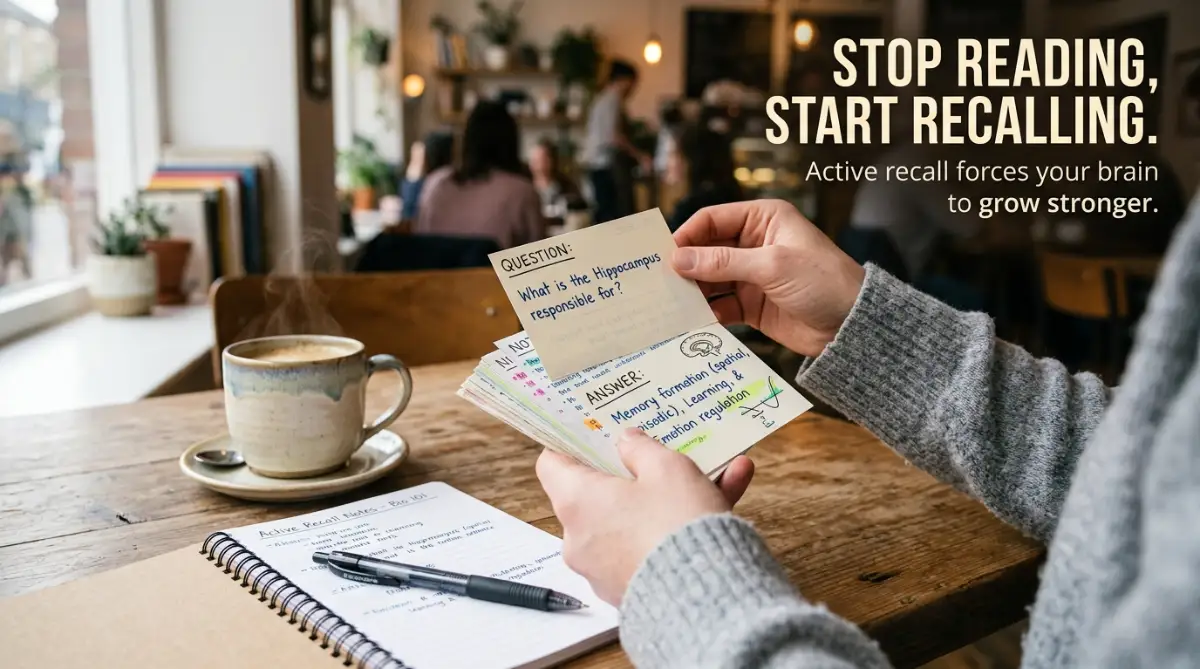
If there is only one habit you take away from this post, it should be active recall. This is the heavy lifting of the studying world. Active recall means testing yourself at every single opportunity without looking at the answers.
When you read a page of a textbook, immediately close the book. Look at the wall and try to explain what you just read using your own words. You will probably stumble, hesitate, and realize you missed a few key points.
That brief moment of struggle is where the actual learning happens. When you force your brain to dig deep and retrieve the information, you strengthen the neural pathways. It is exactly like lifting weights in the gym to build a stronger muscle.
I know active recall can feel extremely exhausting at first. My personal study sessions used to be highly relaxed because I would just quietly read my notes. When I switched to actively testing myself, I would get tired in just twenty minutes.
Pro Tip from my own experience: I used to get really frustrated when I tested myself and got the answers wrong. But I soon realized that getting things wrong during practice is actually the goal. Every mistake you make right now is a mistake you will never make in the real exam hall.
Do not just read the summary at the end of a chapter. Look at the headings and turn them into questions. If the heading is "The Causes of the French Revolution," ask yourself, "What were the main causes?" and try to list them out loud.
Science-Backed Method 3: The Feynman Technique
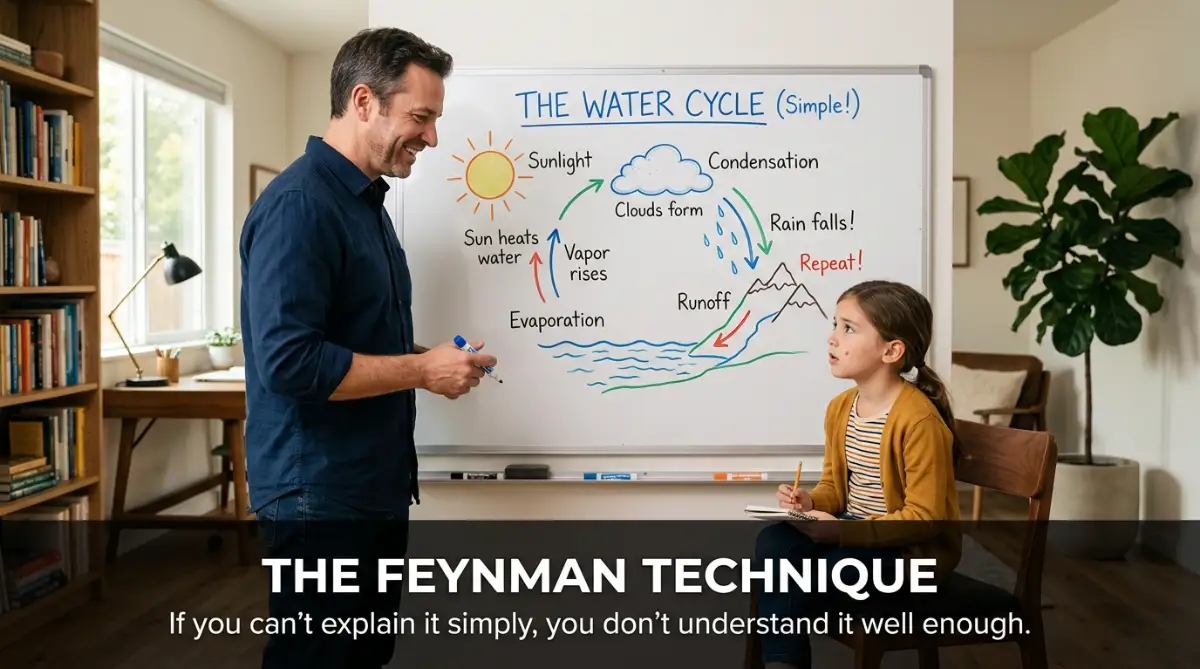
Albert Einstein famously said that if you cannot explain it simply, you do not understand it well enough. This is the core foundation of the Feynman Technique, named after the brilliant physicist Richard Feynman.
He realized that the best way to learn any complex topic is to pretend you are teaching it to a sixth-grader. When we try to sound smart, we use heavy jargon and complicated words to hide what we do not know.
But when you are forced to teach a child, you have to strip away all the fancy vocabulary. You have to break the concept down into its most basic, understandable parts. You have to use simple analogies from daily life.
To use this technique, grab a blank piece of paper and write your topic at the top. Now, write down an explanation of the topic as if you were speaking to a twelve-year-old. When you get stuck or struggle to find the right simple word, you have found a gap in your knowledge.
Go back to your textbook, fill that specific gap, and try again. This method completely destroys the illusion of competence. It proves to you exactly what you know and exactly what you are just pretending to know.
Science-Backed Method 4: Interleaving (Mix Up Your Practice)
Most people study by using a method called "blocking." This means they will spend three straight hours studying only math, and then three hours studying only history.
While this feels organized, science shows it is highly inefficient for long-term memory. Instead, researchers recommend a practice called interleaving. Interleaving means mixing up different topics or different types of problems within a single study session.
For example, instead of doing twenty division problems in a row, you do a mix of division, multiplication, and fractions. When you do the same type of problem over and over, your brain goes on autopilot.
You stop thinking about the strategy needed to solve the problem because you know every question is the same. Interleaving forces your brain to constantly stay alert and adapt. It teaches you not just how to solve a problem, but how to identify which strategy to use in the real world.
It might feel a little chaotic and difficult at first. You will probably make more mistakes during your practice sessions. However, studies show that students who use interleaving score significantly higher on their final exams.
The Foundation of Memory: Sleep and Nutrition
You can use all the spaced repetition and active recall in the world, but it will not matter if your foundation is broken. We treat our bodies like machines that can run on zero sleep and terrible food, especially during exam season.
This is the biggest mistake you can possibly make. Sleep is not a luxury; it is the biological save button for your brain. When you learn new things during the day, they are stored in a temporary holding area in your brain.
It is only when you enter deep sleep that these memories are transferred to long-term storage. If you pull an all-nighter to study, you are actively preventing your brain from saving the information you just read. You are literally working hard just to throw the knowledge away.
Furthermore, your brain needs proper fuel to build those strong neural connections. Drinking five cups of sugary energy drinks will give you a temporary spike, followed by a massive crash.
You need to focus on eating brain-healthy foods like walnuts, fish, eggs, and plenty of water. A hydrated brain processes information much faster than a dehydrated one. Treating your body with respect is the ultimate secret weapon for better memory retention.
By applying these science-backed techniques step-by-step, you can completely transform the way you learn. It requires patience and a willingness to change your old habits. But the reward is a powerful, reliable memory that will never let you down when it matters most.
Master-Level Strategies to Lock Information in Your Brain
Now that we know the basic science behind why we forget, it is time to look at some highly advanced tactics. These are the exact same methods used by medical students and professional memory champions. You do not need a special brain to use these tools; you just need the right strategy.
One of the most powerful tricks you can use is called the "Memory Palace" or the Method of Loci. This technique involves linking complex information to a physical location you already know perfectly. It works because the human brain is exceptionally good at remembering physical spaces and maps.
Imagine walking through your childhood home in your mind. If you need to memorize a list of historical events, you mentally place the first event on your front porch. You place the second event on the living room couch, and the third inside the kitchen fridge.
When you sit down for your exam, you simply close your eyes and mentally walk back through that house. As you walk past the couch in your mind, the memory of that historical event will instantly pop up. It sounds almost like magic, but it is deeply rooted in how human psychology works.
Another incredibly effective tactic is managing your mental energy properly. Imagine your brain has a strict daily budget for energy. You need to organize your study hours just like the beginner's blueprint to zero-based budgeting give every dollar a purpose to ensure no mental energy goes to waste.
If you try to learn highly complex topics when you are already exhausted, you will absorb absolutely nothing. Your brain is dealing with something called cognitive overload. According to scientific research on cognitive load, when your working memory is too full, new information simply bounces off.
To prevent this, you should break large, intimidating topics into tiny, bite-sized pieces. Do not try to learn an entire chapter of biology in one sitting. Focus on mastering just one single cellular process before moving on to the next.
Taking mental breaks is just as important as the study session itself. Just like gamers learn how to stop vr motion sickness and enjoy gaming longer by stepping away, your brain needs moments away from the screen to rest. During these short breaks, your subconscious mind is actually working hard to organize the information you just consumed.
You should also pay close attention to your emotional state before you sit down with your books. Heavy anxiety and outside stress will literally block your brain from forming new memories. According to the American Psychological Association guidelines on stress and memory, high stress levels physically shrink the part of your brain responsible for learning.
If financial worries are weighing you down, finding out how to force your bank to lower your personal loan rates can actually relieve that pressure and clear your mind. You have to remove the friction from your life so your brain can focus entirely on learning.
Finally, build a study environment that matches the exam environment as closely as possible. If your final test is going to be in a quiet, brightly lit room, you should practice in a similar setting. This is called state-dependent memory, and it makes recalling information much easier on the big day.
The Dangerous Study Traps That Secretly Sabotage Your Success
Even if you know the best techniques, it is incredibly easy to fall into bad habits. Many students unknowingly do things that actively destroy their chances of retaining information. These mistakes seem harmless on the surface, but they can completely derail your academic progress.
The biggest trap people fall into is the illusion of multitasking. You might think you can watch a YouTube video, text your friends, and study for a chemistry exam all at once. Your brain physically cannot focus on two complex tasks at the same time.
Instead of multitasking, you are actually just rapidly switching your attention back and forth. Every time you switch away from your book to check a message, you lose your mental momentum. It takes the average person nearly twenty minutes to get back into a deep state of focus after a single distraction.
Over time, this constant context-switching leads to massive mental burnout and poor grades. You will feel like you studied for five hours, but your brain only recorded about thirty minutes of actual learning. You have to put your phone in another room and give your material your undivided attention.
Another terrible mistake is ignoring the tools and environment you use to learn. If you study on a digital device, a sudden crash can ruin your flow. Learning how to diagnose and fix overheating issues in high performance laptops keeps your study sessions smooth and uninterrupted.
Similarly, protecting your digital flashcards and study notes is incredibly important. You do not want to lose months of hard work to a sudden computer crash or a hacked account. This is why understanding the hidden dangers of cloud storage and how end to end encryption saves you is a smart habit for modern students.
We also need to talk about the danger of sacrificing your physical health for an exam. Too many ambitious people think that skipping sleep to cram more information is a badge of honor. In reality, it is the absolute fastest way to guarantee you will forget everything.
As highlighted by the National Sleep Foundation's research on memory consolidation, sleep is the exact moment your brain transfers short-term knowledge into long-term memory. When you stay up all night, you hit the "delete" button on everything you just read.
Failing to fix these bad habits causes a terrible emotional chain reaction. When you constantly study hard but get bad grades, you start feeling a deep sense of worthlessness. You might start avoiding challenging subjects entirely because you are terrified of failing again.
You must protect your mental health by studying smarter, not just longer. If you keep pushing yourself in the wrong direction, you will eventually hit a wall of exhaustion. Recognizing these common traps is the very first step toward building a healthier relationship with learning.
Your Blueprint for Unstoppable Memory Growth
Building a powerful, reliable memory is entirely within your control. It does not happen overnight, and it definitely requires a bit of uncomfortable effort at first. However, the feeling of walking into an exam fully confident in your knowledge is worth every single second of practice.
Start by slowly replacing your passive reading habits with active recall and self-testing. Use the Feynman technique whenever you feel confused by a complex theory or math problem. Make sure you are spacing out your review sessions so your brain gets the maximum benefit from your effort.
Most importantly, give yourself some grace and patience during this transition. You are basically rewiring the way your brain processes information, and that takes time. Celebrate the small victories, like remembering a difficult formula without having to check your notes.
If you are looking for even more structured guidance, checking out Stanford University's guide on effective learning strategies can provide amazing additional insights. Remember, the goal is not to be perfect right away. The goal is simply to be a little bit better at learning today than you were yesterday.
I know exactly how overwhelming it feels to stare at a blank exam paper while your heart races. But I also know the incredible relief that comes when you finally figure out how to make information stick. You have the ability to master any subject in the world, as long as you trust the process and stop standing in your own way.
Frequently Asked Questions About Memory Retention
Why do I forget things immediately after reading them?
Your brain instantly filters out information it thinks is unnecessary to save energy. Because passive reading requires very little mental effort, your brain assumes the text is not important enough to keep. You have to actively test yourself to signal to your brain that the information actually matters.
Can I improve my memory if I am naturally forgetful?
Yes, absolutely. Memory is not a fixed trait you are born with; it is a skill you can train like a muscle. By using methods like spaced repetition and active recall, anyone can drastically improve their ability to remember facts.
How many hours should I study a day?
Quality is always much more important than quantity when it comes to learning. Two hours of highly focused active recall will always beat six hours of distracted, passive reading. You should aim for short, intense bursts of study followed by proper rest breaks.
Does listening to music help you study better?
It completely depends on the type of music and the specific person. Songs with heavy lyrics usually distract your brain because it naturally tries to process the words. If you want to listen to background noise, stick to instrumental music, lo-fi beats, or classical tracks.
Is it better to study in the morning or at night?
This relies heavily on your personal biological clock, also known as your circadian rhythm. Some people naturally have peak focus right after they wake up, while others concentrate better in the quiet of the night. Experiment with both times and track when you feel the most alert and productive.
Disclaimer: The information provided in this blog post is for educational and informational purposes only. It is not intended to be a substitute for professional medical advice, psychological treatment, or professional educational counseling. Always seek the advice of a qualified professional regarding any mental health, cognitive, or learning concerns.