
The Silent Worry: Why Choosing the Wrong Protection Hurts Your Family
Most parents I talk to know they need life insurance, but they keep pushing it off because the whole process feels confusing and pushy. You do not need a degree in finance or hundreds of dollars a month to protect your family if something happens to you. In this clear guide, I will break down how to choose the right policy, dodge costly sales traps, and lock in the best protection for your budget.
What would happen to your family if you were suddenly no longer there to support them? Who would pay the monthly rent, pay off the mortgage, or handle the growing school expenses for your children?
I still remember sitting awake at 2 AM holding my newborn, completely terrified by the sudden thought of my family struggling if something happened to me. I spent weeks staring at confusing insurance websites, feeling totally lost and overwhelmed by the big words they used. It was an incredibly stressful time in my life, but finally figuring out how to build that safety net changed everything for my peace of mind.
Unfortunately, finding a clear path to protect your family is much harder than it should be. The journey to securing their future is often blocked by several common issues:
- Confusing Language: Insurance websites use complex words and legal terms that feel like a foreign language to everyday people.
- Pushy Sales Agents: Many agents care more about their commissions than your actual needs, pushing expensive policies you do not want.
- Too Much Information: Searching online leads to endless articles with conflicting advice, leaving you more confused than when you started.
- Hidden Expenses: Many people buy a policy only to discover hidden fees and rising costs that force them to cancel it later.
You might feel a sense of guilt, believing you are failing your children by putting off this task. This state of constant delay keeps your family exposed to sudden financial damage.
You deserve to feel confident and secure in the choices you make to protect your home. Let us clear away the confusion and look at how these policies actually work.

💡 At a Glance: What You Need to Know First
- Term Life is usually best: For most families, buying a 20- or 30-year term policy gives you the biggest payout for the cheapest monthly cost.
- Do not rely only on work: Employer-provided life insurance almost always disappears the day you change or lose your job.
- Aim for 10x to 12x your income: Multiply your yearly take-home pay by 10 to 12 to make sure your mortgage, debts, and kid's schooling are fully covered.
- Lock in your rate early: Every year you wait makes your premium more expensive. Buying while young and healthy locks in the lowest rate for life.
Your Practical Roadmap to Understanding Life Insurance Policies
Let us make this simple and easy to understand. Life insurance is not a one-size-fits-all product.
There are different types of plans designed for different stages of life and financial budgets. Knowing these options helps you choose the perfect safety net for your loved ones.
If you are a visual learner, take a quick moment to watch this short video that perfectly explains how these different policies work, and then keep reading to discover how to easily lower your monthly costs.
Term Life Insurance: The Simple and Affordable Shield
Term life insurance is the most basic and easy-to-understand option available today. It is designed to protect your family for a specific block of time, which is why it is called "term."
You choose a period, such as ten, twenty, or thirty years. You pay a set monthly fee, and if you pass away during this time, your family receives a cash payout.
How Term Life Insurance Works in Real Life
Think of term life insurance like renting a home. You pay for the space only for the time you live there.
If you stop paying, or if the lease ends, you no longer have the home. Similarly, once the term of your policy ends, the coverage stops completely.
Let us look at a quick example. Meet David, a thirty-year-old father who just bought a home with a thirty-year mortgage.
David buys a thirty-year term life insurance policy worth three hundred thousand dollars. If David passes away at year fifteen, his family gets the full payout to pay off the house.
If David lives past thirty years, the policy ends naturally, and his family does not get any money. However, David's kids are now grown up, and his mortgage is fully paid off anyway.
The Big Benefits of Going with Term Life
First, it is incredibly cheap compared to other options. Young, healthy people can often get large coverage amounts for the price of a couple of pizzas a month.
Second, it is simple. There are no investment accounts, no hidden management fees, and no confusing terms to track.
Whole Life Insurance: Lifetime Protection with Added Savings
If term life is like renting a house, whole life insurance is like buying one. It is a type of permanent life insurance that never expires as long as you pay your premiums.
This policy does two jobs at the same time. It offers a guaranteed death benefit for your family, and it builds up a savings account over time.
The Dual Nature of Whole Life
Every time you pay your monthly premium, a portion of that money goes into a separate account. This account is called the cash value of your policy.
Over the years, this cash value grows at a guaranteed rate. You can eventually borrow money against this cash value or even use it to pay your future premiums.
Let us look at Sarah, a business owner who wants to leave a guaranteed inheritance for her children. She chooses a whole life policy because she knows it will pay out no matter when she passes away.
Over thirty years, her cash value grows significantly. When she needs extra money to expand her business, she takes a low-interest loan directly from her policy.
Why Some People Avoid Whole Life Policies
The biggest drawback is the monthly cost. Whole life premiums can easily be five to ten times more expensive than term life for the exact same payout amount.
Because of this high cost, many families struggle to keep up with the payments. If you cancel the policy early, you might lose a large portion of your saved money to high fees.
Universal Life Insurance: The Flexible Alternative
Universal life insurance is another type of permanent protection, but it offers a unique twist. It allows you to adjust your payments and your coverage amount as your life changes.
If you have a great financial year, you can pay more into your policy to build up your cash value faster. If times get tough, you can reduce your payments or even use your accumulated cash value to cover the monthly fees.
Understanding the Risks of Universal Life
While flexibility sounds great, it requires active management and attention. If you pay too little for too long, your cash value can dry up completely.
If that happens, your policy could collapse, leaving you with absolutely no coverage in your older years. It is best for people who like to monitor their financial accounts closely.
To help you clearly see how these three main types stack up against each other, here is a simple side-by-side comparison for a healthy 30-year-old looking for $500,000 in coverage:
Note: For almost every young family, a simple Term Life policy gives you the biggest safety net for the smallest monthly bill.
Myth vs. Reality: Clearing Up Insurance Confusion
Let us look at some common myths that prevent people from making smart decisions.
How to Decide Which Option Fits Your Life
Choosing between these options does not have to be a stressful task. You can make a smart choice by focusing on your current budget and long-term goals.
When to Choose Term Life Insurance
You should consider term life if you want the absolute most coverage for the lowest possible cost. It is also ideal if you only need coverage until your debts are paid off and your children are independent.
When to Choose Permanent Life Insurance
You should consider whole or universal life if you want to leave an inheritance regardless of when you pass away. It is also useful if you want an extra way to build cash savings and have a high budget to support the payments.
Protecting your loved ones is one of the most loving and responsible decisions you will ever make. By understanding these options, you can step forward with absolute peace of mind.
Smart Strategies to Lower Your Premiums and Maximize Value
Buying a protective policy is only the first step on your journey. If you want to get the most value for your hard-earned money, you need to use the same advanced strategies that financial experts use.
These insider methods can help you lower your monthly payments while keeping your family fully protected. They are simple to understand and easy to put into action once you know how the system works.
The Policy Laddering Method
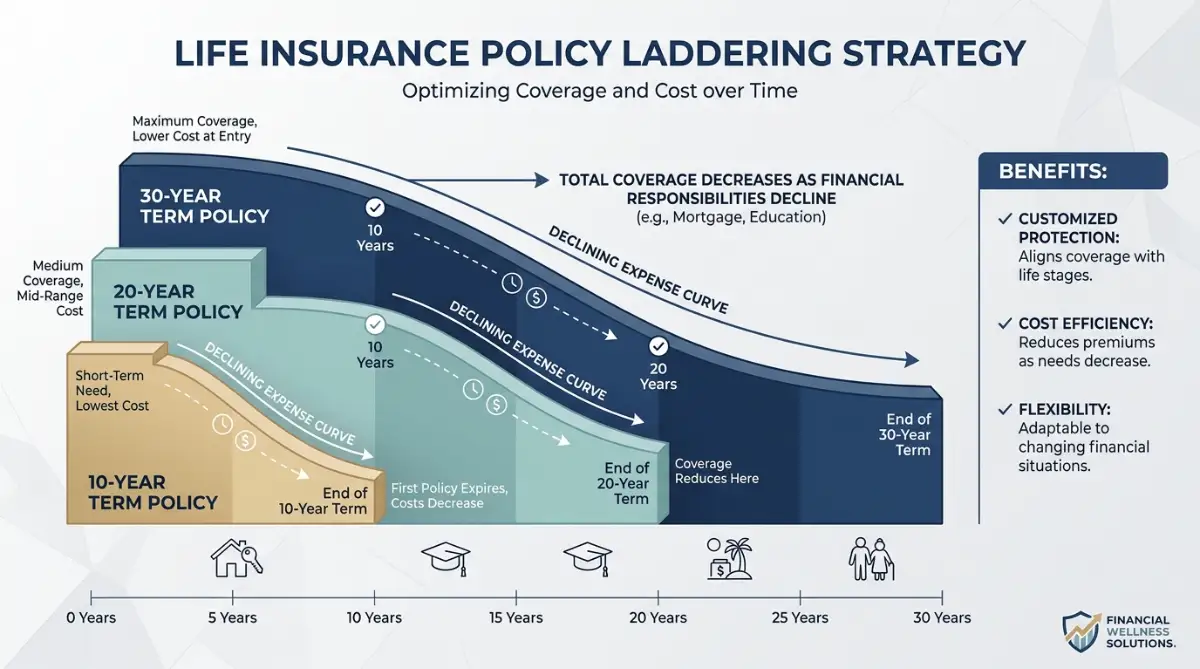
One of the smartest ways to save money on your coverage is to build a policy ladder. Instead of buying one massive, expensive thirty-year policy, you can buy multiple smaller policies with different time lengths.
This works because your financial responsibilities naturally go down as you get older. Your mortgage gets paid off, your savings grow, and your children finish school and start working.
Imagine you need five hundred hundred dollars in total coverage to protect your family right now. Instead of buying a single thirty-year term policy for that full amount, you can split your coverage into three parts:
- A ten-year term policy for two hundred thousand dollars to cover your immediate, high-cost parenting years.
- A twenty-year term policy for two hundred thousand dollars to cover the remaining years of your home mortgage.
- A thirty-year term policy for one hundred thousand dollars to cover basic final expenses and final bills.
Here is the real math behind why laddering works so well:
By stacking your policies this way, you save over $12,000 across 30 years while keeping maximum coverage when your expenses are highest.
By using this smart setup, your total monthly cost drops significantly over time. As each shorter policy ends, your monthly bill gets smaller because you no longer need that extra protection.
You can learn more about how this system compares to other tools by looking at Investopedia's guide to term insurance which explains these basic definitions in detail.
Unlocking the Power of Policy Riders
Riders are simply extra features or add-ons that you can attach to your basic policy. Think of them like choosing custom upgrades when buying a new car.
While some riders cost extra, others are completely free and offer massive protection when things go wrong. Choosing the right add-ons can save your family from financial ruin during a medical emergency.
The Waiver of Premium Rider
This is one of the most useful options you can add to your plan. If you get seriously injured or sick and cannot work, this rider stops your monthly bills.
The insurance company will pay your premiums for you until you recover and can work again. This ensures that you do not lose your family's protection just because you lost your active income.
Living Benefits Rider
This feature allows you to access a portion of your death benefit while you are still alive. If you are diagnosed with a severe illness, you can use this cash to pay for medical treatments.
It helps you focus on getting better instead of worrying about how to pay your hospital bills. It is a highly practical tool that turns your policy into an active shield during your lifetime.

Improving Your Health-Rate Category
Most people do not realize that insurance companies place you into specific health classes before setting your price. Even a small improvement in your daily habits can push you into a better category.
If you can move from a "standard" rating to a "preferred" rating, your monthly cost can drop by twenty to thirty percent. This is why planning ahead before you apply is so highly effective.
Take Time to Prepare for the Medical Exam
If your policy requires a medical checkup, treat it like an important test. Avoid salty foods, caffeine, and heavy workouts for a few days before your appointment.
Drinking plenty of water and getting a good night's sleep can temporarily lower your blood pressure and cholesterol numbers. These tiny changes can lead to a much lower price offer from the underwriter.
Clean Up Your Credit Score
In many areas, insurance companies look at your credit history to determine how responsible you are. A higher credit rating directly translates to cheaper monthly premiums for your family.
If you want to make sure your finances are in perfect shape before you apply, learning how to fix a damaged credit score without falling for scams is a great place to start your journey.
Budget Your Premiums Correctly
To make sure you never miss a payment and lose your protection, you must build these costs into your regular savings plan. If you need help organizing your cash flow, using the beginner's blueprint to zero-based budgeting can help you give every single dollar a clear target.
This prevents you from accidentally letting your policy lapse due to a simple math mistake. It builds a strong financial base that supports your goals for years to come.
Hidden Traps: Pitfalls Families Face When Buying Protection
When people try to set up their family safety net, they often make simple errors that cost them thousands of dollars. Avoiding these major pitfalls will keep your money safe and ensure your family actually gets paid when they need it.
Relying Solely on Your Employer's Plan
It is incredibly common for people to assume they are fully covered because their job offers a basic group policy. While free coverage is a wonderful benefit, relying on it as your only shield is highly dangerous.
These workplace policies almost always end the moment you leave your job, get laid off, or retire. If you develop a health condition later in life, buying a personal policy on your own will be much more expensive or even impossible.
For the longest time, I made the huge mistake of thinking the basic insurance from my day job was all I needed to keep my family safe. It was a scary wake-up call when a close friend got laid off and lost all their coverage in a single afternoon, which finally pushed me to buy a personal policy I actually owned.
Hiding Medical Details on Your Application
Some people try to lower their prices by hiding their smoking habits or past medical issues on their forms. This is a massive mistake that can ruin your entire plan.
Insurance companies have deep access to medical databases and will verify your history. If they discover you lied, they can cancel your policy immediately or refuse to pay your family after you pass away.
Forgetting the Impact of Inflation
A payout of one hundred thousand dollars might seem like a massive amount of money today. However, over twenty or thirty years, the rising cost of living will make that amount feel much smaller.
If you do not factor in future inflation, your family might not have enough cash to pay for basic living expenses. Always aim to buy slightly more coverage than you think you need right now.
Do's and Don'ts for Smart Policy Shopping
- Do: Compare quotes from at least three different companies before making your final decision.
- Don't: Buy a policy just because a relative or friend recommended their personal agent.
- Do: Read the fine print to understand exactly what causes of death are excluded from the payout.
- Don't: Let your policy sit in a drawer without reviewing it every time you have a major life event.
How Debt Affects Your Needed Coverage Amount
If you have high personal loans or credit card balances, you need to add those totals directly to your policy amount. Otherwise, your family will have to use their payout cash to pay off your old banks.
If you want to free up extra cash to buy a better policy, you can take action to say goodbye to credit card balances using a clear, structured plan. This will reduce your overall debt load and lower the total amount of insurance you need to buy.
Additionally, learning how to negotiate with lenders can save you a fortune. You can discover how to force your bank to lower your personal loan rates to immediately reduce your monthly bills.
These smart financial moves work together to protect your household. They give you the breathing room needed to build a solid wall of safety around the people you love.

Your Immediate Action Plan for Financial Peace
Taking action to protect your family's future is one of the most rewarding steps you can take. You do not need to wait until you have a perfect budget or a massive savings account to begin.
Start by looking at your current expenses and determining how much protection your family would need to live comfortably without your income. You can use free resources like the Forbes Advisor life insurance calculator to get a highly accurate estimate of your target numbers.
Once you have your target number, reach out to an independent broker who can search multiple companies for the best rates. Remember that a simple, affordable term policy is always better than having no protection at all.
Your family's safety and your personal peace of mind are worth the effort. Take that first simple step today, and rest easy knowing their tomorrow is fully secure.
Signing my own policy papers honestly felt like a giant heavy rock was lifted right off my chest. I promise you, taking this small action today will give you a level of daily comfort and confidence you never knew you were missing.
Disclaimer: The information shared in this article is based on my personal experience and general research to help make things easier to understand. I am not a licensed financial advisor, tax expert, or insurance agent. Always talk to a certified professional before buying any insurance policy or making big financial choices for your family.