The Hidden Nightmare Inside My Wallet
I remember the exact moment my heart sank at the bank. I was sitting across from a loan officer, ready to buy my first home, confident my finances were in perfect order.
Then, she turned the computer monitor toward me and pointed at a three-digit number on the screen. It was way lower than I ever expected.
I had not missed a single payment, I had a good job, and I thought I was doing everything right. Yet, my score was completely broken, and I felt embarrassed, confused, and utterly helpless. I realized right then that the banking system judges us on invisible rules nobody ever bothers to teach us in school.
This silent problem does not just affect buying a house. A low financial reputation sneaks into every single corner of your daily life, slowly eating away at your peace of mind.
You might get rejected for a simple apartment lease because the landlord sees you as a risk. You end up paying hundreds of dollars more for basic car insurance compared to someone with a better profile.
Even setting up a new cell phone plan or getting electricity turned on in your new place can require massive security deposits. It feels like you are constantly being punished for mistakes you did not even know you were making.
The anxiety of checking your banking app becomes a heavy weight on your chest. You start second-guessing every purchase, wondering if buying groceries will somehow trigger another drop in your rating.
It is a lonely, frustrating cycle that leaves you feeling trapped in a financial corner. But the truth is, you are not bad with money; you are simply playing a game where nobody handed you the rulebook.
Unmasking the Silent Credit Killers (And How to Beat Them)
To fix this frustrating issue, we need to look at the exact habits that drain your points behind the scenes. You might think you are being financially responsible, but the algorithms judge your actions very differently.
Let us break down exactly what is happening in the shadows of your financial profile. I will show you how to outsmart the system using clear, actionable steps you can take today.
The Invisible Trap of High Utilization
Most people believe that as long as they pay their bills on time, their profile is completely safe. This is one of the biggest myths in the personal finance world.
Your payment history is just one piece of the puzzle. The amount of money you owe compared to your total available limit is just as important.
Think of it like carrying a backpack. If your backpack can hold fifty pounds, and you are carrying forty-five pounds every single day, you look exhausted and stressed to anyone watching.
Banks see your spending limits the exact same way. If you have a limit of one thousand dollars and you spend nine hundred dollars on it, the bank thinks you are desperate for cash.
They do not care if you plan to pay it all off at the end of the month. The system takes a snapshot of your account on a random day, and if your balance is high on that specific day, your points will drop instantly.
Watch This Quick Explainer Video to Understand How Spending Limits Actually Work!
To keep your profile healthy, you need to follow a very specific rule of thumb. You should always try to keep your balance below thirty percent of your total limit at all times.
If you really want to maximize your points and impress lenders, aim to keep that number below ten percent. This shows the system that you have access to money, but you are responsible enough not to spend it all.
I used to put every single grocery run and gas station trip on my favorite rewards card just to get points. I did not realize that keeping my balance near the limit made me look incredibly risky to banks, even though I always paid it off at the end of the month.
If you are struggling to keep your balances low, there is a simple trick you can use. You can call your bank and ask them to increase your total spending limit.
If they increase your limit, and you keep your spending exactly the same, your ratio automatically drops. This is one of the fastest ways to force your numbers to go up without paying off a massive amount of debt overnight.
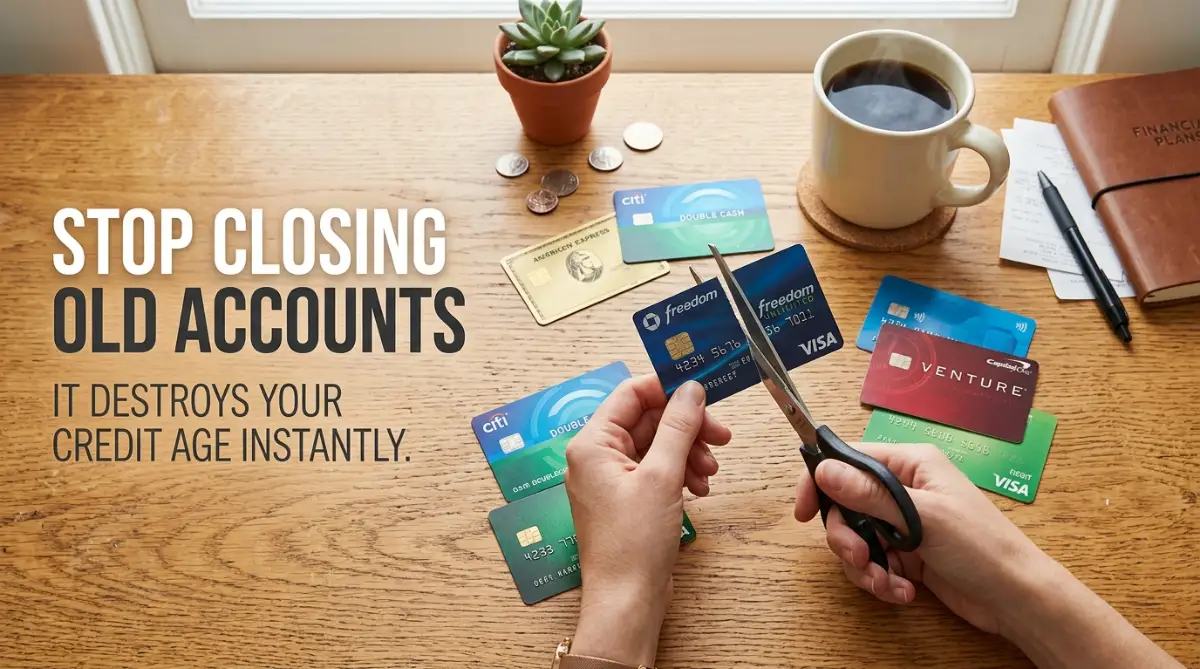
The Mistake of Saying Goodbye to Old Plastic
When we finally pay off an old debt, our first instinct is usually to close the account completely. It feels like a massive victory to cut up that plastic and throw it in the trash.
However, doing this actually hurts your financial reputation deeply. The system loves a long, stable history, and closing your oldest account is like tearing up the best part of your resume.
Let us look at a quick comparison to understand why this happens.
When you close an old account, two terrible things happen to your profile at the exact same time. First, you instantly reduce your total available limit, which pushes your utilization ratio higher.
Second, you slowly shorten your average age of accounts. Lenders want to see that you have been managing money well for a decade, not just for a few months.
If you have an old card that you never use, just put it in a drawer at home. You can use it once every few months to buy a small coffee just to keep the account active.
The Hidden Danger of Tiny Forgotten Bills
We usually worry about missing massive mortgage payments or massive car loans. But sometimes, it is the tiniest forgotten bills that cause the most massive damage.
Imagine you move out of an old apartment and you forget to pay a final thirty-dollar internet bill. You completely forget about it as you settle into your new place.
Six months later, that internet company gets tired of waiting and sells your thirty-dollar debt to a collections agency. The moment that collection hits your profile, your numbers will absolutely tank.
It does not matter if the debt is for thirty dollars or three thousand dollars. The algorithm only sees that you failed to fulfill a financial promise, and it punishes you severely.
This happens incredibly often with medical bills as well. A hospital might send a small lab fee to an old address, and you never even know you owe the money until you get rejected for a loan.
To protect yourself, you need to check your detailed financial report at least once every few months. You can pull this report for free and scan it for any strange collection accounts.
If you find a tiny bill in collections, you can often negotiate with the agency. You can offer to pay the bill in full if they agree in writing to delete the negative mark from your record completely.
The Hard Truth About Shopping Around
When you are looking for a new car or a new place to live, you naturally want to shop around for the best deal. You might apply at four different places just to see who gives you the lowest interest rate.
Every time you formally apply for new money, the lender does a deep dive into your profile. This is known as a "hard inquiry," and it leaves a permanent footprint on your record.
One single hard inquiry will only drop your points by a tiny bit. But if you apply for five different things in a single week, the system panics.
Multiple applications make you look desperate for cash. The algorithm thinks you are facing an emergency and you are trying to borrow as much money as humanly possible to survive.
You should only apply for new accounts when you absolutely need them. If you are just curious about your approval odds, use pre-qualification tools instead.
These pre-qualification tools perform a "soft inquiry" on your profile. A soft inquiry lets you see your offers without leaving any negative footprints or causing your points to drop.
Building a strong financial foundation takes time, patience, and a deep understanding of these hidden rules. Once you stop making these invisible mistakes, your profile will naturally begin to heal and grow stronger every single month.
Next-Level Strategies to Bulletproof Your Financial Identity
Building a healthy financial reputation is a lot like trying to get into shape at the gym. You cannot just eat healthy for one single week and expect to have a perfect body forever.
Once you fix the basic problems we talked about earlier, you have to shift your focus to long-term maintenance. I want to share a few highly guarded secrets that bankers rarely explain to regular people.
These are the exact same strategies that financial experts use to keep their numbers securely in the top tier. If you apply these properly, you will start to see consistent, upward growth every single month.
The Magic of the Statement Closing Date
Most people think that as long as they pay their bill before the official due date, their profile is completely safe. This is a massive misunderstanding that traps thousands of hardworking people.
Your bank actually reports your balance to the system on a totally different day called the statement closing date. This date usually happens about three weeks before your actual payment is due.
Imagine your bank taking a surprise photograph of your living room. If they take the picture when the room is messy, they will assume you are a messy person, even if you clean it up the very next day.
If you make a massive purchase and wait until the due date to pay it off, the bank takes that snapshot while your balance is sky-high. The system instantly penalizes you for having high utilization.
To beat this invisible system, you need to find out exactly when your statement closes every month. You can easily find this date on your monthly PDF statement or by calling customer service directly.
Once you know that date, make sure you pay down your balance to almost zero a few days before the statement actually closes. This ensures the bank takes a snapshot of a perfectly clean account.
If you want a deeper dive into these invisible banking rules, you can read up on exactly how the banking system tracks your consumer data from official consumer protection sources.
Becoming an Authorized User (The Piggyback Method)
If you have a very thin file or a history of bad marks, rebuilding from scratch can feel incredibly slow and frustrating. There is a completely legal shortcut you can use to borrow someone else's good reputation.
This strategy is called becoming an authorized user on a trusted family member's account. You can ask a parent or a spouse who has excellent financial habits to add your name to their oldest, cleanest card.
The moment they add your name, their entire history of perfect, on-time payments for that specific card gets copied onto your personal record. It instantly boosts your average age of accounts and lowers your overall utilization ratio.
The best part is that they do not even have to give you the physical piece of plastic. They can just cut up the extra card when it arrives in the mail to protect their own money.
You get all the positive benefits of their good behavior without ever having access to spend a single dime. Just make sure the person you ask actually pays their bills on time, or their bad habits will hurt you instead.
If you are trying to help a loved one fix their situation, you might want to learn more about fixing a broken credit history safely without paying expensive agencies.
Locking Down Your Personal Information
In today's highly connected digital environment, protecting your personal data is no longer just an option. Identity theft is one of the fastest ways your points can drop from excellent to terrible overnight.
Thieves can open massive loans in your name while you are asleep, and you might not notice until debt collectors start calling your house. Protecting your financial data from hackers is just as important as securing personal files with strong encryption on your computer.
I highly recommend placing a permanent security freeze on your profile with the major reporting bureaus. A freeze completely locks your file so that no bank or lender can view it without your specific permission.
If nobody can view your file, nobody can open a new loan in your name. When you genuinely need to apply for a new car or apartment, you can easily "thaw" the freeze for a few days using a private PIN code.
You can also legally request your detailed financial report for free every week to scan for any suspicious activity. Checking your own file does not hurt your points at all.

The Dangerous Traps That Wipe Out Months of Hard Work
Even if you follow all the right steps, a single bad decision can instantly undo years of excellent financial behavior. I have seen incredibly smart people fall into these traps simply because they were trying to be helpful.
You need to recognize these emotional and psychological pitfalls before they trap you. Let us look at the most common mistakes that destroy healthy profiles on a daily basis.
The Nightmare of Co-Signing a Loan
We all want to help our family and friends when they are struggling. If your younger sibling asks you to co-sign a car loan because they cannot get approved alone, your natural instinct is to say yes.
Please understand that co-signing is never just a character reference. When you sign that paper, you are legally telling the bank that you will pay the entire debt if your sibling suddenly stops paying.
I had a close friend who co-signed a small apartment lease for his cousin. The cousin lost his job, missed three rent payments, and moved out without telling anyone.
Those missed payments went straight onto my friend's permanent record, completely ruining his chances of buying a house for his own family that year. The bank did not care that it was not his fault; they only cared that his name was on the contract.
Unless you are completely prepared to pay the entire bill out of your own pocket every single month, you must politely say no. You have to protect your own financial stability first.
Falling for the Retail Store Pitch
Picture yourself standing in line at your favorite clothing store with a basket full of items. The cashier smiles and offers you a massive twenty percent discount on your entire purchase if you just sign up for their store card today.
It sounds like free money, and the application only takes two minutes on their tiny keypad. This innocent decision is actually a massive trap that hurts your profile in multiple ways.
First, the application triggers a hard inquiry, which dings your points instantly. Second, store cards usually come with extremely low spending limits, like three hundred dollars.
If you buy two hundred dollars worth of clothes on that new card, your utilization ratio for that specific account instantly shoots up to almost seventy percent. The system sees this massive spike and punishes your rating immediately.
Instead of opening random cards for tiny discounts, focus on mapping out a solid budgeting strategy that allows you to pay cash for the things you want. A quick twenty-dollar discount is never worth a long-term drop in your financial standing.
Disputing Accurate Information as a Game
There is a terrible rumor on social media that if you dispute every single negative mark on your record, the system will eventually get tired and delete them. Some shady online gurus even sell templates teaching people how to lie to the reporting bureaus.
This strategy is incredibly dangerous and rarely works the way people claim. The bureaus use highly advanced software to verify your payment history directly with your bank.
If you constantly dispute accurate, legitimate debts, the bureaus can label your file as "frivolous." Once this happens, they can legally refuse to investigate any future claims you make, even if someone actually steals your identity later.
If you have a legitimate negative mark, the best approach is to negotiate a "pay-for-delete" agreement directly with the collection agency. You can also research the exact factors lenders look at during an application to understand what really matters.
Sometimes, getting out of a bad situation requires smart negotiation. This is similar to negotiating better personal loan terms when you feel like you are paying too much interest.
Using Debt Consolidation the Wrong Way
When people feel overwhelmed by multiple high-interest bills, they often take out one massive personal loan to pay everything off at once. This is called debt consolidation, and it sounds like a brilliant idea on paper.
You go from having five stressful due dates to just one simple monthly payment. The problem happens a few months later when the original plastic cards are completely empty.
Without strict discipline, the temptation to start using those empty cards again becomes incredibly powerful. People end up maxing out the old accounts while they are still paying off the massive consolidation loan.
Now, they have twice as much debt as they started with, and their financial profile completely crashes under the heavy burden. Finding smart ways to manage debt is tough, much like learning how to use creative tools and keeping your budget intact without overspending.
You have to change your underlying spending habits first, or the consolidation loan will just become another heavy anchor dragging you down.
Your Action Plan for Ultimate Financial Peace
Taking control of your financial reputation does not happen overnight, but it is entirely within your reach. You now know the silent mistakes that drag you down and the exact strategies to reverse the damage.
Start by downloading your official report today to see exactly where you stand. Check for any tiny forgotten bills or strange accounts that you do not recognize.
Next, find out your statement closing dates and set calendar reminders on your phone to pay your balances down early. This one tiny habit will create the biggest positive shift in your numbers over the next few months.
Stop applying for store discounts, politely refuse to co-sign for friends, and keep your oldest accounts active with small, routine purchases. Every small, disciplined choice you make acts like a brick building a solid fortress around your financial identity.
By staying educated and visiting naxusjournal.com for more resources, you are already steps ahead of the average consumer. Remember, this is a marathon, not a quick sprint to the finish line.
I used to lose sleep staring at my own terrible numbers, feeling like I would never be able to afford a decent life. Once I stopped guessing and started treating my finances like a strategic game, everything completely turned around for me. You have the exact same power to rewrite your financial story starting today, so take a deep breath and take that first step.
Questions People Also Ask About Financial Health
Does checking my own numbers hurt my profile?
No, checking your own data through a reputable app or official website never hurts you. This is known as a "soft pull," and it is completely invisible to lenders who review your application in the future. You should check your status regularly to catch errors early.
How long do late payments stay on my record?
A missed payment usually stays on your official history for up to seven full years. However, its negative impact naturally fades over time, meaning a mistake from five years ago hurts you far less than a mistake from five months ago.
Will getting a raise at work automatically increase my points?
Your income is totally invisible on your standard financial report, so a higher salary does not directly boost your points. However, making more money allows you to pay down your balances much faster, which drastically improves your utilization ratio.
Is it better to carry a small balance every month to show activity?
This is one of the most common and expensive myths out there. You should always pay your statement balance in full every single month to avoid paying massive interest charges to the bank.
Can my spouse's bad financial habits ruin my personal record?
When you get married, your financial profiles remain completely separate from each other. However, if you open joint accounts together or co-sign on a mortgage, any missed payments on those specific shared accounts will damage both of your records equally.
Disclaimer: The information provided in this article is for educational and informational purposes only and does not constitute professional financial or legal advice. Every individual's financial situation is unique. Please consult with a certified financial planner or a professional advisor before making any major financial decisions, taking out loans, or aggressively restructuring your debt.