The Frustration of Stagnant Savings
If your bank account pays you 0.01% interest, you are basically lending the bank your hard-earned money for free while they earn 7% lending it to someone else. With inflation eating grocery budgets every week, letting cash sit in a regular savings account guarantees you lose money every single month. You only need two simple tools to fix this: a flexible High-Yield Savings Account (HYSA) for fast cash emergencies and a locked Certificate of Deposit (CD) to protect your future goals. Let's compare both so you can stop leaving free money on the table.
If you are reading this right now, you probably share that exact same feeling of financial frustration. You are doing the responsible thing by not spending every single dollar you earn. You are actively trying to protect your future, but everyday inflation is quietly eating away at your purchasing power.
Walking into a grocery store and seeing how much less your money buys today compared to last month is genuinely terrifying. When your savings account pays you almost nothing, you are actually losing money in real time. This invisible drain destroys your mental peace and leaves you feeling completely stuck in the rat race.
People constantly tell you to invest in the stock market, but that comes with risks that might keep you awake all night. You just want a safe, reliable place to store your cash where it can actually grow without the fear of losing it all. You know better options exist, but the banking world feels like a complicated maze designed to confuse you.
Do you lock your money away, or do you keep it easily accessible for sudden emergencies? This is the exact dilemma millions of hard-working people face every single day.

The good news is that you do not have to settle for the terrible rates your local brick-and-mortar bank offers. You have access to powerful financial tools that completely change how your money grows over time.
By understanding the basic mechanics of how different accounts work, you take back control of your financial destiny. We are going to break down everything you need to know, in plain English, so you can make the absolute best choice for your hard-earned cash.
Before You Start: The Fast 60-Second Summary
- Traditional banks cost you money: Big physical banks pay almost zero interest (0.01%) while inflation eats your buying power.
- Use an HYSA for your emergency fund: High-Yield Savings Accounts pay 4% to 5% APY and give you total, penalty-free access to your cash anytime.
- Use a CD for firm future dates: Certificates of Deposit lock your money for a fixed term (3 months to 5 years) in exchange for a guaranteed, market-proof return.
- Never mix up their jobs: Never lock your living expenses in a CD, and never keep 1-year house deposit savings in a low-interest checking account.
Why Your Regular Bank Account is Failing You
Before we compare your best options, we have to talk about why your current setup is likely a massive mistake. Most of us open a savings account at the exact same physical bank where we have our checking account simply because it is convenient. We like walking into a building, talking to a teller, and seeing all our balances on one simple mobile app.
However, that convenience comes at an incredibly high and silent cost. Physical banks have massive overhead expenses, including paying for beautiful buildings, local property taxes, and hundreds of daily employees. To cover these massive costs, they pay you an embarrassingly low interest rate on your deposits.
While they pay you a fraction of a percent, they lend your exact money out to other people for mortgages and auto loans at much higher rates. They are making a massive profit directly off your desire for simple convenience. You have to stop accepting this unfair trade immediately if you want to build real security.
The Silent Thief Called Inflation
Imagine filling a bucket with water, but there is a tiny, almost invisible pinhole at the very bottom. Over time, no matter how much water you originally put in, the bucket will slowly empty itself. This is exactly how inflation works against the cash sitting in your traditional savings account.
If the cost of food, housing, and gas goes up by four percent, but your bank only pays you zero-point-one percent, you are going backwards. Your ten thousand dollars will buy significantly fewer groceries next year than it can buy today. To simply maintain your standard of living, your money must grow at a rate that fights back against rising prices.
This is why moving your cash out of a traditional account is not just a smart idea; it is an absolute necessity for your survival. You must force your dollars to earn their keep and protect your future buying power.
The Magic of High-Yield Savings Accounts
If you want your money to grow while still being able to touch it whenever you want, a High-Yield Savings Account (HYSA) is your best friend. These accounts operate exactly like the regular savings account you already have, but with one massive upgrade. They pay an interest rate that is often ten to fifteen times higher than a traditional physical bank.
Almost all high-yield accounts are offered by online-only banks. Because these banks do not have to pay for expensive physical branches, they pass those massive savings directly to you in the form of higher interest. You manage everything through a very secure website or a highly rated mobile app.
Your money is completely safe, easily accessible, and continuously growing while you sleep. You can transfer money back to your main checking account whenever you need to pay a sudden bill.
The Beauty of Total Flexibility
The biggest advantage of a high-yield account is complete and total liquidity. Liquidity simply means how fast and easily you can turn your savings into spendable cash without facing any penalties. If your car engine explodes tomorrow morning, you can move your funds instantly and pay the mechanic by the afternoon.
This flexibility makes an HYSA the absolute perfect home for your emergency fund. An emergency fund is designed to protect you from life's random disasters, so it must be available at a moment's notice. You never want to jump through complicated hoops when you are already dealing with a highly stressful situation.
Pro Tip: I used to keep my emergency fund in my regular checking account because I was afraid of online banks. I quickly realized my mistake because I kept accidentally spending my safety net on random online shopping. Moving my money to a separate high-yield account kept it safe from my own impulsive habits while earning me free extra cash every month.
Watch this incredibly helpful breakdown on why everyone needs a proper emergency fund setup today:
The Catch: Variable Interest Rates
While a high-yield account offers amazing flexibility, there is one very important detail you must understand clearly. The interest rate on these accounts is completely variable, meaning it can change at any time without much warning. The bank decides this rate based on what the broader national economy is currently doing.
If the national central bank raises rates, your online savings account will likely start paying you even more money. However, if the economy shifts and national rates drop, your bank will lower the interest they pay you accordingly. You are never guaranteed a specific rate for a long period of time.
This unpredictability is totally fine for an emergency fund, but it might frustrate you if you are planning for a specific future goal. If you need absolute certainty about exactly how much money you will earn, you might need a different tool entirely.
The Predictable Power of a Certificate of Deposit
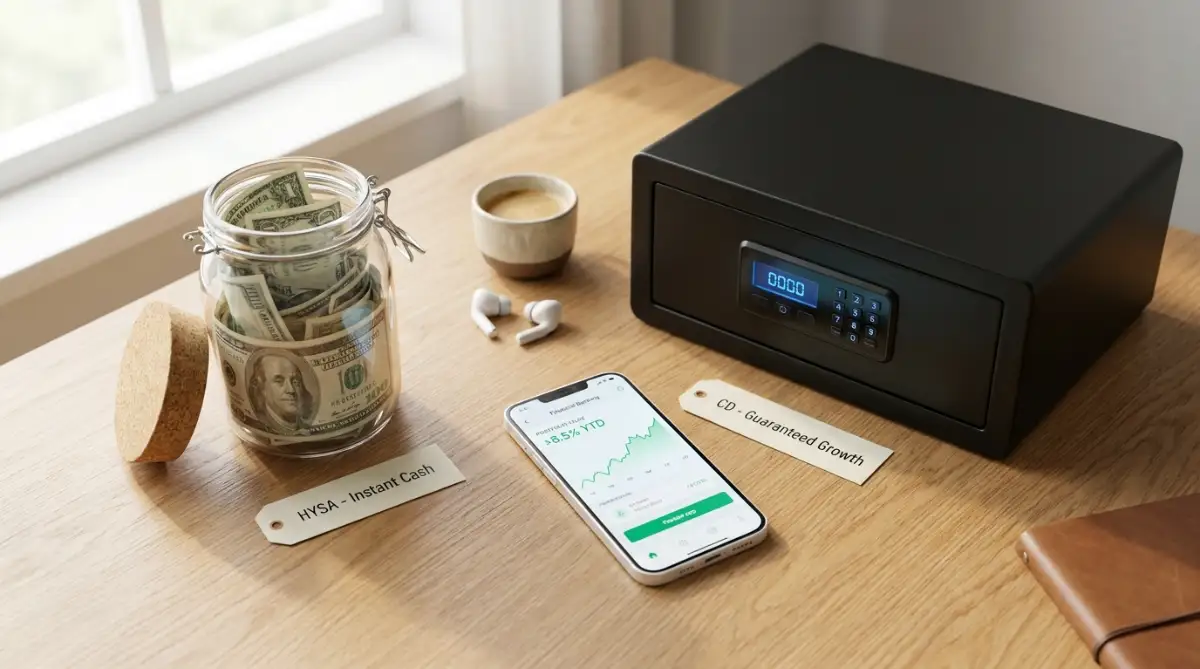
If a high-yield savings account is like an open jar of flexible cash, a Certificate of Deposit (CD) is like a locked digital vault. A CD is a special type of deposit account where you agree to leave your money completely untouched for a specific amount of time. In exchange for your absolute promise not to withdraw the cash, the bank rewards you with a guaranteed interest rate.
You can choose the time frame that works best for your specific life goals. Banks offer CDs for as short as three months or as long as five years. The general rule is that the longer you agree to lock up your money, the higher the interest rate the bank will offer you.
When you open a CD, the rate you secure on day one is locked in for the entire duration of the term. Even if the national economy crashes and savings rates drop to zero, your bank must continue paying you the high rate you originally agreed upon.
The Benefit of Absolute Certainty
Human beings love predictability, especially when it involves their hard-earned life savings. When you put your cash into a CD, you know the exact mathematical calculation of your future wealth. You can look at a calendar, point to a specific date next year, and know exactly how many dollars will be sitting in your account.
This absolute certainty makes CDs the perfect tool for medium-term financial goals that have a very strict timeline. For example, if you are saving a large down payment to buy a house next spring, you cannot risk that money losing value. You want a guaranteed return so you can plan your future budget perfectly.
Locking your money away also provides a massive psychological benefit for people who struggle with impulsive spending. Knowing you cannot easily touch the cash stops you from draining your savings for a sudden, unnecessary luxury purchase.
The Penalty for Breaking the Rules
The guaranteed rate of a CD sounds amazing, but you must respect the contract you made with the bank. If you suddenly demand your money back before the agreed time limit expires, the bank will hit you with an early withdrawal penalty. This penalty often eats up a large portion of the interest you earned, and sometimes even digs into your original deposit.
This is why you should never, ever put your main emergency fund into a Certificate of Deposit. Emergencies do not care about your bank's timeline; they happen randomly and require immediate cash. If you lose your job, paying a heavy fee just to access your own safety net will make a terrible situation even worse.
Always read the fine print before locking your money away. Some banks charge three months of interest as a penalty, while others might charge much more.
Side-by-Side Comparison: Making the Right Choice
To make things incredibly simple, let us look at how these two powerful tools stack up against each other. Understanding the core differences helps you build a bulletproof strategy for your specific lifestyle.
As you can clearly see, neither tool is inherently better or worse than the other. They simply serve two completely different purposes in your financial journey. Many wealthy people actually use both of these accounts simultaneously to protect their money from different angles.
You do not have to pick just one winner. You can use a flexible account for your immediate safety and a locked account to grow your future wealth.
Real-Life Scenarios to Help You Decide
Sometimes, reading definitions is not enough to truly grasp how to manage your daily budget. Let us walk through a few practical, real-life situations to show exactly how you should apply this knowledge today.
Scenario 1: The New Parent Needing Security
Imagine you just had a baby, and your household expenses are suddenly completely unpredictable. You might need to buy expensive medicine in the middle of the night, or your washing machine might break from doing too much laundry. You have five thousand dollars saved up to protect your growing family.
In this situation, locking your cash in a CD would be a massive mistake. The unpredictability of a new baby requires absolute flexibility and instant access to your funds. You should place every single dollar of that five thousand into a High-Yield Savings Account.
Your money will still earn a highly competitive interest rate every month. More importantly, you will sleep peacefully knowing that if a random disaster strikes at 2 AM, your cash is ready to deploy instantly.
Scenario 2: The Future Homeowner
Now imagine you have been aggressively saving money for three years, and you finally have twenty thousand dollars for a house down payment. You have spoken to a real estate agent, and you plan to start seriously looking for a home in exactly twelve months. You already have a separate, fully funded emergency account for daily surprises.
Leaving that massive twenty thousand dollars in a variable savings account is slightly risky if national rates suddenly drop. Because you know exactly when you need the money, you should lock it into a 12-month Certificate of Deposit.
You instantly secure a high, guaranteed rate for the entire year. When your 12-month term ends, your money automatically unlocks, completely loaded with predictable interest, and ready to buy your dream home.
The Snowball Effect of Compound Interest
Regardless of which path you choose, the real magic happens through something called compound interest. When your bank pays you interest this month, that new money is added to your total balance. Next month, you earn interest not just on your original deposit, but also on the interest you just earned.
It is exactly like rolling a tiny snowball down a very long, snowy hill. At first, it grows slowly and seems insignificant. But as it rolls, it gathers more snow at a faster pace, eventually becoming a massive, unstoppable boulder of wealth.
The most important factor in building this massive snowball is simply starting as early as possible. Every single day you wait to move your money out of a traditional bank, you are actively losing the power of compounding growth.
Understanding these foundational concepts is just the beginning of your financial transformation. Now that you know how the tools actually work, we need to dive into the advanced strategies that will maximize your returns without adding any unnecessary stress to your life.
Real Numbers: What $10,000 Earns in 1 Year
Note: That is up to $499 of free money you lose every single year simply by keeping cash in a standard local branch.
Mastering the Insider Strategies for Maximum Growth
Now that you understand the basic mechanics of high-yield savings and locked certificates, it is time to think like a professional. You do not have to choose just one path and hope for the best. The smartest savers use a combination of these tools to create a financial system that practically runs itself.
If you want to protect your money from inflation while maintaining total peace of mind, you need a dynamic strategy. Leaving a massive pile of cash in just one place is a missed opportunity for higher returns. Let us look at a few advanced methods that the wealthy use to keep their money completely safe while maximizing their monthly interest.
The Genius of the "CD Ladder" Strategy
This is arguably the most powerful secret in personal banking, and it completely solves the problem of locked money. A CD ladder is a simple strategy where you divide your total savings into smaller pieces and open multiple accounts with different expiration dates. Instead of locking all your cash away for three years, you create a revolving door of available money.
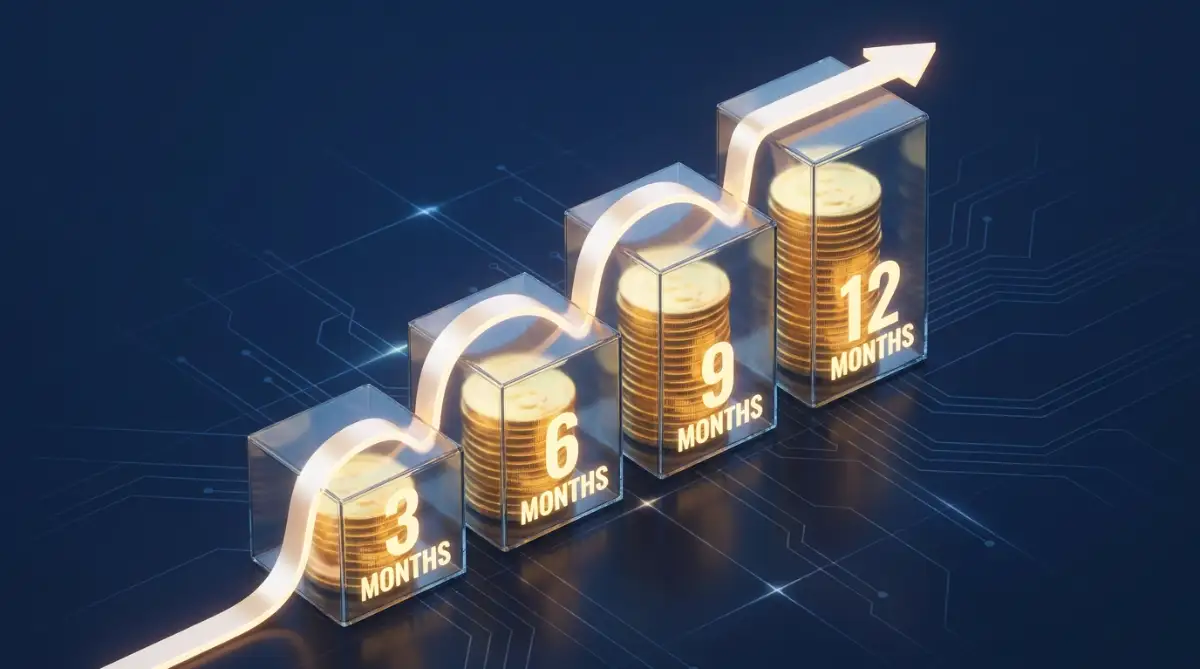
Let us say you have ten thousand dollars that you want to grow safely. Instead of putting it all into one single Certificate of Deposit, you divide it into four chunks of two thousand five hundred dollars. You put the first chunk into a three-month CD, the second into a six-month CD, the third into a nine-month CD, and the last into a twelve-month CD.
Because of this setup, you will have a chunk of money naturally unlocking and becoming available to you every three months. When that first CD expires, you can either take the cash if you need it, or reinvest it into a brand new twelve-month term. You are constantly capturing the highest possible interest rates without ever having your entire savings locked up at the exact same time.
Quick Blueprint: The 4-Step $10k CD Ladder
- Bucket 1 ($2,500 in 3-Month CD): Unlocks in 90 days. Perfect for quarterly tax buffers or seasonal family costs.
- Bucket 2 ($2,500 in 6-Month CD): Unlocks in 180 days. Reinvest into a new 12-month CD if no emergency happens.
- Bucket 3 ($2,500 in 9-Month CD): Unlocks in 270 days. Keeps your cash constantly moving toward the highest available rate.
- Bucket 4 ($2,500 in 12-Month CD): Completes the full year cycle. After 12 months, you will have guaranteed cash maturing every single quarter!
Securing Your Digital Bank Branch
Since almost all high-yield savings accounts and the best CDs are offered by online-only institutions, your computer is now your primary bank branch. If you cannot access your device, you literally cannot access your life savings. You have to treat your personal hardware with the exact same respect a traditional bank treats its physical vault.
The Non-Negotiable Rule of Public Banking
When you use online banks to secure high interest rates, your digital privacy becomes your most valuable asset. It is extremely tempting to check your growing account balances on your phone while sitting at a local cafe or airport. However, logging into a financial portal on an open, public Wi-Fi network is practically handing your money directly to cybercriminals.
Thieves actively monitor these unencrypted networks, waiting to steal your banking passwords and drain your accounts instantly. Before you ever open a financial app away from home, you must deeply understand what a VPN is and how it protects your online privacy on public networks. Masking your internet connection is the only way to ensure the massive wealth you are building actually stays in your pocket.
The Cybersecurity and Infrastructure Security Agency (CISA) clearly warns that independent digital savers are heavily targeted by online fraud. Always use strong, unique passwords for every single banking app you download. Turn on two-factor authentication immediately, and never ignore a security alert from your financial institution.

The Dangerous Traps That Will Destroy Your Progress
Building a safe, profitable home for your money is a wonderful feeling, but the journey is filled with hidden emotional traps. Many well-meaning people completely self-sabotage their own financial success by making easily avoidable mistakes. You have to actively guard your mindset against panic, greed, and terrible advice from internet gurus.
Managing your cash is highly emotional, and your brain will sometimes try to trick you into taking the easy way out. Making a wrong move with a Certificate of Deposit or a High-Yield Savings Account can cost you hundreds of dollars in lost interest or severe penalties. Let us break down exactly what you must avoid at all costs.
Trapping Your Ultimate Safety Net
The single biggest mistake you can ever make is chasing a high interest rate at the expense of your family's safety. When a bank offers a massive rate for a three-year locked term, it is incredibly tempting to deposit every single dollar you own. But if you lock up your emergency fund, you are walking on a tightrope without a safety net below you.
I once heard a heartbreaking story of a young family who locked their entire ten-thousand-dollar emergency fund into a strict CD. Two months later, the main breadwinner lost their job unexpectedly, and the mortgage was due. To get their own money back to survive, they had to pay a massive early withdrawal penalty that completely wiped out their savings progress.
Your true emergency fund belongs in a highly liquid High-Yield Savings Account, completely free from any locking mechanisms. The slightly lower interest rate is exactly what you pay for the priceless luxury of sleeping well at night. Never trade your daily peace of mind for a few extra dollars of promised interest.
The Exhaustion of Rate Chasing
When you enter the world of online banking, you will constantly see advertisements for brand new banks offering slightly better rates. If your current bank pays four percent, and a new one offers four-point-two percent, you might feel the sudden urge to move all your money. Moving your cash constantly to grab tiny pennies is a massive waste of your personal time and energy.
Jumping constantly between different platforms to chase fractions of a percent will cause severe mental fatigue. It feels exactly like trying to stop VR motion sickness and enjoy gaming longer; if you do not steady yourself and pick one direction, you will just end up feeling completely sick and exhausted. Pick one highly rated, trustworthy institution and stay there for the long haul.
The Consumer Financial Protection Bureau (CFPB) suggests focusing entirely on consistent, automatic deposits rather than obsessing over tiny rate fluctuations. Your wealth grows significantly faster when you simply deposit more money regularly. A slightly lower rate combined with massive consistency will always beat a slightly higher rate with poor saving habits.
Ignoring the Government Safety Badges
Online banks offer incredible tools, but not every single website offering high interest is actually a legitimate bank. Sometimes, aggressive financial technology startups promise massive returns but do not actually carry federal insurance on your deposits. If one of these unverified companies goes out of business, your entire life savings could simply vanish into thin air overnight.
You must act as your own strict security guard before handing over a single penny. Always scroll to the absolute bottom of the bank's website and look for the official badge of the Federal Deposit Insurance Corporation (FDIC). This federal badge guarantees that the government will refund your money, up to a massive limit, even if the bank completely collapses tomorrow morning.
If you are using a credit union instead of a standard bank, look for the National Credit Union Administration (NCUA) badge. These two organizations are the absolute gold standard of financial protection. If you cannot clearly find these exact badges on the website, close the browser immediately and find a different bank.
Believing the "Stock Market is Always Better" Myth
Friends and family members who casually watch financial news will constantly tell you that savings accounts are for foolish people. They will aggressively push you to put your house down payment or your emergency cash directly into the stock market. They will claim that investing is the only way to beat inflation and achieve real wealth.
While the stock market is amazing for long-term retirement planning, it is an incredibly dangerous place for money you need soon. If you invest your emergency fund and the global market suddenly crashes by twenty percent, your safety net is severely broken. Money that you plan to spend within the next three to five years has absolutely no business being in the stock market.
Protecting your short-term cash from market volatility is the exact reason High-Yield Savings Accounts and CDs exist in the first place. Do not let loud, aggressive opinions bully you into taking risks you simply cannot afford. Your financial timeline is uniquely yours, and safety must always be your top priority.
Smart Questions About Storing Your Cash
Do I have to pay taxes on the interest I earn from these accounts?
Yes, the federal government considers any interest you earn from a savings account or a Certificate of Deposit as standard taxable income. At the beginning of the year, your bank will send you a specific tax document called a 1099-INT form showing exactly how much your money grew. You must report this exact number to the tax authorities when you file your annual return.
Can I add more money to my CD after I open it?
In almost all standard cases, you cannot add additional funds to a Certificate of Deposit once the initial term begins. You make one single lump-sum deposit on day one, and the door firmly locks behind it until the term naturally expires. If you save more money later in the year, you will simply need to open a brand new account for those new funds.
How long does it take to transfer money from an online savings account?
Moving money from your online High-Yield Savings Account to your traditional physical checking account usually takes one to three business days. This slight delay happens because the two different banks have to verify the electronic transfer securely. Always keep a very small buffer of cash in your main checking account to handle any immediate, same-day expenses while you wait.
Are there any monthly maintenance fees with these high-yield accounts?
The absolute best online banks do not charge any monthly maintenance fees whatsoever, and they do not require massive minimum balances. Because they save so much money by not having physical branches, they aggressively compete for your business by dropping annoying fees completely. Always read the fine print carefully, and immediately reject any bank that tries to charge you just for keeping your account open.
What actually happens when my CD term finishes?
When your locked term reaches its final expiration date, the bank will enter a brief grace period, usually lasting around seven to ten days. During this short window, you can freely withdraw all your cash and interest without paying any penalties at all. If you completely ignore the notifications and do nothing, the bank will automatically lock your money into a brand new term.
Your Final Checklist for Financial Peace
You are now heavily equipped with the exact knowledge required to stop losing money to traditional, greedy banks. The barrier to entry is completely non-existent, and opening a new, profitable account takes less than ten minutes on your phone. The only thing standing between you and a rapidly growing pile of safe cash is your own willingness to take action today.
Stop accepting the terrible interest rates your current bank is feeding you. You work entirely too hard for your money to let it sit in an account that actively loses value against daily inflation. Every single day you delay making this simple move is another day you are leaving free money sitting on the table.
The 24-Hour Action Plan
- Audit Your Current Accounts: Log into your traditional bank tonight and check the exact interest rate they are currently paying you.
- Determine Your True Needs: Separate your total savings mentally into two piles: money you need for sudden emergencies, and money you are saving for future dates.
- Open the Right Tool: Open a High-Yield Savings Account for the emergency pile, and completely fund it by tomorrow afternoon.
- Protect the Future: If you have extra cash you definitely will not touch for a year, research the best Certificate of Deposit rates and lock it away securely.
You absolutely have the power to build a solid wall of financial security around your family without taking wild risks. It might feel slightly uncomfortable moving your money to a new institution at first, but the confidence you gain is life-changing. Always keep educating yourself and finding new ways to optimize your daily life.
You can always explore more highly practical financial advice and deep technical guides on our main home page whenever you feel stuck. Small, calculated steps forward eventually cover massive distances if you just refuse to stay frozen in fear.
I know exactly how intimidating the banking world can feel when you are just starting to take control of your future. But the very first month I saw a massive interest deposit hit my new online account, I knew I was finally winning the game. You completely deserve that exact same feeling of victory, so take a deep breath, trust your new knowledge, and go put your money to work today!
Disclaimer: The information provided in this blog post is for educational and informational purposes only and does not constitute professional financial, tax, or legal advice. Interest rates, account terms, and economic conditions change frequently. Always consult with a certified financial planner or tax advisor before making any major decisions regarding your personal savings or investment strategy.