
Why Borrowing Money Used to Be a Complete Nightmare
Traditional banks love to make borrowing feel like an interrogation, while giving savers practically zero interest on their deposits. Peer-to-peer (P2P) lending cuts the middleman out of the room entirely, matching everyday borrowers directly with regular investors. In this guide, I will break down the exact mechanics behind how P2P platforms evaluate risk, split up your cash safely, and help both sides get a much fairer deal.
Have you ever felt like just another number on a spreadsheet when dealing with a massive financial institution? You are certainly not alone in this struggle.
This creates a deeply frustrating problem for everyday borrowers. The application process is incredibly slow, entirely inflexible, and often lacks basic human empathy. If your credit score is even slightly below their perfect target, they simply shut the door in your face.
On the other side of the fence, the people who actually deposit money in the bank get almost nothing in return. They earn fractions of pennies in interest while the bank makes huge profits off their deposits. This unfair system leaves borrowers begging for help and everyday savers losing money to inflation. We desperately needed a better way to connect people who need money with people who want to grow their savings.

At a Glance: What You Need to Know First
- Direct Matchmaking: P2P networks bypass traditional banks by directly connecting borrowers with retail investors through secure algorithms.
- Fractional Funding: Your money is never tied to a single borrower; large loans get chopped up into tiny $25 notes to spread default risk.
- Smart Risk Grading: Platforms categorize every loan from Grade A to Grade E based on debt ratios and income stability, not just generic credit scores.
- Strict Illiquidity: Unlike a savings account, money committed to P2P loans remains locked up for 2 to 5 years and only returns as monthly installments.
The Smart Alternative: Breaking Down the Magic of Direct Loans
What if you could completely bypass the bank and borrow money directly from other regular people? This is the core idea behind peer-to-peer lending, often shortened to P2P lending.
Instead of walking into a giant brick-and-mortar bank branch, you log into a digital platform. This system acts as a digital bridge, directly matching someone who needs cash with investors willing to provide it. You get a much fairer chance at approval, and the people funding your loan get a much better return on their money.
If you want a quick visual breakdown of how this modern money exchange happens, check out this amazing explanation below.
To truly grasp how this modern financial system operates safely, we need to look under the hood. Let us explore the exact mechanics that make these direct loans possible without causing total chaos.
Step 1: Creating the Digital Marketplace
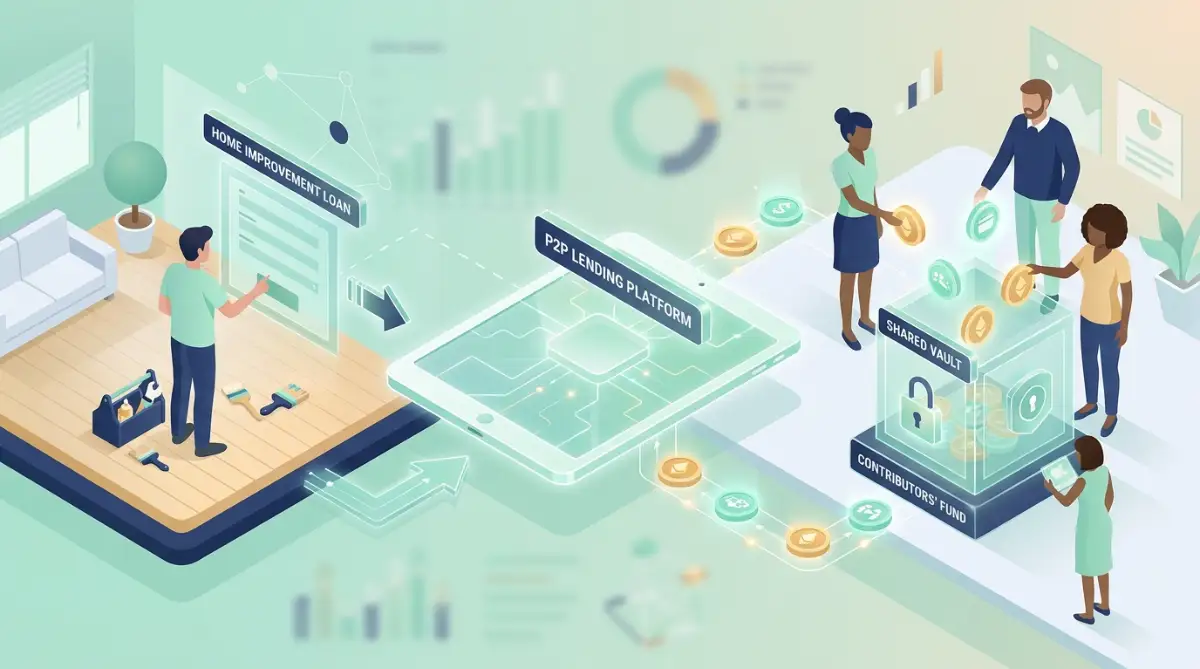
The very first thing you need to understand is the role of the P2P platform. Think of this platform like a massive online marketplace, similar to eBay or Uber, but specifically built for money.
When you use a ride-sharing app, the app does not actually own the cars. It simply provides the clever technology to match a driver with a passenger safely. A P2P lending platform works exactly the same way. The platform itself does not lend out its own money. Instead, it provides the secure digital space where borrowers and lenders can safely find each other.
To make this happen, the platform uses advanced matching algorithms. When a borrower signs up, they fill out a detailed application stating exactly how much money they need and what they plan to do with it. The algorithm then processes this request in a matter of seconds. It checks the basic identity of the borrower to prevent fraud and ensures all legal requirements are met.
Once the borrower is verified, their loan request is posted openly on the digital marketplace. It becomes a live listing that thousands of eager investors can browse through at any time of day.
Step 2: The Science of Risk Assessment and Grading
Now, you might be wondering about safety. If there is no strict bank manager, how do we know the borrower will actually pay the money back? This is where the platform's risk assessment engine steps in.
P2P platforms do not just randomly post loan requests and hope for the best. They use very smart data science to grade every single borrower. While traditional banks rely almost entirely on a simple credit score, modern platforms look at a much wider range of human factors. They analyze a person's debt-to-income ratio, their steady employment history, and even the specific purpose of the loan.
Based on all this math, the platform assigns a specific "Grade" or "Rating" to the loan request. An "A-Grade" loan usually means the borrower has excellent financial habits, making them a very safe bet. However, because they are safe, the interest rate they have to pay is quite low. On the other hand, a "C-Grade" loan might go to someone with a slightly spotty history. This is riskier for the lender, so the borrower has to pay a much higher interest rate to compensate for that risk.
I learned this lesson the hard way. When I first started looking into this system as an investor, I blindly assumed everyone was perfectly trustworthy. My biggest mistake was totally ignoring the risk grades attached to each profile and chasing only the highest interest rates. I quickly realized that balancing high-risk and low-risk loans is the only real way to keep your money safe in this system.
Understanding Loan Grades & Risk Allocation
Before funding any borrower, P2P platforms assign a risk grade to the loan. Here is a quick breakdown of how these grades balance interest returns with default risk, along with a practical portfolio allocation guide:
Expert Insight: Understanding the Spread
In the traditional banking world, the difference between the interest a bank pays to a depositor and the interest they charge a borrower is called the "spread." Banks keep this entire spread to pay for their huge office buildings, CEO bonuses, and advertising campaigns.
Because P2P platforms exist entirely online, their running costs are incredibly low. They take a very small, flat fee for connecting the two parties. This means borrowers get lower interest rates, and lenders get higher returns because the greedy middleman is completely removed from the equation.
Step 3: Funding the Loan in Tiny Fractions
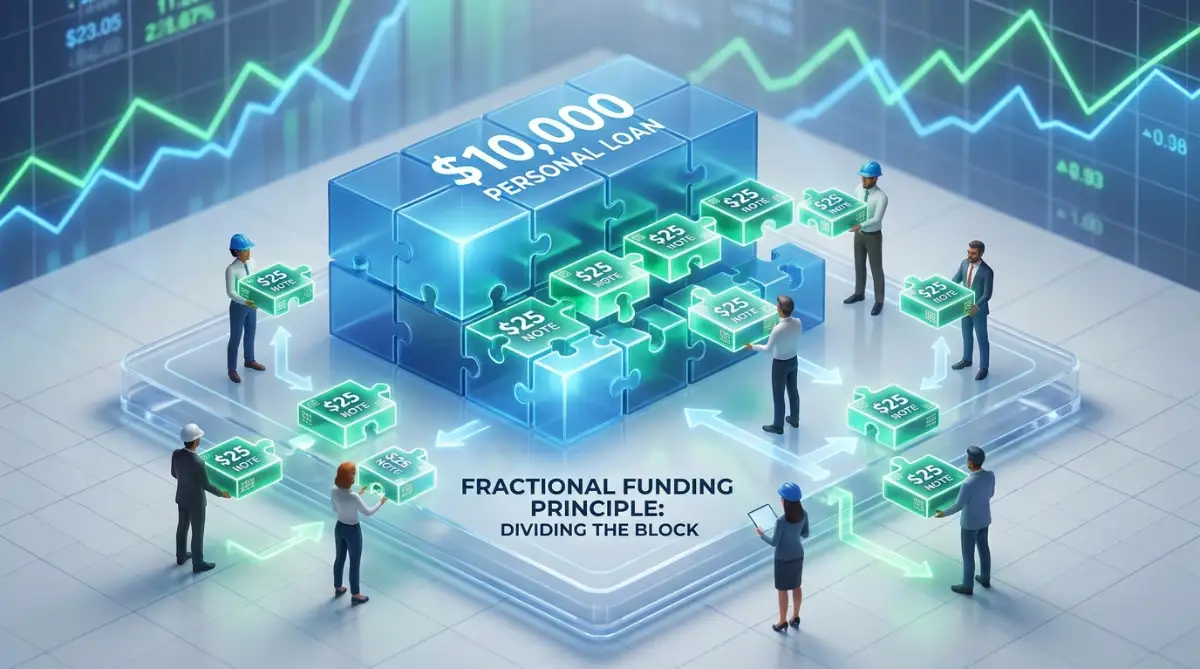
This is perhaps the most brilliant mechanic of the entire P2P system. Let us imagine a borrower named Sarah needs a $10,000 personal loan to consolidate her credit card debt. In the old world, a single bank would hand her a $10,000 check.
In the P2P world, it is highly unlikely that one single person will give Sarah the full $10,000. That would be incredibly risky for that one investor. If Sarah loses her job and cannot pay, that one investor loses all their money.
Instead, the platform uses a clever method called fractional funding. The massive $10,000 loan request is chopped up into hundreds of tiny pieces, sometimes called "Notes." These notes can be as small as $25 each.
Think of it like a community potluck dinner. Instead of one person cooking a massive feast for fifty people, everyone simply brings one small dish to share. The result is a full table of food, but no single person had to carry the heavy burden of paying for it all.
Myth vs Reality: Who Actually Funds These Loans?
- The Common Myth: You need to be a wealthy millionaire or a professional Wall Street trader to fund loans on a P2P platform.
- The Actual Reality: Because of fractional funding, anyone with just $25 in their pocket can create an account and start funding loans. Everyday teachers, nurses, and retail workers use these platforms to grow their small savings bit by bit.
When Sarah's loan goes live on the marketplace, 400 different people might decide to contribute $25 each. Within a few days, her loan is fully funded.
For the investors, this is the ultimate safety net. If an investor has $1,000 to lend out, they do not give it to one person. They give $25 to 40 different borrowers. If one borrower suddenly stops paying, the investor only loses a tiny $25 fraction of their total money. The interest earned from the other 39 borrowers easily covers that small loss.
This simple mathematical trick is exactly how ordinary people can safely act like a bank without taking on massive, life-ruining financial risks.
Mastering the Platform: Insider Secrets for Long-Term Success
Once you understand the basic mechanics of fractional funding, the next logical step is setting up a system that practically runs itself. Many beginners log into their accounts every single day, manually hand-picking loans to fund. This might feel exciting at first, but it quickly becomes completely exhausting.
If you want to see consistent, long-term growth without losing your mind, you need to rely on automation and strict filtering.
Almost every major peer-to-peer platform has a built-in feature called an "auto-invest" tool. Think of this tool like the thermostat in your house. You set your preferred temperature once, and the machine works quietly in the background to keep your home comfortable. With an auto-invest tool, you simply set your specific criteria for borrowing or lending, and the platform does all the heavy lifting while you sleep.
For example, you can tell the system to only invest your money in A-grade or B-grade borrowers who have an established work history. The algorithm will automatically grab those tiny $25 fractions of loans the exact second they hit the marketplace. This gives you a massive advantage over manual users who are simply too slow to catch the safest opportunities.
My 3-Rule Checklist for Setting Up Auto-Invest Filters:
- Cap Per-Loan Exposure: Never put more than 1% of your total account balance into any single note (e.g., $25 on a $2,500 total balance).
- Employment Minimums: Only target borrowers with at least 24 consecutive months of documented employment history.
- Debt-to-Income (DTI) Hard Limit: Automatically filter out any application where the borrower’s existing DTI ratio exceeds 35%.
Another incredibly powerful secret is the magic of reinvesting your returns. When borrowers make their monthly payments, tiny bits of interest will start piling up in your digital account. Your first instinct might be to transfer that cash straight to your checking account and spend it on a nice dinner. I highly recommend doing the exact opposite.
By setting your account to automatically use that earned interest to fund brand new loans, you create a snowball effect. Your money starts making its own money. If you are struggling with balancing your regular expenses while trying to invest, learning how to properly build an emergency fund first will give you the confidence to leave your P2P earnings alone so they can grow.
For borrowers, the biggest insider secret is maintaining complete transparency. When you apply for funding, the platform often asks for a written explanation of why you need the money. Do not leave this blank. People are far more likely to fund your request if they connect with your human story. Whether you are funding a small business expansion or exploring debt consolidation loans vs balance transfers, explaining your clear plan builds instant trust with the community.
The Silent Traps That Destroy New Portfolios
Even with smart algorithms doing the heavy lifting, human psychology often gets in the way. People make highly emotional decisions when money is involved, and in the peer-to-peer space, these mistakes can wipe out your hard-earned savings very quickly.
The most common and destructive trap is chasing unrealistically high returns. When you log into the platform, you will inevitably see C-grade or D-grade loans offering massive interest rates. It is highly tempting to dump all your money into these options, hoping for a fast payday.
What the shiny green numbers do not tell you is the real, uncomfortable truth behind those grades. These borrowers often have a history of missed payments or deeply unstable income. When a borrower completely defaults on a loan, you do not just lose the promised interest. You lose your entire initial principal. One defaulted high-risk loan can easily wipe out the profits you made from thirty safe loans.
Another massive pitfall is completely ignoring liquidity. This is a fancy financial term that simply means how quickly you can turn your investments back into raw, usable cash.
A traditional checking account is highly liquid. You can walk up to an ATM and get your cash instantly. Peer-to-peer lending is the exact opposite. When you fund a three-year loan, your money is completely locked away inside that agreement. You cannot simply hit a "withdraw" button and demand your $5,000 back because your car broke down. Educational resources from the Financial Industry Regulatory Authority (FINRA) regularly warn everyday users to fully understand the strict timeline of alternative investments before committing large amounts of money.
If you ever plan to borrow money through these networks, your biggest mistake would be treating this system like easy, consequence-free cash. Just because there is no bank manager staring you down does not mean your obligations disappear.
These platforms report directly to the major national credit bureaus. If you miss your payments, it will heavily damage your financial reputation. While there are safe ways to eventually fix a damaged credit score, it is a long, stressful road that you should avoid at all costs.
Always review the fine print regarding platform security as well. Since you are uploading highly sensitive identity documents, you should verify that the company uses bank-level encryption. The Federal Trade Commission (FTC) advises consumers to thoroughly check the privacy policy of any financial app before handing over their social security numbers or home addresses.
Your Next Steps for a Smarter Financial Future
Instead of leaving this page and instantly forgetting everything you just read, I want you to take a few simple, practical steps today.
First, take a brutally honest look at your current financial situation. Are you looking to borrow money for a smart, specific reason, or are you hoping to slowly grow a small pile of savings? Knowing your exact goal will help you choose the right digital platform.
Next, start incredibly small. If you decide to test the waters as an investor, do not transfer your entire life savings on day one. Move a tiny amount of money—maybe just fifty or one hundred dollars. Spend a few weeks watching how the system distributes your funds into those tiny $25 notes. Watch how the dashboard updates when a borrower makes their very first payment.
Finally, set up your automated rules and simply walk away. Let the technology do the stressful work for you. The most successful people in this space are the ones who check their accounts once a month, not once an hour.
My personal journey with alternative financing completely changed when I stopped treating it like a casino and started treating it like a slow, steady garden. I highly encourage you to take that very first small step today, because building a smarter financial future is one of the most rewarding things you will ever do for yourself.
Answers to Your Biggest Questions
How much money do I actually need to get started?
You do not need to be wealthy to participate in this network. Most major platforms allow you to open a basic account and start funding individual loan notes with as little as $25. This extremely low entry point makes it highly accessible for anyone wanting to learn the ropes.
Can I withdraw my money from the platform at any time?
No, and this is a very common misunderstanding. When you lend your cash out, it is strictly tied up in a legal contract for the duration of the loan, which is typically two to five years. You only get your money back slowly as the borrower makes their monthly principal and interest payments.
Are these digital loans safe for my personal credit score?
If you are applying as a borrower, platforms will usually do a "soft pull" on your credit to give you an initial interest rate offer, which does not hurt your score at all. However, once you fully accept the funds, it becomes an official debt, and any late payments will definitely harm your official credit history.
Disclaimer: The information provided in this article is for educational and informational purposes only and does not constitute official financial advice. Always consult with a certified financial advisor before making any major borrowing or investing decisions.