
The Heavy Burden of Multiple Monthly Payments
Imagine waking up every single morning with a sinking feeling in your chest. Before you even pour your first cup of coffee, the heavy thought of upcoming due dates crashes over you.
You check your phone, and there it is again. Another text alert from a different credit card company reminding you of a minimum payment. Juggling three, four, or even five different accounts every single month is completely exhausting.
It feels like you are running on a treadmill that keeps speeding up, yet you are going nowhere. No matter how hard you work or how many extra shifts you take, those high-interest charges constantly eat away at your progress.
You send off a large chunk of your hard-earned paycheck, hoping to see a difference. But when the next statement arrives, the principal balance has barely moved. This constant, heavy pressure drains your daily energy and makes everyday decisions incredibly stressful.
Should you buy fresh groceries this week, or should you pay the minimum amount on card number three? This is a massive, silent weight that millions of hardworking people carry every single day.
Why Finding the Right Way Out Feels Impossible
When you try to find a way out of this trap, the sheer amount of bad advice can make things much worse. Here is why so many people struggle to find a real solution:
- Information overload paralyzes your choices. You search online for answers and immediately find hundreds of conflicting opinions from random forums.
- Credit card companies push flashy zero-percent offers. These offers often hide tricky fine print, and if you miss one small detail, you end up in a worse financial spot.
- So-called experts offer one-size-fits-all advice. They completely ignore your unique credit score, your exact monthly income, and your personal living expenses.
- Predatory lenders promise instant overnight relief. They actually trap you in endless cycles of hidden fees and sky-high loan origination costs.
- People confuse short-term fixes with long-term strategies. Moving your owed money from one account to another without a solid plan just resets the debt clock.
The Hidden Cost on Your Mental Well-Being
The damage caused by this financial stress goes far beyond just numbers on a screen. It deeply impacts your personal life in ways you might not even realize:
- You stop answering unknown phone calls. The deep fear of aggressive debt collection agents keeps you constantly on edge and nervous.
- Your sleep quality drops drastically. Lying awake at night doing mental math completely ruins your focus and energy for the next workday.
- Relationships suffer from heavy financial friction. Hiding credit card statements from your partner creates a thick wall of guilt, shame, and secrecy.
- Your self-worth takes a massive, unfair hit. Society wrongly equates financial struggles with personal failure, making you feel entirely alone in this fight.
- Planning for a better future stops completely. When you are just trying to survive the current week, dreaming about a new home or retirement feels absolutely impossible.
We need to address the root cause of this problem right now. You cannot keep applying tiny bandages to a massive financial wound.
To actually break free, you need a smart, mathematical approach to clear what you owe. This is exactly where the debate between a debt consolidation loan and a balance transfer begins. Both methods have specific rules, and choosing the wrong one can cost you thousands of dollars.
Let us break down exactly how you can map out your escape route today.

How to Choose Your Perfect Debt Defeating Strategy
Taking control of your finances does not require a degree in advanced economics. It simply requires a clear understanding of your current situation and the willingness to take structured action.
You do not have to rely on guesswork anymore. By following a logical, step-by-step approach, you can easily figure out which financial tool will serve you best.
Let us look at the exact steps you need to take right now to stop the endless cycle of high interest.
Map Out Your Exact Enemy: The Debt Audit
Before you can choose between a loan or a new credit card, you have to know exactly what you are fighting against. You cannot defeat an enemy that you cannot see.
Most people avoid looking at their bank statements because it brings up feelings of anxiety. But skipping this step is like trying to drive to a new city while blindfolded.
You need to sit down at your kitchen table with a pen, a piece of paper, and all of your current statements. Write down the name of every single account you owe money on.
Next to the name, write down the total balance owed, the minimum monthly payment, and most importantly, the Annual Percentage Rate (APR). The APR is the exact speed at which your debt is growing.
Let us look at a real-life scenario. Imagine a person named Sarah. She felt completely overwhelmed until she finally wrote everything down.
Sarah discovered she was paying a massive 25% APR on her store credit card and 19% on her primary bank card. She was paying over $150 every month just in pure interest charges. That was money vanishing into thin air.
Once you have this list, add up the total amount you owe across all accounts. Then, add up the total minimum payments you are forced to make each month.
This final number gives you a clear baseline. If a new strategy cannot lower that monthly payment or slash those interest rates, it is not worth your time.
The Balance Transfer Strategy: Pausing the Interest Clock
Now that you know your numbers, let us examine the first major weapon in your arsenal. A balance transfer credit card is essentially a tool that lets you hit the pause button on your interest charges.
Here is exactly how it works. You apply for a brand new credit card that offers a 0% introductory APR for a specific amount of time. This promotional period usually lasts anywhere from 12 to 21 months.
Once approved, you move the high-interest balances from your old cards onto this new card. For the entire promotional period, every single dollar you pay goes directly toward the principal balance.
This can save you hundreds, or even thousands, of dollars in interest. However, this strategy comes with some very strict mathematical rules you must follow.
First, moving your money is almost never free. Most banks charge a balance transfer fee, which is typically between 3% and 5% of the total amount you are moving.
If you transfer $5,000, a 3% fee means $150 is immediately added to your new balance. You need to calculate if the interest you save over the next year is higher than that upfront fee. In most high-interest cases, it absolutely is.
Second, you must have a rock-solid plan to pay off the entire balance before the 0% period ends. Think of that promotional window as a ticking stopwatch.
If you transfer $6,000 to a card with a 15-month 0% offer, you need to pay exactly $400 every single month. If you only pay the minimums and the 15 months run out, your interest rate will immediately shoot up to a standard, high rate.
This option is perfect for people who have a good credit score and the strict discipline to aggressively pay down their balance in a short time.
The Consolidation Loan Approach: Forcing Financial Discipline
Sometimes, a balance transfer is not enough. If your total debt is too large to pay off in 15 months, or if you struggle with credit card temptation, you need a different tool.
A debt consolidation loan is a type of personal loan designed to combine all your messy debts into one clean package. You borrow a lump sum of money from a bank or online lender.
You use that exact lump sum to completely pay off all your individual credit cards. Suddenly, you go from managing five stressful due dates to just one single monthly payment.
The biggest advantage here is the structure. A consolidation loan gives you a fixed interest rate and a fixed monthly payment for a specific term, usually between two to five years.
Think of this like turning five messy, unpredictable water streams into one strong, manageable river. You know exactly how much you have to pay on the 1st of every month, and you know the exact date you will be entirely debt-free.
Let us look at another practical scenario. Imagine a man named David who owes $15,000 spread across four different credit cards. His average interest rate is 22%, and his minimum payments keep fluctuating.
David applies for a personal consolidation loan and gets approved for an 11% interest rate over a three-year term. He immediately pays off all four cards.
Now, David makes one predictable payment every month. He cannot easily add more debt to the loan, which forces him to stick to his financial plan.
Furthermore, this method often helps your credit score over time. By paying off your revolving credit cards, your credit utilization ratio drops significantly.
This ratio is a massive factor in how credit bureaus calculate your overall score. Just remember, the golden rule of this strategy is that you must lock away your old credit cards.
If you get a loan to clear your cards, but then start spending on those empty cards again, you will end up with double the debt. You must attack the root habit of overspending while using the loan as your protective shield.
Next-Level Strategies to Master Your Debt Payout
Once you understand the basic differences between a balance transfer and a consolidation loan, you need a long-term game plan. Winning this financial battle requires more than just picking a product.
You need to set up smart systems that protect your progress over the coming months. If you simply move your money around without changing your daily habits, you will end up right back where you started.
Let me share a few advanced secrets that professional financial advisors use to keep their clients on track. These strategies will ensure your success is permanent, not just temporary.
Decode the Hidden Math Before You Sign Anything
Every financial product looks incredibly appealing on the front page of a website. The marketing teams want you to focus only on the big, bold numbers like "Zero Percent" or "Low Monthly Payment".
However, the real truth is always buried deep inside the terms and conditions. You must become a financial detective and read the fine print carefully.
For a balance transfer, you already know about the upfront transfer fee. But did you know there is also a strict time limit on when you can actually make the transfer?
Many banks require you to move your balances within the first 45 days of opening the account. If you wait too long, you completely lose that special promotional rate.
If you are leaning toward a personal consolidation loan, you need to watch out for origination fees. Some lenders charge a massive upfront fee just for processing your application.
If a lender approves you for a $10,000 loan but takes a 5% origination fee, they will only deposit $9,500 into your bank account. You are still legally responsible for paying back the full $10,000, plus all the interest.
Always ask your lender for a clear, written breakdown of every single fee before you accept the money.
Build a Defensive Shield Against Future Borrowing
One of the biggest secrets to getting out of debt is completely stopping the flow of new debt. You cannot empty a leaking bathtub if you leave the faucet running.
This is exactly why you need to build a small starter emergency fund immediately. I know it sounds crazy to save cash when you have massive high-interest accounts to pay off.
But let us look at a very real scenario to understand why this is so important. Imagine a woman named Emily who just consolidated all her cards into a clean personal loan.
She feels great because her payments are finally manageable. Two months later, her car breaks down on the way to work, and the mechanic demands $800 for the repair.
Because Emily put every spare dollar she had toward her loan, her bank account is completely empty. She has no choice but to pull out an old credit card and charge the $800.
Just like that, she is caught in the trap again, juggling a new high-interest payment alongside her new loan.
If Emily had saved a basic cash buffer of $1,000 before aggressively attacking her debt, she could have paid the mechanic in cash. You must protect your payoff plan by keeping a small emergency fund in a separate savings account.
The Art of Negotiating with Your Creditors
Many people wrongly assume that bank rules are carved in stone. The truth is, creditors are often willing to negotiate if they believe it is the only way they will get paid.
Before you apply for a new loan or a transfer card, simply pick up the phone and call your current credit card companies. Ask to speak directly with the retention department.
Tell them you are struggling to keep up with the high interest rate and are considering moving your balance to a competitor. Very often, they will magically offer you a temporary rate reduction to keep your business.
Even if they only lower your rate by a few percentage points, that small victory saves you pure cash every single month. It costs you absolutely nothing to ask, and the worst they can say is no.
Dangerous Traps That Will Keep You Broke
Even with a perfect plan, the journey to financial freedom is filled with hidden landmines. I have seen countless hardworking people make simple mistakes that cost them dearly.
When you are stressed about money, it is very easy to make emotional decisions instead of logical ones. To protect your hard work, you must actively avoid these five major financial pitfalls.
Shutting Down Old Accounts Immediately
This is the most common mistake people make right after paying off a credit card. It feels incredibly satisfying to call the bank and completely cancel the account you just cleared.
However, doing this can immediately damage your overall credit score. A massive part of your credit profile is based on your average age of accounts.
Think of your credit history like a professional resume. A longer work history makes you look highly reliable to potential employers.
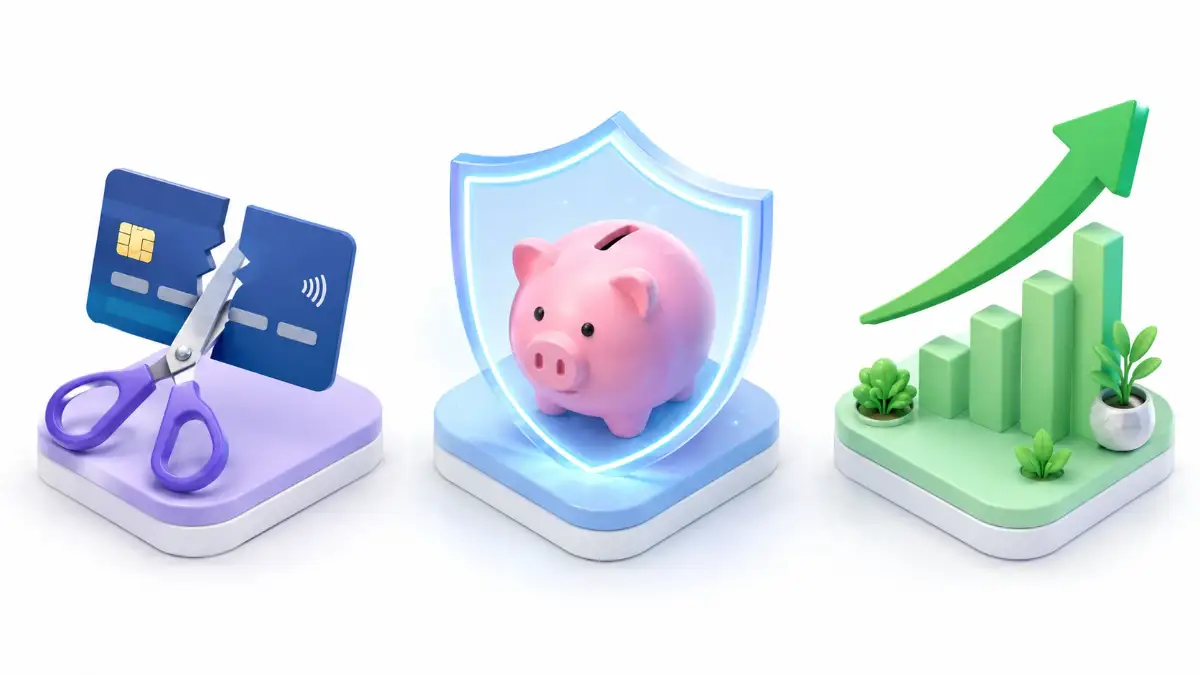
When you close your oldest credit card, you instantly erase a large chunk of your good financial history. Instead of closing the card, simply cut up the physical plastic and delete the number from your online shopping apps.
Keep the account open with a zero balance. This keeps your available credit high and your utilization ratio low, which boosts your score nicely over time.
Treating the Cleared Limits as Free Money
Whether you use a loan or a transfer, the end result is the same: your old credit cards suddenly have a zero balance. Seeing thousands of dollars in available credit can be extremely tempting.
It is very easy to convince yourself that you deserve a small reward for being so responsible. You might think, "I will just put this one dinner on the old card and pay it off immediately."
That single dinner quickly turns into a weekend trip, and before you know it, you are drowning again. You now have the new loan payment plus a brand new high-interest card balance to worry about.
This specific mistake leads directly to bankruptcy for many families. You must mentally treat those old credit limits as if they do not exist.
Missing the Promotional Expiration Date
If you choose the balance transfer route, your entire success depends on beating the clock. The bank is secretly hoping that you forget when your zero percent offer expires.
Let us say you have a $4,000 balance on a card with a 12-month promotional period. You must divide $4,000 by 12, which means your exact goal is to pay $334 every month.
Many people just pay a random amount, assuming they will catch up later. Then, month 13 arrives, and the bank slaps them with a massive 29% interest rate on the remaining balance.
Do not trust your memory when it comes to banking deadlines. Set up automatic monthly transfers from your checking account for the exact mathematical amount you need.
Applying for Too Many Offers at Once
When people get desperate for a solution, they tend to panic and apply everywhere. They fill out applications for three different loans and four different credit cards on the same day.
Every single time you submit an official application, the lender performs a hard inquiry on your credit report. A single hard inquiry is fine, but multiple inquiries in a short time send a terrible signal.
Banks see this as a sign of extreme financial distress. They assume you are about to lose your job or that you are desperately hunting for survival cash.
This panic applying will heavily lower your credit score and result in instant rejections across the board. Take your time, do your research, and apply for only the single best option that fits your math.
Ignoring Your Core Spending Habits
This is the hardest truth to accept on your journey to becoming debt-free. Neither a loan nor a transfer card can fix the underlying behavior that caused the problem in the first place.
If you consistently spend more money than you earn every month, no financial product in the world can save you. These tools only treat the symptoms of the disease, not the root cause.
You must sit down and honestly evaluate where your cash is going every single week. Are you eating at restaurants too often, or paying for five different streaming services you never watch?
You need a basic, realistic budget that tells your money exactly where to go. Combine a solid monthly budget with your new payoff strategy, and you become completely unstoppable.
Your Blueprint for Complete Financial Freedom
We have covered a massive amount of ground today, and you now hold the exact blueprint to take back your life. You no longer have to feel like a helpless victim to rising interest charges.
You now understand that a balance transfer card is a brilliant tool if you need a short, aggressive sprint to the finish line. It is perfectly designed for smaller amounts that you can clear before the promotional clock runs out.
On the other hand, you know that a consolidation loan acts like a steady, predictable marathon. It forces strong discipline through a fixed monthly payment and protects you from the temptation of revolving credit.
The heavy anxiety you feel right now is simply a fear of the unknown. Once you grab a pen, write down your exact numbers, and calculate your options, that deep fear will disappear.
It will be replaced by a clear, undeniable sense of purpose and control. You have the intelligence and the strength to execute this plan perfectly.
Stop letting banks profit heavily off your hard work and daily stress. Choose your strategy, stick to your budget, and start walking confidently toward a completely debt-free life today.