
The Silent Stress of the Minimum Payment Trap: My Personal Wake-Up Call
If your credit card interest rate is sitting above 20%, you are paying a heavy tax just to carry a balance. Most people assume credit card terms are carved in stone, but a single 15-minute phone call can slash your rate by 3% to 7%. Here is the exact game plan you need to turn the tables, talk to the right department, and keep more cash in your pocket every month.
Almost everyone with a credit card knows this exact feeling of frustration. We work hard for our money, yet a massive chunk of our monthly payment simply vanishes into the bank's profit pool as interest charges. When your annual percentage rate (APR) is sitting comfortably over twenty percent, trying to pay down the principal balance feels like trying to empty the ocean with a small teaspoon.
The truth is, most of us just accept the numbers printed on our statements as final. We assume the system is rigid and unchangeable. We get caught up in the stress of making sure the minimum payment is made on time, entirely forgetting that we have a voice as consumers.
This silent acceptance is exactly what credit card issuers bank on. They hope you never realize that your interest rate is not a permanent tattoo, but rather an ongoing agreement that is surprisingly flexible. Once I understood that the rules were negotiable, the fear of calling my bank completely disappeared.

Before We Dive In: Quick Action Checklist
- Your rate is never permanent: Banks spend heavy budgets acquiring new users, making it far cheaper to lower your rate than lose your business.
- Come armed with real proof: Check your latest credit score and pull one zero-percent balance transfer offer from a competitor before making the call.
- Ask for Retention right away: Frontline agents often have locked software permissions; ask for the retention desk to unlock real discounts.
- Review every 6 to 12 months: Whenever your credit score bumps up or you get a pay increase, call back to request another rate drop.
The Hidden Psychology Behind Bank Negotiations
Before you even think about picking up the phone, you need to understand exactly how the person on the other end of the line views your account. Credit card companies are not charity organizations, but they are highly logical businesses. They rely entirely on math, risk assessment, and customer retention metrics.
When you understand their business model, you suddenly gain a massive advantage. You stop asking for favors and start presenting logical business propositions.
Why Your Bank Actually Wants to Keep You
It might shock you to hear this, but your bank does not want you to close your account. Finding a brand new, reliable customer is incredibly expensive for credit card companies. They spend massive amounts of money on marketing campaigns, sign-up bonuses, direct mailers, and affiliate commissions just to get one new person to apply for a card.
If you have a history of making your payments on time, you are considered a highly profitable, low-risk asset to them. If you get frustrated with their high rates and move your balance to a competitor, they lose a steady stream of income.
Here is a simple look at how banks view the math behind your account:
When you realize that giving you a small rate reduction is actually the cheapest option for the bank, your confidence naturally grows. You are not begging; you are simply offering them a chance to keep a good customer.
Here is a realistic breakdown showing how a simple rate drop keeps real dollars in your pocket on common balances:
Gathering Your Financial Ammo Before the Call
You cannot walk into a negotiation empty-handed. If you call customer service and simply say, "My rate is too high, please lower it," you will almost certainly get a polite rejection. The representative needs a valid, documented reason to approve your request in their computer system.
To give them that reason, you need to gather specific pieces of information about your own account and your current financial standing.
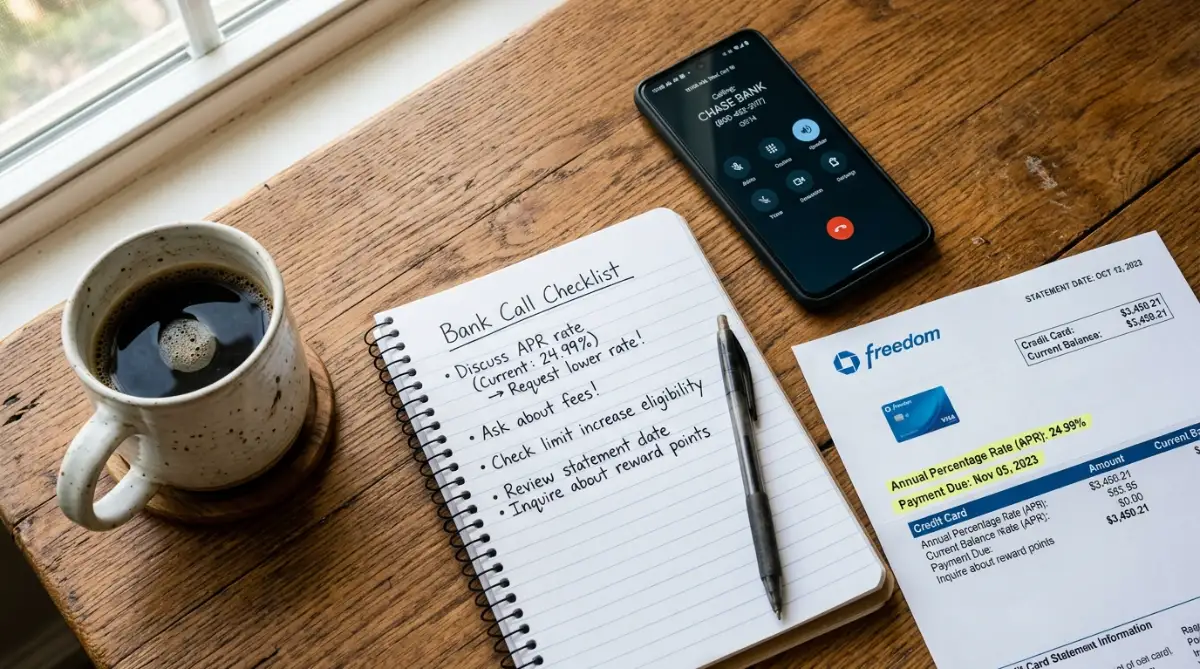
First, check your current credit score. You do not need a perfect score, but you do need to know where you stand. If your score has improved since you first opened the credit card, this is your primary weapon. It proves that you are a safer borrower today than you were in the past.
Second, look at your payment history with this specific bank. Have you made your last twelve payments on time? A flawless payment record is the most powerful argument you can make. It tells the representative that you are reliable and worth keeping around.
I used to think loyalty meant absolutely nothing to big corporations. But after hanging up on a failed negotiation attempt early on, I realized my mistake was asking for a favor instead of proudly reminding them of my flawless five-year payment history. The moment I changed my approach, their tone changed completely.
The Power of Knowing Your Alternatives
One of the most effective strategies you can use is having a backup plan ready. In the financial world, this means knowing exactly what competitor banks are offering you right now.
Have you been receiving promotional mailers for 0% introductory balance transfer cards? Have you seen online ads for credit cards offering a much lower ongoing APR than what you currently pay?
Here is exactly how to find and use competitor offers:
Watch this short guide on how balance transfers work to understand the offers you are looking for.
Take ten minutes to search for these offers online or check your physical mailbox. Write down the name of the competing bank and the specific rate they are offering. When you eventually make your call, you will use this information to gently remind your current bank that you have other options.
Think of it like buying a car. If you tell a dealer that the lot across the street is offering the same car for less money, they will usually try to match that price to keep your business. The credit card industry works the exact same way.
Myth vs Reality: Credit Card Rates
- The Myth: You need an excellent credit score of 800+ to even ask for a rate reduction.
- The Reality: Consistency matters far more than perfection. Even with an average credit score, a solid history of on-time payments gives you excellent leverage to negotiate a better deal.
Strategic Timing: When to Pick Up the Phone
Believe it or not, the day and time you choose to call your credit card company can actually impact your success rate.
Customer service representatives are human beings. If you call them when they are overwhelmed, stressed, and dealing with a massive queue of angry customers, they are less likely to go out of their way to help you.
Monday mornings are notoriously bad times to call any customer service department. People spend the weekend reviewing their bills and wait until Monday to call in and complain. The hold times are long, and the representatives are often exhausted.
Instead, aim for the middle of the week. Tuesday, Wednesday, or Thursday mid-mornings are usually the sweet spots. The call volume is generally lower, the representatives are more relaxed, and they have more time to actually look through your account details and find available promotions.
Expert Insight:
Behavioral psychology suggests that people are much more willing to accommodate requests when they are not feeling rushed. By calling during off-peak hours, you give the representative the mental space they need to become your advocate, rather than just treating you like another ticket in a long queue.
Preparing Your Mental Script
The final step before making the call is writing down exactly what you are going to say. When we get nervous, our minds tend to go blank. Having a physical piece of paper in front of you keeps you focused and prevents you from rambling.
Start by writing down your opening statement. It should be polite, direct, and completely clear about your intentions. You want to establish right away that you are a loyal customer who wants to stay with the bank, but you need a little help to make that happen.
Keep this quick cheat sheet handy so you can read it directly from your notepad during the conversation:
- Your Opening Pitch: "Hi, I have been an on-time customer with you for over three years. My current rate is 24%, but I just received a 16% promo offer in the mail from another bank. I really prefer staying with you, but the interest is too high. Can you match that rate so I can keep using this card?"
- If the First Agent Says No: "I completely understand your system has set limits. Could you please transfer me to the retention department to see what special loyalty promotions are available for my account?"
Next, bullet point your main arguments. Write down your current credit score, how long you have been a customer, and the specific competitor offers you found.
Finally, prepare yourself for the first "no." The first person you speak with might read from a standard script telling you that they cannot lower your rate. Do not let this discourage you. This is completely normal and is simply the first small hurdle in the negotiation process.
Knowing that rejection is just part of the game removes the sting. You are not asking for a personal favor; you are conducting a basic business transaction. Keep your voice calm, keep a smile on your face (they can hear it in your voice), and get ready to firmly but politely state your case.
Insider Strategies to Secure and Keep a Lower Rate
Getting the customer service representative on the phone is only the beginning of the process. The real magic happens when you know exactly how to guide the conversation, even when things do not go your way immediately.
Most people give up the second they hear the word "no." But in the financial industry, a "no" from a frontline worker often just means "I do not have the system permissions to say yes."
Frontline phone agents are usually restricted by specific software limits. They can only offer what their screen allows them to offer. If their system says you do not qualify for a random promotional rate drop, you need to gently escalate the conversation. You can do this by politely asking to speak with the retention department or a supervisor. The retention department has much more authority to manually adjust your account settings because their entire job is to keep you from leaving the bank.
The Hardship Request Secret
If your current financial situation has genuinely changed due to a job loss, medical emergency, or unexpected life event, you have another powerful option. Almost every major bank has internal hardship programs. These programs are designed specifically to prevent accounts from defaulting. By explicitly stating that you are experiencing financial hardship and want to avoid falling behind, you trigger a different set of rules. Organizations like the Consumer Financial Protection Bureau heavily encourage consumers to proactively ask their lenders about these specific programs before a missed payment happens. Banks would much rather freeze your interest rate temporarily than send your account to a collections agency.
Securing Your Victory for the Long Term
Once you successfully get that rate lowered, your job is not entirely over. You have to protect this new victory. The bank will monitor your account closely for the next few months to ensure they made a good decision by trusting you.
The absolute best way to lock in your new status is to set up automatic payments immediately. Even if you only automate the minimum payment amount, it guarantees you will never be late. A single late payment can automatically trigger a penalty APR, wiping out all of your hard work in an instant. Additionally, keeping your overall credit utilization low will naturally protect your standing. If you are curious about how these specific factors weigh into your overall profile, understanding the official FICO scoring models can give you a massive long-term advantage.
You can also leverage this success to improve your overall financial health. If you are actively working on fixing a damaged credit score safely, this lower interest rate will help you pay down the principal balance much faster, which directly boosts your score.

The Trapdoors: What Ruins a Perfectly Good Negotiation?
Navigating a phone call with a bank can feel intimidating, and it is very easy to let emotions take over. However, making a few common missteps can instantly shut down your chances of getting a better deal.
The biggest and most damaging mistake is issuing empty threats to cancel your account. Many people think that angrily shouting, "I will just close my card right now!" will scare the bank into submission. This is a terrible idea.
First, the bank representative has likely heard this exact threat twenty times already that day. Second, if you have a large outstanding balance, the bank knows you cannot just magically close the account without paying it off or transferring it. If you threaten to cancel without having a solid backup plan, the representative might simply call your bluff and say, "Okay, I can process that closure for you right now." Suddenly, you are stuck with a closed account that still demands monthly payments, which heavily damages your credit history.
Instead of threatening, you should always have a real alternative ready. Knowing how balance transfers compared to other options actually work gives you silent, calm confidence. You do not need to shout when you know you can easily move your money elsewhere.
Scenario A (The Emotional Approach):
You get frustrated on the call, complain about how unfair the fees are, and threaten to leave. The representative becomes defensive, reads a standard rejection script, and ends the call. You walk away angry, with the exact same high APR.
Scenario B (The Logical Approach):

You calmly mention that you have been reviewing your household budget. You state you are happy with their service but have received a pre-approved mailer from a competitor offering a much lower rate. You ask if they can match it so you do not have to go through the hassle of moving your balance. The representative sees you are a rational, prepared customer and works hard to find a solution.
Another massive pitfall is acting entitled during the conversation. Remember that the person on the phone is just a normal human working a stressful job. If you treat them poorly, they will do the bare minimum required to get you off the line. If you treat them with genuine kindness and respect, they will often search through their system for hidden promotional offers just to help you out.
If you find yourself overwhelmed by multiple high-interest accounts and the bank refuses to budge, it might be time to look into professional guidance. Reaching out to a certified non-profit organization like the National Foundation for Credit Counseling can provide you with structured, safe ways to manage debt when direct negotiation fails.
Your Personal Blueprint for Financial Relief
Here is your simple action plan for the next 24 hours:
- Find a quiet time: Block out twenty minutes on your calendar for tomorrow morning or mid-afternoon.
- Write down your stats: Jot down your current credit score, the number of years you have held the card, and your flawless payment history.
- Find one competitor: Look online for just one promotional offer from a different bank to use as your leverage.
- Make the call: Dial the number on the back of your card, take a deep breath, and calmly state your case.
This small, focused effort is a massive step toward destroying high-interest debt fast. I still remember how my hands were slightly shaking the first time I dialed my bank's customer service number to ask for a rate reduction. I was so afraid they would laugh at me. But when the representative cheerfully agreed to drop my rate by four percent, a massive wave of relief washed over me. Taking control of my financial conversations completely changed my life, and I know it will do the exact same thing for you.
Questions People Often Ask About Rate Drops
Will asking for a lower interest rate hurt my credit score?
No, simply calling your bank to request a lower rate will not impact your credit score at all. The bank representative usually does a "soft pull" to review your account history, which never shows up as a negative mark on your credit report. You can ask as many times as you like without fear of penalty.
How often should I try negotiating my credit card terms?
A good rule of thumb is to evaluate your accounts every six to twelve months. If your credit score has recently gone up, or if you just received a raise at work, that is the perfect time to call. Banks frequently update their internal promotional offers, so a "no" today could easily become a "yes" in a few months.
What should I do if the bank flat out refuses to lower my APR?
If you have escalated to a supervisor and they still refuse, calmly thank them and hang up. Your next step should be applying for a 0% introductory balance transfer card with a different bank. Moving your debt to a competitor completely bypasses your current bank's refusal and immediately stops the high-interest charges.
Disclaimer: The information provided in this article is for educational and informational purposes only and does not constitute financial, legal, or professional advice. Always consult with a certified financial planner or advisor before making any major decisions regarding your personal credit or debt management.