The Frustrating Reality of Growing Your Savings Today
Most savings accounts pay you pennies while inflation eats away at your hard-earned cash, and regular high-yield investments get sliced up by painful tax bills. But there is a quiet, reliable way to earn predictable passive income without handing a big chunk of your profits over to the IRS: lending money to local cities for community projects. Here is a simple, no-nonsense look at how municipal bonds work, why they protect your wealth, and how you can start collecting tax-free payouts on your own terms.
Many of us try putting our cash into the stock market, hoping for much better returns. But the extreme ups and downs can easily give you sleepless nights. One week your portfolio is looking great, and the next week a random news event entirely wipes out your hard-earned progress.
On the flip side, keeping your cash under a mattress or in a basic checking account guarantees you will lose buying power over time due to heavy inflation. Then there is the biggest silent profit killer: taxes. Every time you actually manage to make a small profit from your standard investments, the government steps in to take a big slice of it. This constant tug-of-war leaves everyday savers feeling exhausted and defeated.
How do you protect your money, grow it safely, and avoid handing half your profits over at tax time? Are you forced to choose between wild financial risks and guaranteed stagnation?
Not necessarily. There is a quiet, steady path that local governments use every single day to fund your community. It happens to be one of the most reliable ways to build wealth, but most regular people completely ignore it.

Before we dive into the details, here’s what you need to know:
- Federal Tax Immunity: The interest you earn from most municipal bonds is completely exempt from federal income taxes, and buying from your home state often makes it state-tax-free as well.
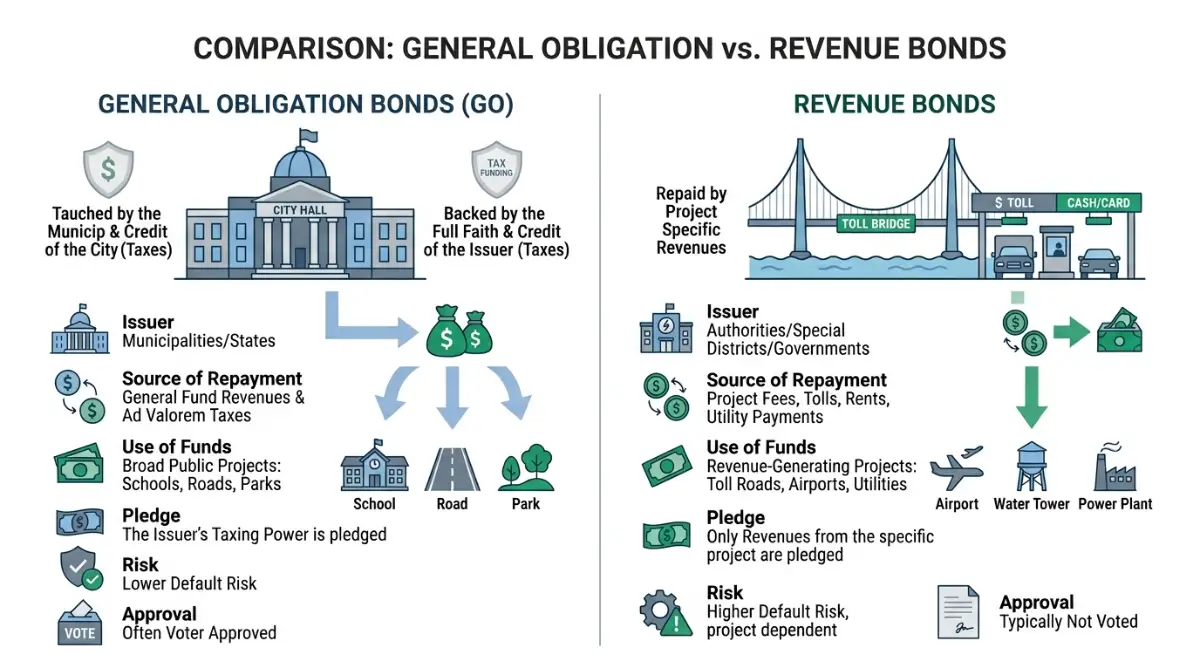
- Two Main Categories: General Obligation (GO) bonds are backed by a city’s overall tax revenues, while Revenue bonds depend on earnings from specific projects like toll roads or water utilities.
- The Math Works in Your Favor: A 4% tax-free yield puts the exact same spending cash in your pocket as a 5.7% to 6.3% taxable return from a bank or corporate bond, depending on your tax bracket.
- Simple Ways to Start: You do not need thousands of dollars to begin; you can buy low-cost municipal bond ETFs through any standard brokerage app with just a few dollars.
How Local Projects Turn Into Steady Income Streams
If you want to understand how this system actually works, you have to look at how a city manages its money. Imagine your town urgently needs a new public high school or a large water treatment facility. The local government usually does not have enough extra cash sitting in the bank to pay the construction company upfront.
Instead of waiting several decades to collect enough tax money, the town asks everyday people to lend them the cash right now. When you buy a municipal bond, you step up and become the lender for these local projects.
In exchange for your cash today, the town makes a strict legal promise to pay you back in full on a specific date in the future. Plus, they agree to pay you a steady, fixed amount of interest every year for your trouble. It is exactly like giving a direct loan to a very reliable friend, except this friend has the legal power to collect property taxes to ensure you get paid back.
From an economic and mathematical standpoint, this creates a highly stable flow of capital for everyone involved. The interest rate the city offers is usually a bit lower than what a big private corporation would pay you. However, the federal government really wants to encourage these local town improvements.
So, they offer a massive legal benefit for investors: the interest you earn from these local loans is usually completely exempt from federal income taxes. This specific tax rule changes the math entirely for people who want to save money efficiently.
Watch this short video to completely understand how local infrastructure funding works in plain English:
The Two Main Types of Local Bonds You Should Know
When you decide to lend money to a city or state, your money is not just thrown into a giant, random pile. There are strictly defined rules about how the city will gather the funds to pay you back. Understanding the exact source of your payback money is an essential part of becoming a smart investor.
The market generally splits these local loans into two major categories. Knowing the difference between them will protect your money and help you sleep better at night.
1. General Obligation (GO) Bonds
When a city issues a General Obligation bond, they are basically using their full taxing power to guarantee your money. They do not rely on just one single project to generate cash. If the city struggles to pay you your interest, they have the legal authority to simply raise property taxes or sales taxes on the residents to cover the debt.
Because the city can forcefully collect taxes to pay you back, these are considered incredibly safe. You are relying on the overall economic health and tax base of the entire city.
2. Revenue Bonds
Revenue bonds are quite different and heavily tied to one specific public project. Let us say your city wants to build a brand new toll road or expand the local airport. The city will issue a revenue bond specifically for that exact project.
The money used to pay your interest comes directly from the profits of that specific project. If it is a toll road, your interest is paid by the daily toll fees collected from drivers.
I used to think all local bonds were perfectly safe, so I blindly considered buying a few without checking the details. I quickly realized that ignoring the specific revenue source of a bond is a massive mistake; always check if the project actually makes enough daily money before you lend them a single penny.
Breaking Down the Myth of the Ultra-Rich Investor
A lot of regular people avoid looking into local government bonds because they believe a very common rumor. They think you need a massive fortune to even participate.
You do not need to be a millionaire to help fund a local hospital or a new public park. By using modern investing apps, a normal person can easily buy a small slice of a massive bond portfolio. This allows you to spread your money across hundreds of different cities, lowering your risk even further.
The Simple Mathematics of Tax-Free Returns
To truly appreciate why these local investments are so powerful, we need to look at the basic math behind taxes. When you put money into a high-yield bank account or a corporate loan, you have to pay taxes on every single dollar of interest you earn.
If your regular bank account pays you 5% interest, but you lose a large chunk of that to income taxes, your actual take-home money is much lower. This is where the magic of the Tax-Equivalent Yield (TEY) comes into play.
Tax-Equivalent Yield is just a fancy mathematical formula that helps you compare a tax-free local bond to a regular, taxable investment. It shows you exactly how much a normal bank account would need to pay you to match the tax-free money from a city bond.
Let us use a very simple example to make this clear. Imagine you are in a 30% federal tax bracket based on your daily job income. You find a highly rated municipal bond that pays a strict 4% interest rate completely tax-free.
To figure out the real value of this 4%, you divide the tax-free rate by the amount of money you keep after taxes. In this case, you keep 70% of your money (because the tax rate is 30%).
If you divide 4 by 0.70, you get roughly 5.7%.
Here is a quick look at what a flat 4% tax-free return is actually worth across different federal income brackets:
What does this specific number mean for you? It means a regular, taxable bank account or corporate bond would have to guarantee you a 5.7% interest rate just to equal the exact same spending cash you get from the 4% tax-free city bond.
This simple math proves why simply looking at the advertised interest rate on a bank website can easily trick you. You always have to calculate what you actually get to keep in your pocket after the government takes their share.
Why Checking the Credit Score of a City Matters
Just like a normal human being has a personal credit score, every city, town, and state has an official credit rating. When you apply for a bank loan, the bank checks your financial history to see if you pay your bills on time.
The financial market does the exact same thing to local governments. Independent rating agencies look closely at a city's tax revenue, their current debt limits, and their overall economic health. They then assign a simple letter grade to the city's bonds.
Understanding the grading system:
- AAA or Aaa: This is the highest possible grade. The city is incredibly wealthy, highly organized, and essentially guaranteed to pay you back on time.
- AA or A: Very strong financial health. There might be tiny economic issues, but your money is still extremely secure.
- BBB or Baa: This is considered the lowest level of "investment grade." The city is currently stable, but a bad economic recession could make it difficult for them to pay their debts.
- Junk Bonds (Below BBB): These cities are struggling heavily with debt or falling populations. They will offer you a very high interest rate to tempt you, but the risk of losing your money is a real threat.
Never lend your money based solely on a high interest rate. A struggling town might offer you an amazing 8% return, but if they go totally bankrupt next month, that promised return means absolutely nothing. Always check the official rating first.
Smart Strategies to Build a Reliable Income Stream
To turn these local government loans into a truly reliable passive income machine, you need to look beyond the basic interest rate. The professionals use very specific methods to protect their cash while maximizing what they keep in their pockets. Let us explore how you can apply these same advanced tactics to your own portfolio without feeling overwhelmed.
The Double Tax-Free Secret (The Home State Advantage)
We already discussed how lending money to a city usually protects your interest payments from federal income taxes. But what about your state taxes? If you live in a place with heavy state income taxes, you are still losing money every time an investment pays you out.
The secret here is extremely simple but highly effective: always look for projects located in your own home state. When you buy a local bond issued by your specific state or city, the interest is almost always completely free from both federal and state income taxes. Some people call this a "double tax-free" investment. If you live in a city with local income taxes, you might even get a triple tax-free benefit.
For high earners, this home-state advantage is an absolute game changer. It legally shields a huge portion of your passive income from the government. Before you buy anything, you should always check the official local debt transparency portal provided by the Municipal Securities Rulemaking Board to verify the exact tax status of the project you want to fund.
The Staircase Method (Building a Bond Ladder)
One of my biggest fears when I first started saving was locking up all my money for too long. What if I lend my cash to a city for ten years, but I suddenly need that money to buy a house in three years?
Instead of dumping all your savings into one single long-term project, smart savers use a method called "laddering." Imagine building a staircase with your money.
- Step 1: You take a portion of your cash and buy a short-term bond that pays you back in one single year.
- Step 2: You take another portion and buy one that pays back in two years.
- Step 3: You buy a third one that matures in three years, and so on.
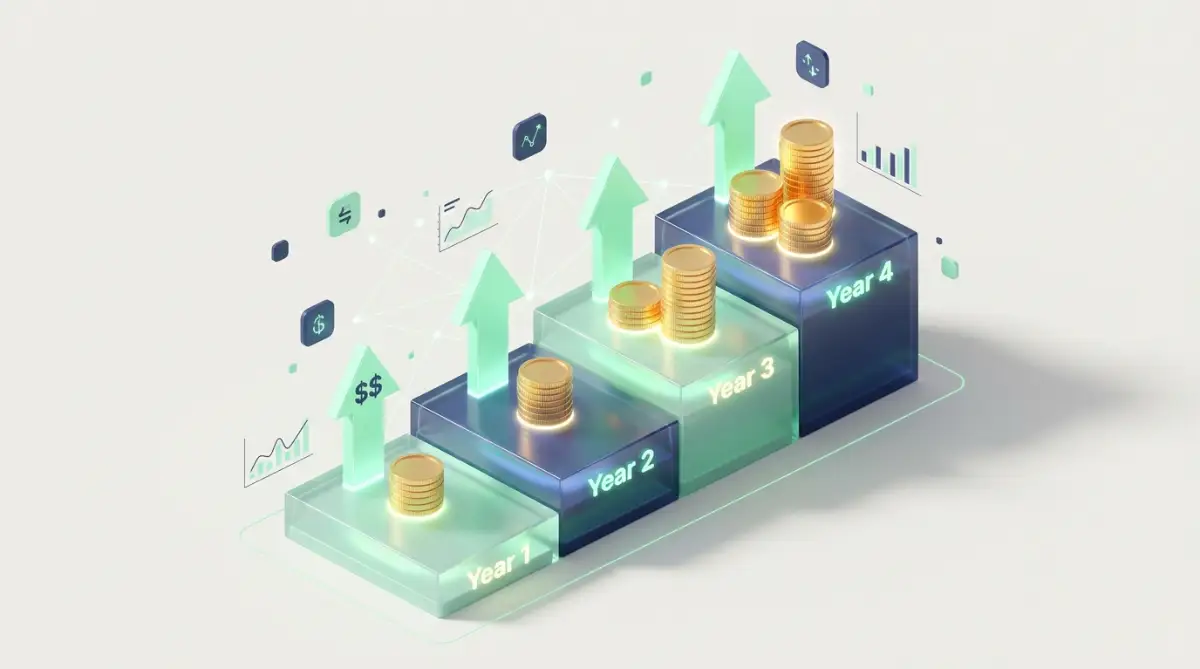
By building this financial staircase, you have cash freeing up and returning to your bank account every single year. When that one-year project pays you back, you can either spend the cash or reinvest it at the top of your ladder. This constant cycle gives you highly predictable cash flow while keeping your money flexible. Properly managing the timeline of your investments is essential; otherwise, locking up all your cash at once becomes one of the biggest financial mistakes that destroy early retirement.
Funds vs. Individual Selection
You do not have to pick individual cities by yourself. If scanning through hundreds of different local projects sounds exhausting, you can easily use an Exchange Traded Fund (ETF). These funds pool money from thousands of regular people to buy a massive collection of local government loans all at once.
This instantly spreads your risk across the entire country. If one tiny town struggles to pay its debt, your overall portfolio barely feels a thing because you own pieces of hundreds of other secure cities. Just keep an eye on the management fees, as they will eat into your tax-free profits over time. You can review regulatory guidelines on fixed-income pricing through independent financial authorities to ensure you are not paying hidden fees.
If you are trying to decide between picking individual bonds and buying a broad fund, here is my quick rule of thumb:
- Go with Individual Bonds: If you have at least $10,000 to invest, want a 100% predictable payout schedule, and plan to hold every bond all the way to its maturity date.
- Go with a Low-Cost ETF: If you are investing smaller amounts every month, want instant spread across hundreds of cities, and do not want to spend hours reading municipal financial reports.

Silent Money Traps That Catch Beginners Off Guard
Even the safest financial paths have hidden potholes. While lending money to local municipalities is generally considered extremely secure, making a blind decision can still cost you a lot of money. I have seen plenty of everyday savers stumble into these common traps simply because they did not read the fine print.
Let us break down the exact pitfalls you must avoid to keep your savings completely safe.
The Interest Rate Seesaw Effect
This is probably the most confusing trap for beginners to understand. The price of an existing fixed-income asset and the current market interest rates work exactly like a playground seesaw. When general interest rates go up, the resale value of your current investment goes down.
Imagine you lend money to a city, and they promise to pay you a 3% interest rate for the next five years. You are happy. But six months later, the economy changes, and new cities start offering a massive 5% interest rate.
If you suddenly need to sell your 3% asset to another person to get your cash back early, no one will pay you full price for it. Why would they buy your 3% asset when they can easily go buy a brand new one paying 5%? You will be forced to sell yours at a heavy discount, meaning you actually lose a chunk of your original money.
The U.S. Securities and Exchange Commission frequently warns everyday people about how changing market rates affect your principal. The simplest way to entirely avoid this seesaw trap is to just hold the investment until the final payback date. If you hold it to the very end, the temporary price drops do not matter at all. The city will still hand you back your exact original amount.
Using Long-Term Tools for Short-Term Needs
You should never put money into these local projects if you might need that cash to pay your rent next month. These are slow, steady, long-term wealth builders. If your car engine explodes or you have a sudden medical bill, selling these assets early will trigger fees and possible losses. Always make sure you build an emergency fund from scratch and keep it in a highly liquid bank account before you start locking away your extra cash in local city projects.
The Alternative Minimum Tax (AMT) Surprise
While most local government debt is free from federal taxes, there is a sneaky exception called the Alternative Minimum Tax. Some specific local projects, like funding a private airport terminal or a private sports stadium, fall under this tricky rule.
If you earn a high salary, the IRS might force you to pay taxes on the interest from these specific "private activity" projects. Before you hit the buy button, always look at the official description. It should clearly state whether it is "AMT-Free." If you ignore this tiny detail, your brilliant tax-free strategy will completely fall apart when tax season arrives.
Your Action Plan for Steady Passive Income
Getting started with these local investments does not require a finance degree or a massive wall of computer screens. It simply requires patience and a clear understanding of your own goals. You are stepping away from the chaotic daily swings of the stock market and choosing a path of slow, predictable safety.
Start by checking your current tax bracket. If the government is currently taking a large bite out of your paycheck, these tax-free assets will naturally provide you with a much higher mathematical advantage. Take a few minutes this weekend to look up projects happening right in your own state to secure that double tax-free benefit.
Remember, the goal is not to get rich overnight. The goal is to build an unbreakable financial foundation that quietly pays you cash while you sleep. Keep your emergency cash separate, build a sensible staircase with your maturity dates, and always check the credit rating of the city before you hand over your hard-earned money.
I know how incredibly intimidating it feels to move your cash out of a basic bank account and into something new. But the moment I received my first completely tax-free interest payment, my entire perspective shifted. I finally felt like I was working with the financial system instead of constantly fighting against it. You have the exact same power to take control of your financial future today.
Frequently Asked Questions by Everyday Savers
Can I actually lose my money on a municipal bond?
Yes, but the risk is incredibly low compared to the stock market. If a city goes totally bankrupt, they might default on their loan, meaning you could lose some or all of your money. This is why you should only ever buy from cities that hold a high official credit rating, like AA or AAA.
Should I buy individual bonds or just use a mutual fund?
If you are a beginner with a smaller amount of money, a mutual fund or an ETF is usually the smartest choice. It instantly spreads your money across hundreds of different cities, so you do not have to worry about one single town failing. Individual bonds are better for advanced savers who want precise control over their exact payback dates.
Do I have to report tax-free interest to the IRS?
Yes, absolutely. Even though you usually do not have to pay federal taxes on this specific interest, the IRS still requires you to report the total amount on your annual tax return. It is extremely important that you organize your financial documents like a pro and hand the correct forms to your accountant to avoid any unnecessary audits.
How long do I have to lock up my money?
The timeline is completely up to you. You can find short-term options that pay you back in just one year, or you can find long-term infrastructure projects that hold your cash for twenty years. You choose the exact timeline before you make the purchase, so always match it carefully with your personal future needs.
Disclaimer: The information provided in this article is for educational and informational purposes only and does not constitute financial, tax, or legal advice. Always consult with a certified financial advisor or tax professional before making any investment decisions to ensure they align with your personal financial situation.