
The Silent Stress of Watching Your Savings Lose Value
Leaving your hard-earned cash in a basic bank savings account right now is basically watching it lose buying power every single month. You don't have to risk your emergency cash in unpredictable stocks just to earn a fair return. By setting up a rolling Certificate of Deposit (CD) ladder, you can lock in peak interest rates while making sure a portion of your money unlocks every few months for total peace of mind.
Every single day, millions of people deal with this exact same frustration. You work hard for your money, you do the responsible thing by saving it, but the regular bank accounts give you almost nothing in return. It feels incredibly unfair.
On the other hand, the stock market can feel terrifying. You watch the news, see the red arrows dropping, and hear stories of people losing half their retirement funds overnight. If you are someone who just wants to protect your hard-earned money while getting a fair return, the traditional financial world leaves you feeling trapped.
Before we dive into the details, here’s what you need to know:
- Beat Inflation Safely: A CD ladder lets you capture top-tier fixed rates without locking all your cash away for years at a time.
- Predictable Cash Access: By splitting your money into multiple maturity dates, a portion of your funds unlocks automatically every 3 to 12 months.
- Zero Market Volatility: Unlike stocks, your initial deposit is completely protected up to federal limits when deposited in FDIC or NCUA-insured institutions.
- The Grace Period Rule: Always mark your calendar 7 days before each CD matures so the bank doesn't automatically roll your money into a low-interest default account.
Why Does Traditional Saving Feel So Unrewarding?
It is simple math, really. Regular savings accounts are designed for the bank's benefit, not yours. They take your deposits, lend them out at high rates, and hand you back fractions of a penny.
The reality is, the constant worry about money losing its value creates a background noise of stress in our daily lives. You want peace of mind. You want a system where your money works for you in the background, generating predictable cash flow without requiring you to stare at stock charts or worry about market crashes.
This is exactly why finding a middle ground is so important. We need a way to earn higher interest rates while keeping our original deposits completely safe from loss.

How Certificates of Deposit Actually Work for Regular People
Before we start building a system that generates regular cash flow, we need to understand the main tool we are going to use. Let us talk about Certificates of Deposit, commonly known as CDs.
At its core, a CD is a very straightforward agreement between you and a bank or credit union. You agree to leave a specific amount of money with them for a set amount of time. This time frame is called a term, and it can be anywhere from a few months to several years.
In exchange for promising not to touch your money during this term, the bank agrees to pay you a much higher interest rate than a regular savings account. It is a completely guaranteed return.
Think of it like renting out your money to the bank. Because they know exactly how long they will have your funds, they can confidently lend it out to others. They reward you for giving them that certainty. When the term is up (a date known as maturity), you get your original money back, plus all the juicy interest you earned along the way.
The Big Problem with Using Just One CD
While a standard CD is incredibly safe and offers great returns, it comes with a major catch. If you put all your savings into a single five-year CD to get the highest interest rate, your money is completely locked away.
What happens if your car breaks down next year? What if you need a new roof? If you try to pull your money out before the maturity date, the bank will hit you with an early withdrawal penalty. This penalty can wipe out all the interest you earned, and sometimes even eat into your original deposit.
This fear of losing access to their cash is exactly why most people avoid CDs entirely.
Here is a quick story about my own experience with this trap.
I once locked a big chunk of my savings into a single high-yield CD because the rate looked too good to pass up. But six months later, I had an unexpected medical bill and desperately needed the cash. I had to break the CD, pay a hefty penalty, and I ended up with less money than I started with. That painful mistake taught me that locking everything away at once is a terrible strategy.
Breaking the Trap with a Staggered Strategy
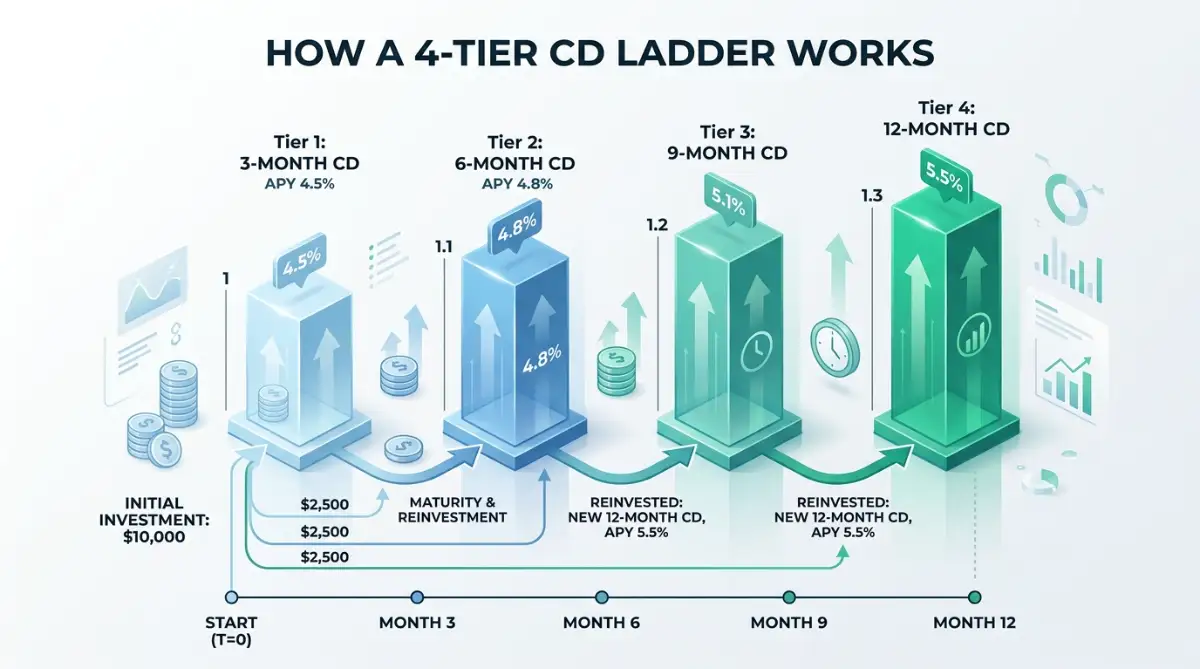
This is exactly where the concept of a ladder comes into play. Instead of putting all your eggs in one basket, you split your money up. You buy several different CDs with different maturity dates.
By staggering the dates when your money becomes available, you create a continuous cycle. Every few months, or every year, one of your CDs will mature.
This gives you a powerful combination: you get the high interest rates of long-term investments, but you also get regular access to your cash without paying any penalties.
Watch this quick explanation of how different terms give you different rates over time:
Real-Life Math: How a $10,000 CD Ladder Actually Pays Out
Here is a practical breakdown of how you can split a $10,000 deposit across four separate terms to generate predictable income without losing access to your cash:
By following this rotation, you receive access to $2,500 plus interest every 90 days. Once the first full year completes, every single bucket is earning the highest long-term interest rate while maintaining quarterly liquidity.
Setting Up Your First Passive Income Cycle
Building this structure is a lot like planting a continuous garden. If you plant all your seeds on the exact same day, all your vegetables will be ready at the same time. You will have too much food for one week, and nothing to eat for the rest of the year.
But if you plant a few seeds every single month, you will have fresh food available to harvest all year round. A CD ladder works exactly the same way with your cash.
Let us look at a simple comparison to see why this method stands out from the rest.
The Magic of Rolling Over
The true power of this system happens when you reach your first maturity date. Let us say your shortest-term CD finally ends. You now have a choice.
If you need the cash for an emergency or a big purchase, you can simply take it. You have full access without a single penalty.
But if you do not need the money, you take that original deposit, plus the interest it just earned, and you buy a brand new long-term CD. You place it at the very back of your line.
As you keep doing this over time, eventually, all of your money will be earning the absolute highest long-term interest rates. Yet, because of how you spaced them out initially, you will still have a portion of your money unlocking on a regular schedule.
Pro-Saver Rule: The 30-Day Emergency Buffer
Before putting a single dollar into a CD term, I always recommend keeping at least one month of living expenses in a standard checking or high-yield savings account. A CD ladder is designed for your secondary reserves and passive earnings, not your immediate grocery or rent money. Keeping this small cash cushion completely eliminates the temptation to break a CD early.
Myth vs Reality: The Lock-Up Fear
The Common Myth: Setting up a CD system means tying up all your hard-earned cash for years, leaving you helpless during an emergency.
The Actual Reality: A properly built ladder actually increases your cash flow. By having funds mature every 3, 6, or 12 months, you always have a guaranteed payday just around the corner. It acts as an automatic, interest-generating emergency fund.
To make this work perfectly, you need to follow a specific, logical sequence. You cannot just guess the amounts or pick random dates. You have to evaluate your own life, understand your cash flow needs, and choose the right bank accounts to match your goals.
In the next steps, we will outline exactly how to divide your money, how to pick the right terms, and how to automate the whole process so you never have to think about it again.
Strategies to Supercharge Your Cash Flow
Once you understand the basic mechanics of staggering your maturity dates, it is time to look at how experts maximize their returns. Building a system is just the first step. Managing it smartly is where the real wealth generation happens.
Many people set up their accounts and completely forget about them. While passive income is supposed to be hands-off, completely ignoring your accounts can cost you a lot of money over time. You want to be strategic about where your money lives and how it grows.
One of the best professional habits is mixing your financial institutions. You do not have to keep all your money at the local brick-and-mortar bank down the street. In fact, online banks and credit unions typically offer much higher interest rates because they do not have to pay for huge physical buildings.
By spreading your deposits across a few trusted online platforms, you can hunt for the absolute best rates for each specific term. Always ensure that the institution you choose is fully backed by the federal government. Keeping your money protected under standard Federal Deposit Insurance Corporation (FDIC) insurance guidelines guarantees that even if the bank fails, your original deposit and earned interest are completely safe up to the legal limits.
The Barbell Method for Changing Markets
Interest rates are always moving up and down based on what the economy is doing. A standard, evenly spaced system works wonderfully, but sometimes you need to adapt to the current environment.
This brings us to a slightly more advanced concept called the "barbell" approach. Imagine a weightlifting barbell: heavy on both ends and empty in the middle. Instead of buying a one, two, three, and four-year term, you divide your cash differently. You put half of your money into very short-term accounts (like three or six months) and the other half into very long-term accounts (like five years).

Why this works in real life:
- When rates are going up: Your short-term accounts mature quickly, allowing you to grab the newly available higher rates immediately.
- When rates are going down: Your long-term accounts are already locked in at the older, much higher rates, protecting your income stream from dropping.
Before you start experimenting with advanced methods, you always need to ensure your basic safety net is secure. A staggered savings plan is an amazing tool, but it should not replace the cash you might need tomorrow. Make sure you take the time to build an emergency fund from scratch and keep those specific funds in a totally liquid, easily accessible checking or high-yield savings account.

The Silent Wealth Destroyers (Mistakes to Avoid)
Even with the safest financial tools on the planet, things can still go wrong if you are not paying attention. I have seen incredibly smart people lose hundreds of dollars simply because they missed a single piece of mail or misunderstood the fine print.
Let us look at the most common traps that catch everyday savers off guard.
The Auto-Renew Trap
This is arguably the most dangerous pitfall in fixed-income investing. When your term officially ends, the bank will usually send you a letter or an email giving you a short window to move your cash. This window is called the grace period, and it usually lasts about ten days.
If you ignore that notice or simply forget about it, the bank will automatically renew your money into a brand new term of the exact same length.
Here is the heartbreaking part: they rarely give you the great promotional rate you had before. Instead, they often drop you down to their standard, embarrassingly low interest rate. You could easily end up locking your money away for another two years earning practically zero interest.
Always set a loud, annoying calendar reminder on your phone a week before your maturity date. You must be the one deciding where your money goes next, not the bank. If you want to understand exactly how banking disclosures work in these situations, reading through official Securities and Exchange Commission (SEC) guidelines on banking products can help you read the fine print like a professional.
Raiding the Cookie Jar Early
We talked earlier about the painful penalties associated with breaking your agreement early. However, many people still underestimate just how harsh these fees can be.
Banks do not just take away a portion of your interest; they calculate the penalty based on a specific number of months.
A Real-Life Warning Scenario:
Let us imagine you open a five-year term because the rate is incredibly attractive. After just three months, your car engine explodes, and you desperately need that cash. When you ask the bank for your money back, they apply a "six months of interest" penalty.
Because you only earned three months of interest so far, the bank will actually dip into your original deposit to cover the rest of the penalty. You will walk away with less money than you originally put in.
This destroys the whole point of a safe investment. You should only ever lock away funds that you are absolutely certain you will not need. Treating these accounts like a regular checking account is one of the biggest financial mistakes that destroy early retirement dreams. Always respect the timeline you agreed to.
Your Action Plan for Guaranteed Cash Flow
You now hold the blueprint for a financial system that generates highly predictable, completely secure passive income. You no longer have to settle for the terrible rates of a traditional savings account, and you do not have to lose sleep worrying about stock market crashes.
By breaking your savings into smaller pieces, staggering their end dates, and continuously rolling them over into higher long-term rates, you force your money to work incredibly hard for you.
Your Final Checklist for Success:
- Take a close look at your finances and create a monthly budget that actually works so you know exactly how much idle cash you can safely lock away.
- Divide that idle cash into three or four equal chunks.
- Shop around at reputable online banks for the best current rates.
- Buy your initial terms (for example: 6-month, 12-month, 18-month, and 24-month).
- Set digital calendar alerts for every single maturity date so you never fall into the auto-renew trap.
I remember exactly how amazing it felt when my very first twelve-month account matured. The interest had piled up perfectly, the cash was fully available, and my financial anxiety completely disappeared. Start small today, stay consistent, and watch how quickly this simple system builds real momentum in your life.
Frequently Asked Questions About Smart Saving
Is a staggered strategy better than a high-yield savings account?
They actually serve two different purposes. A high-yield savings account is perfect for cash you might need tomorrow, while a staggered strategy locks in higher rates to protect you when general interest rates drop. Using both tools together gives you the best mix of daily flexibility and long-term guaranteed growth.
Can I actually lose my original money in this system?
No, your original deposit is completely safe as long as you use a federally insured bank and you do not withdraw your money before the agreed term ends. The only way you lose money is through an early withdrawal penalty, which is completely avoidable with careful planning.
Do I have to pay taxes on the interest I earn?
Yes, the money you make from these bank accounts is generally considered taxable income. At the end of the year, your bank will send you a 1099-INT form showing your total earnings, which you must report when filing. You can review the exact rules regarding this on the official IRS interest income page to ensure you are fully prepared for tax season.
How much money do I need to get started?
You do not need to be wealthy to begin. While some banks require larger deposits, many top-tier online banks allow you to open these accounts with as little as a few hundred dollars. You can easily start a small system today and add more money as your savings grow over time.
Disclaimer: The information provided in this article is strictly for educational and informational purposes. It does not constitute formal financial, legal, or tax advice. Personal financial situations vary greatly. Always consult with a certified financial advisor or tax professional before making significant decisions with your savings.