
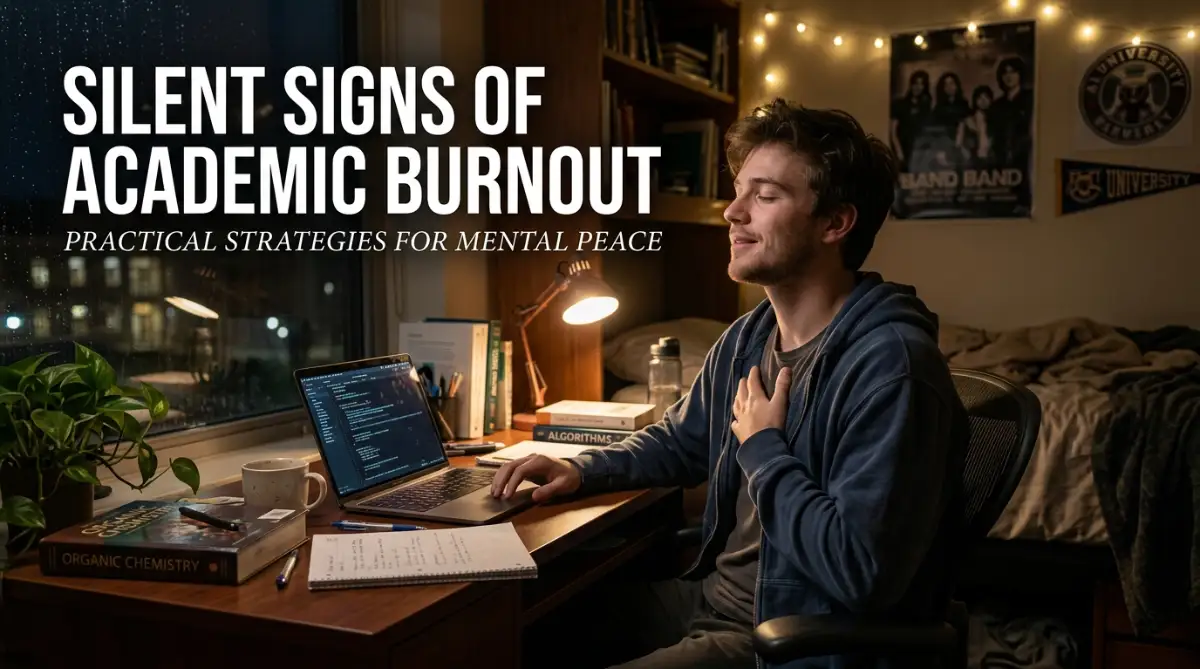
When The Weight of Books Breaks Your Spirit: My Personal Wake-Up Call
I still remember the exact morning my mind completely gave up on me. My alarm was ringing loudly, yet I just lay there staring at the ceiling, feeling completely numb.
I had a massive assignment due in just a few days, but I couldn't bring myself to care anymore. My heart felt incredibly heavy, and a strange wave of sadness washed over me for absolutely no reason.
For weeks, I had been surviving on cheap coffee, very little sleep, and the fear of failure. I kept telling myself that I just needed to push a little harder to get through the semester.
But my body had a completely different plan. That morning, I dragged myself to my study desk, opened my laptop, and instantly started crying uncontrollably.
I wasn't just feeling lazy or a little tired from studying too much. I was completely empty inside, and my passion for learning had turned into pure anxiety.

This is the harsh reality that so many students face every single day. We're taught to chase good grades at all costs, but nobody tells us how to handle the emotional collapse that follows.
You wake up every morning feeling like you ran a marathon in your sleep. The subjects you used to love now feel like massive walls closing in on you.
Your mental peace completely disappears, replaced by a constant, quiet voice whispering that you're falling behind. This invisible pressure slowly steals your joy, making you irritable around your friends and family.
You start canceling plans, avoiding phone calls, and locking yourself in your room just to stare at a blank screen. The worst part is the massive guilt you feel for not being productive while resting.
You can't study because you're exhausted, but you can't rest because you feel guilty for not studying. This endless cycle destroys your daily life, leaving you feeling entirely disconnected from the world around you.
Many people think this is just a normal part of student life. But accepting this level of emotional pain as "normal" is exactly why so many bright minds simply give up.
Your mental health is slowly bleeding out, and the signs are so quiet that you might not even notice them until you crash. It's time we start talking about these silent red flags before they cause permanent damage to your self-esteem.
The Invisible Red Flags You're Probably Ignoring
Burnout doesn't happen overnight like a sudden storm. It creeps into your life very slowly, disguising itself as regular everyday tiredness.
At first, you might just think you need an extra cup of coffee in the afternoon. But soon, you realize that no amount of caffeine can fix a tired soul.
Let me break down exactly what happens when your brain is screaming for a break. If you catch these signs early, you can stop the damage before it gets completely out of control.
Physical Signs That Your Body Is Screaming
The mind and body are deeply connected. When your brain is overloaded with stress, your body takes the hit.
- Unexplained Headaches: You start getting dull, throbbing pain right behind your eyes after just a few minutes of reading.
- Constant Stomach Issues: Stress creates massive amounts of acid in your stomach, leading to random cramps and nausea.
- The "Heavy" Feeling: Your arms and legs feel like they weigh a hundred pounds when you try to get out of bed.
Emotional Numbness and Constant Anger
Academic exhaustion completely changes your personality over time. You stop acting like your normal, cheerful self.
You might find yourself snapping at your parents for simply asking how your day went. Tiny inconveniences, like dropping a pen or losing internet connection, suddenly make you want to cry.
This emotional roller-coaster happens because your brain has no energy left to regulate your feelings. You're running on empty, and even a small push can make you completely break down.
The "Brain Fog" Phenomenon
Have you ever read the same paragraph five times and still have no idea what it says? That's called brain fog.
Your memory starts slipping, and you forget simple things like where you put your keys or a basic formula you've known for years. Focus becomes completely impossible.
You sit at your desk for six hours, but you only get about twenty minutes of real work done. This lack of focus creates even more stress, putting you back into the toxic cycle of guilt.
Myth vs Reality: Breaking The Toxic Productivity Mindset
Before we jump into the actual solutions, we need to clear up some dangerous lies. Society has planted some highly toxic ideas into our heads about what it means to be a "good student".
Rebuilding Your Mind: Science-Backed Healing Strategies
We've talked enough about the pain. Now, let's focus entirely on how to pull yourself out of this dark hole.
You don't need a magical pill or a completely new personality to fix this. You just need to build a few simple, highly protective habits into your daily routine.
These steps are designed to be extremely easy so that you can start applying them right this second. Let's rebuild your mental peace, one small brick at a time.
Step 1: Mastering The Art of Guilt-Free Breaks
The biggest mistake you can make right now is trying to force your way through the exhaustion. Your brain is a muscle, and just like your legs after a long run, it desperately needs a break.
But I'm not talking about taking a break where you scroll through social media for an hour. Looking at a screen during a study break doesn't let your brain rest at all.
Instead, you need to practice low-dopamine rest. This means doing activities that don't constantly stimulate your brain with bright lights and fast information.
Go for a slow walk outside without taking your phone with you. Stare at a tree, stretch your arms, or just lie down on your bed with your eyes closed for ten minutes.
When you remove digital stimulation, your brain gets a chance to truly breathe. You'll be amazed at how much energy returns to your body after just twenty minutes of real silence.
Pro Tip: I used to think playing video games was a good study break, but I always felt more exhausted afterward. I finally realized that replacing one glowing screen with another was frying my brain. Now, my golden rule is: if I'm resting, my phone is completely out of sight.
Step 2: Setting Hard Boundaries With Your Study Space
Your brain is incredibly smart, and it constantly builds associations with your physical environment. If you study in your bed, your brain starts associating your bed with intense stress and anxiety.
This is exactly why you can't fall asleep at night. Your brain thinks your bed is a workplace, not a resting place. You must separate your relaxing zones from your working zones. Even if you live in a tiny room, create a specific corner just for your books and laptop.
When you're sitting in that specific chair, you study. But the moment you stand up and step away, work is officially over.
Don't bring your flashcards to the dinner table. Don't read your notes while lying on the couch. Creating these physical boundaries sends a clear signal to your nervous system. It tells your body when it's time to panic, and more importantly, when it's safe to finally relax.
Step 3: Changing How You View "Failure"
A massive part of academic exhaustion comes from a deep, hidden fear of not being good enough. We tie our entire self-worth to a single letter grade on a piece of paper. If we get an 'A', we feel worthy of love and respect. If we get a 'C', we feel like complete failures who have ruined our entire future.
This perfectionism is a heavy chain around your neck. You need to untie your personal value from your academic performance. A bad grade simply means you didn't understand a specific topic on a specific day. It doesn't mean you're stupid, and it certainly doesn't define your future success.
"Sometimes, doing your best just means surviving the day. And that's perfectly okay."
Step 4: The Reverse Planning Method for Lower Stress
Usually, we write down a massive to-do list in the morning and feel terrible when we only finish half of it. Long to-do lists actually trigger the anxiety centers in your brain before you even start working.
Instead, try the Reverse Planning technique. Start by scheduling your fun activities, your meals, and your sleep first.
Block out the time you want to spend watching a movie or talking to a friend. Once your rest time is strictly protected on your calendar, you can fit your study sessions into the remaining gaps.
This completely changes your mindset from "I have to study all day" to "I only have three hours to study before my movie night". It naturally forces you to be highly focused during those few hours.
Knowing that a guaranteed reward is waiting for you at night makes the hard work feel much lighter. You stop feeling like a prisoner to your textbooks.
Step 5: Feeding Your Brain The Right Fuel
When you're stressed, your body heavily craves sugar and junk food. You reach for cookies, chips, and energy drinks because they give you a fast feeling of happiness. But this creates a massive blood sugar spike, followed by a terrible crash. That crash makes your brain fog worse and drains whatever tiny bit of motivation you had left.
Your brain needs very specific nutrients to repair the damage caused by heavy stress. Drinking enough water alone can clear up half of the headaches you experience during study sessions. Keep a bottle of water right next to your desk at all times. Snack on natural foods like nuts, bananas, and dark chocolate to keep your energy perfectly stable throughout the afternoon.
You don't have to follow a strict diet. Just make sure you're not trying to drive a car with a completely empty gas tank.
Step 6: Finding Your Support System
One of the most dangerous things about mental exhaustion is how deeply lonely it makes you feel. You start believing that you're the only person struggling while everyone else is doing perfectly fine.
But I promise you, the student sitting next to you in class is probably fighting the exact same silent battle. We're all just pretending to have our lives perfectly figured out.
Reach out to a friend and just say, "Hey, I'm feeling really overwhelmed lately." You don't need them to fix your problems.
Just saying the words out loud takes away so much of their power over you. Sharing your struggle instantly cuts the heavy weight of anxiety right in half.
If things are getting incredibly dark, there is absolutely no shame in talking to a school counselor or a therapist. Seeking help isn't a sign of weakness; it's the ultimate proof that you're brave enough to want a better life.
Reclaiming Your Right to a Happy Life
You're a human being first, and a student second. No exam, no assignment, and no degree is worth completely destroying your mental health.
The books will always be there tomorrow. The deadlines can be managed, and the grades can always be improved over time.
But you only get one mind, and you have to protect it fiercely. Start taking small steps today to rebuild your energy and rediscover your peace.
Remember, true success isn't just about crossing the finish line. It's about actually being healthy enough to enjoy the victory when you finally get there.
Mastering Your Mind: Next-Level Habits for Long-Term Peace
Getting out of a severe slump is only the first part of the battle. Staying out of that dark place requires a completely new approach to how you handle your daily routine.
Many students feel better for a week, push themselves too hard again, and immediately crash right back into severe anxiety. To stop this cycle, you need to change how you view your own personal energy.
Think of your daily energy like managing a tight monthly budget. Every single decision you make, from choosing your outfit to worrying about an upcoming presentation, spends a little bit of that mental currency. If you spend it all by noon, your brain simply shuts down for the rest of the day.
The Magic of "Micro-Journaling" Your Stress
You probably already know that writing down your feelings is a great way to relieve pressure. But sitting down to write a massive diary entry can feel like just another heavy chore on your to-do list. Instead, try a concept called micro-journaling. Keep a tiny notebook on your desk, and whenever a stressful thought pops into your head, write it down in exactly one single sentence.
You don't need to solve the problem right then and there. Just the physical act of moving that thought from your brain onto a piece of paper tricks your nervous system into letting it go.
Your brain isn't an endless hard drive. Much like figuring out why you forget what you study, your mind desperately needs secure boundaries and regular mental cleanups to function properly. By writing these thoughts down, you're clearing out your mental RAM. This leaves so much more room for actual learning and deep focus.
The 80/20 Rule for Academic Survival
Perfectionism is the absolute biggest enemy of a healthy student. We often waste hours trying to make an assignment 100% perfect, completely draining our energy in the process. The truth is, 80% of your academic results come from just 20% of your actual effort. Figuring out what truly matters in your syllabus is a massive game-changer for your mental health.
Don't read every single page of a textbook if the professor only tests you on the bolded keywords and lecture slides. Learn to study smart, not exhaustively.
According to mental health experts, understanding the physical impact of chronic stress helps you realize that pushing for absolute perfection physically damages your immune system. Good enough is almost always good enough. Protecting your physical health will always give you a better return on investment than fighting for one extra point on a quiz.
Treat Your Brain Like High-End Technology
We expect our bodies to perform like machines, working perfectly for twelve hours straight with zero maintenance. But even the most expensive machines in the world need time to cool down.
Just like you'd actively manage your time and resources when trying to write a university research paper, you must recognize when your own internal temperature is running too hot.
When your eyes start burning and your thoughts start looping, that's your internal warning light flashing bright red. Don't ignore it.
Shut the system down, walk away from the desk, and give yourself a mandatory reset.

The Dangerous Traps That Make Exhaustion So Much Worse
When we're desperate to feel better, we often make highly impulsive decisions that actually deepen the damage. The path to recovery is filled with hidden traps that are incredibly easy to fall into.
I want to walk you through some of the most common pitfalls I see students making every single semester. Avoiding these specific mistakes will save you weeks of unnecessary emotional pain.
Masking The Pain With Artificial Energy
The absolute worst thing you can do to an exhausted nervous system is flood it with caffeine and energy drinks. You might feel a fake rush of power for an hour, but you're essentially borrowing tomorrow's happiness to pay for today's tasks.
When that artificial energy wears off, the crash is absolutely devastating. Your heart races, your hands shake, and your baseline anxiety goes through the roof.
Medical professionals consistently warn that excessive caffeine intake directly mimics the physical symptoms of clinical anxiety. You're literally drinking a chemical that tells your body it's in extreme danger. Instead of reaching for a fourth cup of co