
The Silent Math That Controls Your Financial Freedom
Ever pay off your credit card balance in full, check your score the next morning, and watch it mysteriously drop 30 points? You aren't alone, and you didn't do anything wrong. Banks run an invisible math game called credit utilization—and if you don't know the exact day they take their balance snapshot, your score will keep taking unearned hits. Here is the simple playbook I use to keep my score climbing without spending an extra dime.
This hidden trap catches hard-working people every single day. You probably know the feeling of doing your absolute best to manage your money, only to get an email saying your score went down. It makes no sense at first. You pay what you owe, so why is the bank punishing you?
The answer almost always points back to a misunderstood number. It is not about how much money you make. It is entirely about how much of your available limit you are using at a specific moment in time. Once you see the strings pulling the system, the game becomes surprisingly easy to win.

⚡ Fast Summary: What You Need to Know
- The Snapshot Rule: Credit bureaus do not look at what you owe on your due date; they record your balance on your statement closing date.
- The Single-Card Trap: Maxing out even one small credit card will tank your score, even if your overall total limit is wide open.
- The Sweet Spot: The most effective utilization ratio for elite credit scores sits between 1% and 9% (avoid leaving all cards at exactly $0).
- The Friday Pay Trick: Making small payments every Friday keeps your balance consistently low, so the bank's surprise monthly snapshot is always positive.
The Hidden Mechanics Behind Your Score
To fix a problem, we first need to understand the simple math behind it. The banks use a very specific formula to judge your reliability. They take the total amount you owe on your cards and divide it by your total available limit.
Imagine you have a single card with a $1,000 limit. If you buy groceries and gas, and your balance reaches $300, you are using 30% of your available limit. This percentage is the core of the entire system. Banks look at this number to decide if you are a safe bet or a risky borrower.
But why do they care so much? To a bank, a person who maxes out their limit looks desperate for cash. Even if you plan to pay it off completely on payday, the computer algorithm cannot see your intentions. The system only sees the raw numbers on the screen. When your balance creeps up toward your maximum limit, the algorithm automatically labels you as a high-risk customer.
This is where the psychology of lending comes in. Lenders want to see that you have access to a lot of money, but you are disciplined enough not to spend it all. Having self-control is the greatest signal of financial health.
Watch This Quick Explanation
If you want to see exactly how these numbers are calculated behind the scenes, this short breakdown will completely change how you view your limits.
The Per-Card Trap Nobody Explains
Most people think the system only looks at the total big picture. While your overall numbers matter, there is a silent killer lurking in the shadows. Lenders also look at the limits on every individual card you own.
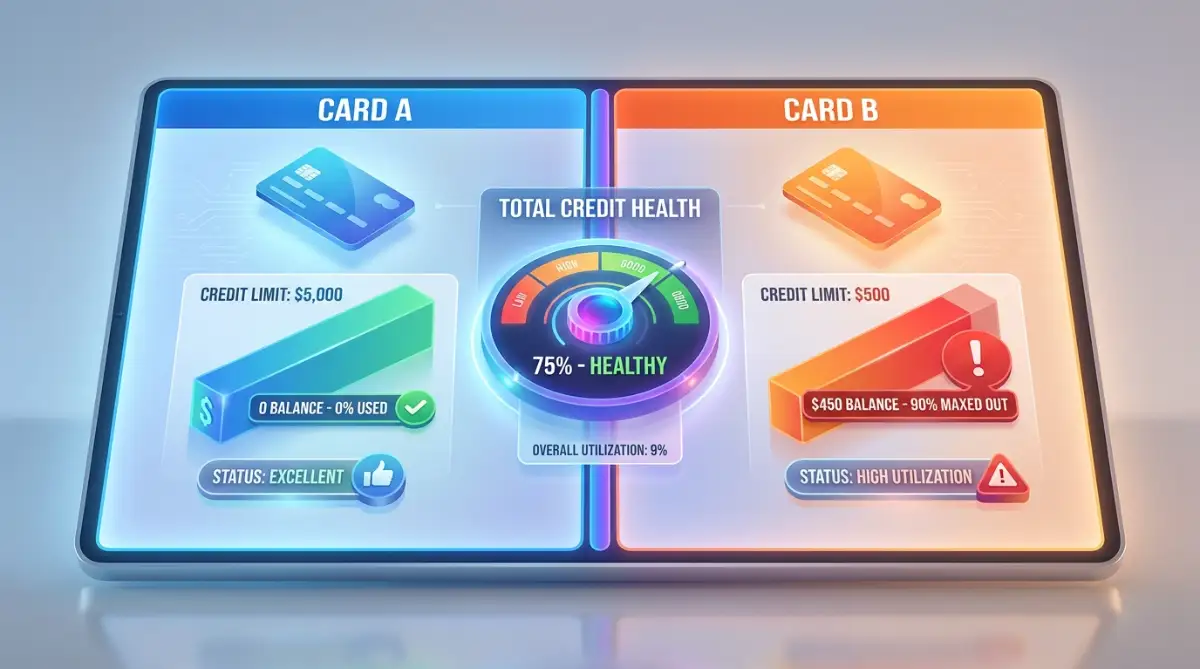
Let me explain. Suppose you have two cards. Card A has a $5,000 limit and a zero balance. Card B has a $500 limit, and you just spent $450 on it. Your overall math looks great because you have $5,500 in total limits and only owe $450. However, Card B is 90% maxed out.
The algorithm sees that single maxed-out card and hits the panic button. Your score takes a massive hit, even though you have plenty of room on the other card.
I learned this the hard way during a holiday season. I put all my shopping on my smallest card to earn specific rewards, leaving my large cards completely empty. I quickly realized that spreading out small charges across multiple cards keeps the individual ratios low and makes the scoring algorithms happy. It was a simple shift in my spending habits, but it changed everything.
The Snapshot Secret The Banks Hide
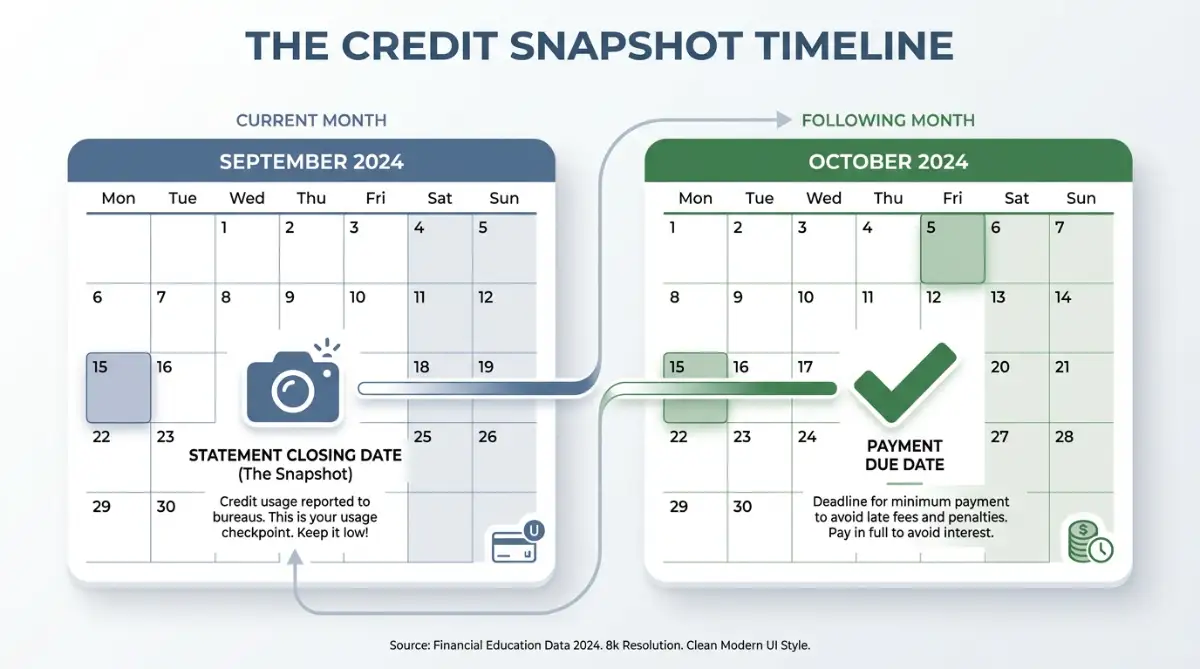
Here is the most important concept you will read today. The biggest point of confusion for most people is the difference between their payment due date and their statement closing date.
Think of the credit bureaus like a teacher taking attendance in a classroom. The teacher (the credit bureau) takes attendance exactly when the bell rings. This moment is your statement closing date. If you are not in your seat, you are marked absent. It does not matter if you walk into the classroom five minutes later. The record is already set.
Most people pay their bill on their due date. However, the bank usually reports your balance to the bureaus a few weeks before that, on the statement closing date.
If you spend $800 on a $1,000 card, the bank takes a snapshot of that $800 and reports it. Even if you pay the entire $800 down to zero on your due date, the credit bureau still thinks you are using 80% of your limit. Your score drops, and you are left wondering what went wrong.
To beat this system, you just need to change your timing. If you pay your balance down two days before the statement closes, the snapshot will capture a tiny balance. You still pay no interest, but now the algorithm sees you as a low-risk borrower.
Here is a simple breakdown of how statement timing impacts the balance reported to credit bureaus:
Myth vs Reality in Credit Math
There is a lot of bad advice floating around the internet. Friends, family, and online forums often repeat old rules that simply are not true anymore. Let us clear up the confusion.
- Myth: You need to leave a 30% balance to build good history.
- Reality: 30% is not a goal; it is an absolute maximum limit. You should never aim to hit 30%. The true sweet spot for top-tier scores is keeping your balances between 1% and 9%.
- Myth: Keeping a balance of exactly $0 is the best way to get a perfect score.
- Reality: Having a 0% ratio across all cards can actually hurt you slightly. The algorithm needs to see that you are actively using the accounts. Leaving a tiny balance like $10 on one card when the statement closes shows active, responsible use.
How to Instantly Improve Your Math
Now that we know how the machine works, we can take control of it. You do not need to earn more money to fix your ratio. You just need to organize the money you already have.
One incredibly effective trick is making multiple small payments throughout the month. Instead of waiting for one big bill at the end of the month, try paying your card off every single Friday. By treating your card like a debit card that gets paid down weekly, your balance never has the chance to grow large. When the bank takes their surprise snapshot, they will always find a nice, small number.
Another highly effective method is simply asking for a bigger limit. If you have been a good customer for a few months, you can call your bank and request a credit limit increase.
If they raise your limit from $1,000 to $3,000, and you still only spend $300 a month, your ratio magically drops from 30% down to 10%. You did not spend a single penny to get this improvement. You just changed the invisible math in your favor.
Copy-Paste Phone Script to Request a Limit Increase (Without a Hard Credit Pull):
"Hi! I've had my card for over six months with a perfect on-time payment record. I would like to request a credit limit increase from $1,000 to $3,000 to help keep my credit utilization low. Before we proceed, could you please confirm if this request can be completed using a soft pull that won't impact my credit score?"
Understanding these hidden rules gives you a massive advantage. You stop guessing and start playing the game exactly how the banks want you to play it. Taking control of your limits is the very first step toward building the financial confidence you deserve.
Next-Level Habits to Control Your Credit Math
Once you understand how the system takes snapshots of your balances, you can start using advanced strategies to keep your numbers looking perfect. Building a top-tier financial profile is not about working harder. It is all about working smarter with the limits you already have.
One of the most powerful secrets in the banking world is the authorized user strategy. If you have a family member or a partner with a long, perfect payment history and a massive credit limit, they can add you to their account as an authorized user. You do not even need to hold their physical card or spend their money.
The moment you are added, their large available limit appears on your personal report. This immediately increases your total available credit. Because your total limit goes up, your overall utilization percentage automatically goes down. The Consumer Financial Protection Bureau (CFPB) notes that understanding these reporting rules can give consumers a major advantage in managing their overall credit health.
Another highly effective habit is setting up custom balance alerts. Most banking apps allow you to receive a text message whenever your balance goes over a certain amount. Set this alert for 10% of your total limit. Whenever your phone buzzes with that alert, it is your signal to log in and make a quick mid-cycle payment.
If you are currently feeling overwhelmed by multiple balances, managing your ratios might seem impossible right now. In this situation, your first priority should be learning how to destroy high-interest credit card debt fast. Getting rid of expensive debt frees up your cash flow, making it much easier to control your limits in the future.
Finally, a truly smart borrower knows the exact statement closing date for every single account they own. Write these dates down on a calendar or put them in your phone. Make it a strict habit to pay your current balance down to almost zero two days before that specific date. This ensures the credit bureaus always see you at your absolute best.

The Hidden Traps That Destroy Hard Work
Even smart, careful people fall into invisible traps when managing their finances. The saddest part is that these mistakes often happen when you are actively trying to do the right thing.
The most common and devastating mistake is closing an old, unused credit card. Many people look at their wallets, see a card they have not used in months, and decide to close the account to be responsible. They think they are decluttering their financial life. In reality, they just shot themselves in the foot.
When you close a card, you instantly wipe out that available limit from your total math. Imagine you have two cards with $5,000 limits, giving you a total limit of $10,000. If you owe $2,000, your ratio is a very safe 20%. Now, you close one card because you never use it. Your total limit drops to $5,000, but you still owe that $2,000. Your ratio instantly shoots up to 40%. You did not spend an extra dime, but your score drops overnight because the algorithm sees you as a higher risk.
To keep your older accounts active without risking overspending, try a simple trick. Put one small, recurring monthly subscription on that old card—like your favorite streaming service. Then, set up an automatic payment to clear that small balance every month. The card stays active, your total limit stays high, and your ratio stays comfortably low.
Another massive pitfall is believing that carrying a balance from month to month helps your score. This is an expensive myth. You do not need to pay interest to build a strong history. Paying your statement balance in full every single month is the smartest way to show lenders you are reliable. If a previous mistake has already hurt your profile, there are safe ways to fix a damaged credit score by focusing on exactly how lenders report your daily habits.
Your Blueprint for a Healthier Financial Future
Taking control of your invisible credit math does not require a degree in finance. It just requires a slight change in your daily habits. You now know that the system watches your balances, takes unexpected snapshots, and judges you based on how much of your limit you use.
Instead of being afraid of your cards, you can now use them like tools.
Your Action Plan for Tomorrow:
- Log into your banking app and find your statement closing date, not just your due date.
- Set a calendar reminder for three days before that closing date.
- If your accounts are in good standing, call your bank and politely ask for a limit increase.
- Never close your oldest accounts, even if they sit safely in a drawer.
By applying these simple steps, you strip away the mystery and take the power back from the banks. You make the algorithm work for you, rather than against you. According to guidelines from the Federal Reserve Board, consistent, responsible use of available credit is a primary indicator of long-term financial stability.
I spent years feeling confused and anxious every time I checked my financial profile. Once I finally started paying attention to my statement dates instead of my due dates, my score steadily climbed without me having to earn an extra penny. My biggest hope is that you use these exact same tricks to unlock the financial confidence you truly deserve.
Frequently Asked Questions About Credit Limits
Does paying my bill early actually help my score?
Yes, but timing is everything. Paying your bill before the statement closing date reduces the balance that gets reported to the bureaus. This keeps your reported utilization incredibly low, which directly boosts your score.
Will requesting a higher limit hurt my credit?
Sometimes, a bank will perform a "hard pull" on your report to approve an increase, which might drop your score by a few points temporarily. However, the long-term benefit of having a higher limit usually outweighs that tiny, temporary dip.
Do charge cards have a utilization ratio?
Traditional charge cards do not have a preset spending limit, so they generally do not factor into your overall utilization math. However, the balance you owe on them is still reported and can affect other parts of your financial profile.
Disclaimer: The information provided in this article is for educational and informational purposes only and should not be construed as professional financial advice. Always consult with a certified financial advisor or a qualified professional before making major decisions regarding your debt, loans, or personal finances.