
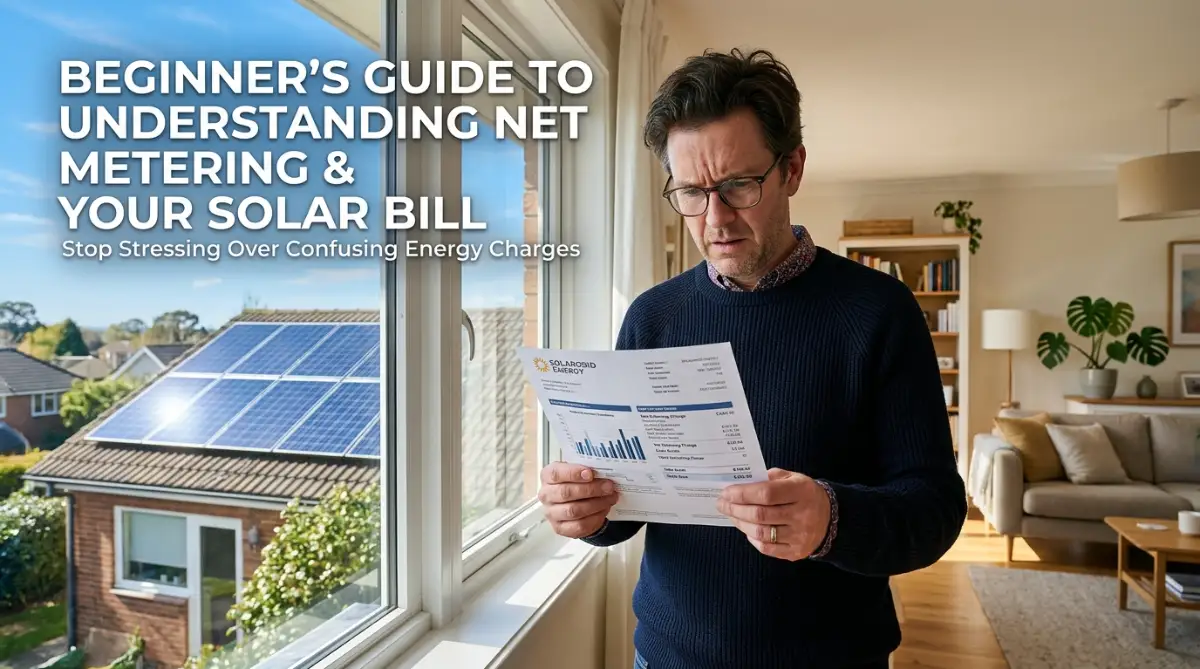
You open your first post-solar electric bill expecting a clean zero. Instead, you're hit with negative signs, mysterious interconnection fees, and an actual balance due.
Your panels didn't fail. The power company just didn't explain the rules.
Net metering isn't magic. It's a strict two-way accounting swap between your roof and the street.
Quick Summary: Decoding Your Solar Bill
-
Your Meter Runs Both Ways: You aren't storing night power on your roof; you're trading midday sunshine for digital utility credits.
-
The "Zero Balance" Myth: Mandatory connection fees and grid taxes ensure you'll always owe a small monthly administrative fee.
-
Time-of-Use Crushes Daytime Credits: Peak evening rates can wipe out hours of cheap afternoon generation unless you shift heavy loads.
-
True-Up Reckoning: Annual settlements pay you pennies at wholesale rates for excess credits, so never oversize just to sell power back.
Why My First Solar Statement Felt Like a Complete Betrayal
I still remember the exact moment I ripped open the envelope containing my very first electric bill after installing solar panels. I was so excited to finally see a big, beautiful zero at the bottom of the page. Instead, my eyes widened as I stared at a confusing jumble of numbers, negative signs, and a balance that definitely was not zero. I felt this heavy knot in my stomach almost immediately. Did I just make the biggest financial mistake of my life? I honestly thought the solar company had lied to me about how much money I would actually save.
This is a terrible and overwhelming feeling that so many new solar owners face every single day. You invest a huge amount of your hard-earned money expecting financial freedom. But instead, you just get hit with extreme anxiety and confusion.
The mental peace you hoped for gets completely replaced by late-night panic searches on the internet. You look up at your roof, knowing the bright sun is shining down, but your monthly statement makes absolutely no sense at all.
The truth is, the big energy companies do not make these paper statements easy to read on purpose. They use complicated industry jargon that makes everyday homeowners feel completely powerless and uneducated.
You are definitely not alone in this highly frustrating struggle, and your beautiful panels are likely working perfectly fine. The real enemy here is just a simple lack of plain-English information about how utility companies actually calculate your daily usage.
The Invisible Battery: How the Grid Manages Your Sunshine
To truly understand what is happening on that piece of paper, we need to talk about the basic concept of how your home interacts with the city power lines. Most people think that once they get panels, their house becomes an isolated island.
This is a very common misunderstanding. Unless you spent tens of thousands of dollars on massive off-grid storage batteries, you are still very much connected to the local power company. Your home is essentially in a constant, invisible dance with the city power lines.
During a bright, sunny afternoon, your roof is likely producing way more power than your television and refrigerator can consume. Your home cannot just hold onto this extra power. It has to go somewhere immediately.
This is where the magic of the connection happens. Your house automatically pushes all that excess, unused power out of your home and straight into the public power lines. Your neighbors end up using the clean sunshine you collected.
In return for giving them this amazing power, the utility company gives you digital credits. You can think of these credits exactly like money sitting in a bank account. You are depositing energy during the day to build up your savings.
Then, when the sun goes down and your family turns on all the lights and the oven, your panels go to sleep. Your house reaches out to the city power lines and pulls electricity back in to keep your home running.
Instead of charging you cash for this nighttime usage, the company simply deducts the digital credits you banked earlier in the day. This simple swapping system is the entire foundation of how you save money.
The Myth vs Reality of Going Solar
The Myth: My solar panels directly power my lights at night because they store the sun's energy inside them.
The Reality: Standard panels have no storage capacity at all. At night, you are buying power from the city, hoping your daytime credits cover the cost.
Decoding the Two-Way Smart Meter on Your Wall
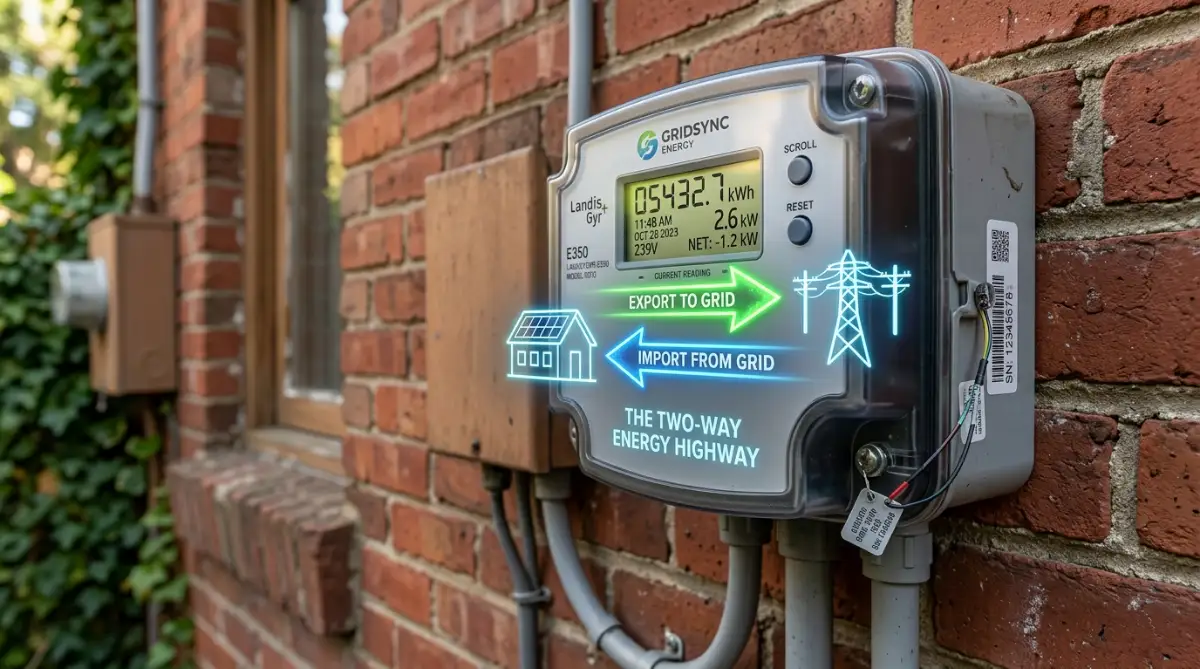
Before you ever try to read the confusing paperwork, you should take a walk outside and look at the side of your house. When your solar system was approved, the city likely swapped out your old electrical meter for a brand new, digital bi-directional meter.
This specific device is the ultimate judge of your monthly bill. Your old meter only knew how to do one thing: count upward as you bought power. The new one is much smarter.
It reads the electricity flowing in both directions. It tracks exactly how much power you take from the street, and exactly how much power you push back to the street.
If you look closely at the digital screen during a sunny day, you might see a small arrow pointing to the left, or the numbers might literally be counting backward. This is a beautiful sight because it means you are actively acting as a mini power plant for your neighborhood.
However, it is highly important to understand that this meter does not measure the total amount of energy your panels create. It only measures what crosses the boundary between your house and the street. Your home consumes a lot of the solar juice before the meter ever gets a chance to see it.
Watch This Video to See Exactly How Net Metering Saves You Money!
If you are still a bit confused about how the power company tracks your energy swapping, do not worry at all. I have found an incredibly helpful visual breakdown that shows exactly how this energy exchange happens in real-time, making it super easy to understand before you look at your next bill.
Translating the Confusing Jargon on Your Statement
Now that we know how the physical swap works, let us look at the actual terminology they use to confuse us. Energy companies love to use abbreviations.
The most common term you will see everywhere is kWh, which stands for Kilowatt-hour. This is simply the unit of measurement they use to sell electricity. Think of it exactly like gallons of gas for your car, but for your home appliances.
When you get your statement, you will notice they split your usage into a few different categories. Let us look at a simple breakdown to make things crystal clear.
If your export number is larger than your import number, you had a fantastic month. You successfully produced more than you consumed. You will not owe anything for the actual energy that month.
Net metering rules change fast depending on where you live, and understanding how your utility values your exported power makes or breaks your monthly savings:
| Billing Structure | Export Credit Rate | Financial Impact |
|---|---|---|
| Classic Net Metering (NEM 1.0 & 2.0) | Full 1-to-1 Retail Credit | Easiest path to near-zero annual bills. |
| Net Billing (NEM 3.0 / Avoided Cost) | Wholesale Value (~75% reduction) | Requires battery storage or strict afternoon load-shifting. |
| True-Up Cash-Out (Excess Year-End) | Wholesale Generation (2¢–4¢ per kWh) | Produces tiny refund checks regardless of export volume. |
Why Your Balance is Never Truly Zero
This is usually the biggest shock for new system owners. Even if you cover 100% of your energy needs with the sun, you will still receive a bill every single month with a small dollar amount owed.
You might aggressively wonder why you have to pay anything if you gave them extra power. The answer lies in mandatory grid connection rules outlined in FTC consumer solar guidance, which clearly explain why local utilities levy service charges regardless of daytime generation.
Maintaining the massive network of wooden poles, thick wires, and neighborhood transformers costs a lot of money. Because you are using their wires to act as your giant temporary battery, they charge you a monthly rental fee for that privilege.
This fee is usually pretty small, often between ten and twenty dollars a month depending on where you live. It also includes mandatory state taxes and public purpose programs that everyone tied to the system has to pay by law.
You cannot offset these specific administrative fees with your extra sunshine credits. Think of it like a mandatory subscription fee just to keep your house attached to the network.
The Secret Trap of Time-of-Use (TOU) Billing
This next section is where many homeowners accidentally lose a massive amount of their potential savings. The concept of net metering sounds perfectly equal on the surface, but power companies have added a sneaky layer of complexity called Time-of-Use rates.
In the old days, a unit of power cost the exact same amount whether you used it at three in the morning or three in the afternoon. A simple one-for-one trade. Those days are mostly gone.
Now, the price of power changes drastically depending on what time of day it is. The utility companies look at when the entire city is using the most power, usually between four in the afternoon and nine at night when everyone gets home from work. They call this the Peak Time.
During Peak Time, they charge you the absolute highest premium price for energy. The problem for solar owners is that the sun usually starts going down exactly when Peak Time begins.
So, during the bright morning and early afternoon, you are exporting massive amounts of power to the city. But the city labels this as Off-Peak time. They give you a much lower credit value for the amazing energy