
The Heavy Burden of Borrowing Blindly
Getting approved for a large sum of money often feels like a massive relief. You might need it for an unexpected medical bill, a dream wedding, or a major home repair.
At that exact moment, the cash in your bank account looks like pure freedom. You feel totally in control of your financial future.
But then the first monthly payment hits your account. Suddenly, the math does not make sense to you anymore.
You start to realize that a huge portion of your hard-earned money is going straight toward unexpected fees and high interest. The relief you felt on day one quickly turns into a heavy, suffocating chain around your daily life.
Why Do Smart People Fall for Bad Financial Deals?
Most people never want to make bad money choices. So why is finding the right solution so incredibly hard?
Here are the main reasons wrong information keeps everyday people trapped:
- Shiny Low-Interest Traps: Lenders heavily advertise extremely low interest rates to grab your attention. They intentionally hide the actual costs in the fine print where you are least likely to look.
- Complicated Financial Jargon: Banks use confusing language that most normal people simply do not understand. When you do not know the exact difference between interest rate and APR, you end up paying for your lack of knowledge.
- The Rush to Solve a Problem: Desperation pushes people to skip the basic math. When you need money immediately, you often sign documents blindly without asking the right questions.
- Fake Online Advice: The internet is completely flooded with bad advice designed to sell you expensive debt. Finding honest, transparent guidance is incredibly difficult.
How Hidden Costs Destroy Your Mental Peace
Money problems rarely stay confined to your bank account. They slowly creep into every single part of your daily life.
When you are trapped in an expensive debt cycle, the emotional toll is massive:
- Constant Daily Anxiety: Waking up in the middle of the night worrying about your next payment ruins your sleep schedule.
- Loss of Personal Confidence: You begin to doubt your own intelligence. You blame yourself for not reading the fine print carefully enough before signing.
- Strained Relationships: Money is the number one cause of arguments between partners. A bad financial decision easily creates resentment in a happy home.
- Fear of the Future: Every time you receive a call from an unknown number, your heart skips a beat. You constantly fear it is a collection agency calling.
The Real Cost You Cannot See on Paper
This situation is incredibly painful because it makes you feel entirely powerless. You work long hours every single day, yet your bank balance never seems to grow.
Instead of building your savings or investing in your future, you are making wealthy financial institutions even richer. This happens entirely because of the things you did not know before you applied.
When you borrow money blindly, you are not just trading your future income. You are trading your freedom, your peace of mind, and your ability to make independent choices.
But you do not have to stay trapped in this endless cycle. Understanding the hidden mechanics behind the money you borrow is your best defense against predatory lenders.
Knowledge is exactly what puts the power back into your hands. Let me show you how to take control of your math.

How to Expose the Hidden Math Behind Your Money (Step-by-Step)
If you want to protect your hard-earned income, you need to think exactly like a banker. You must learn to look past the beautiful advertisements and focus entirely on the raw numbers.
The process is highly logical, and you do not need an advanced math degree to do it. You simply need to know exactly where to look.
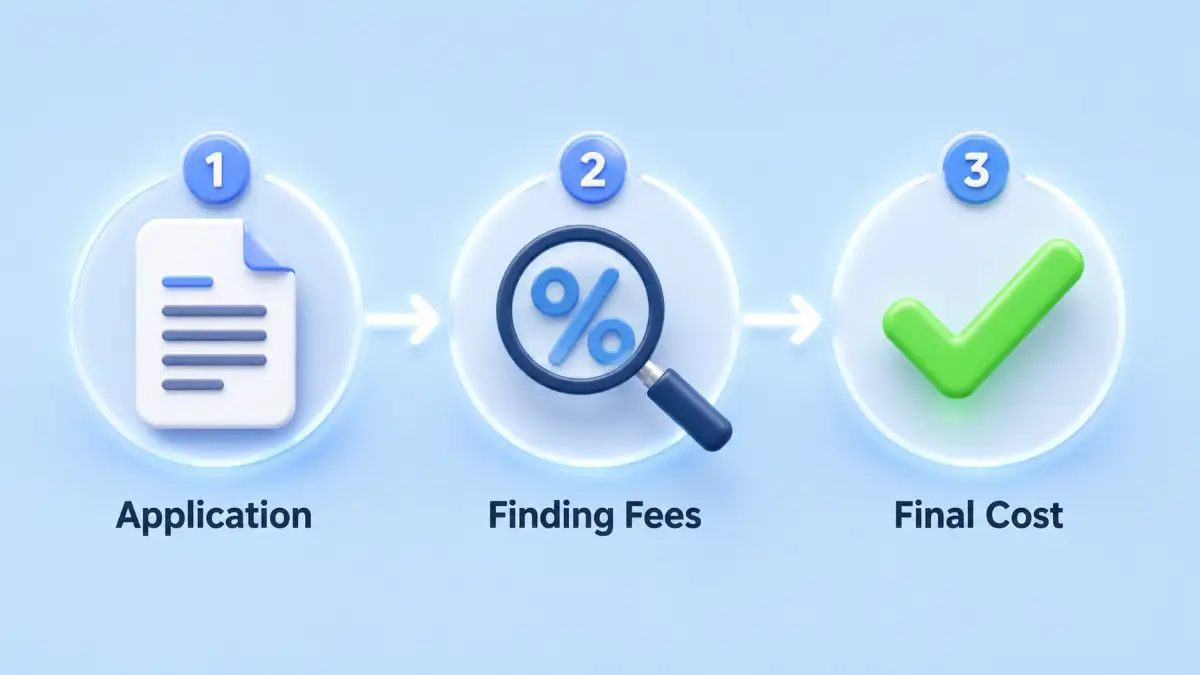
Here are the first three practical, science-backed steps to uncover the real price tag on your borrowed money. You can apply these concepts today to protect your financial future.
Step 1: Crack the Code Between Interest Rate and APR
The absolute biggest mistake people make is looking only at the advertised interest rate. This single number is highly deceptive by design.
The standard interest rate is just the basic cost of borrowing the principal amount. It does not include any of the extra charges you will eventually have to pay.
To find the true cost, you must look directly at the Annual Percentage Rate (APR). The APR combines your basic interest rate with all the mandatory hidden fees to give you one clear, yearly percentage.
A Real-Life Borrowing Scenario
Imagine you are buying a used car and the dealer offers you a seemingly amazing 5% interest rate. You feel excited because it sounds incredibly affordable.
However, they might also charge a documentation fee, a processing fee, and an application charge. When you add all those extra costs together, your actual APR might jump to a painful 9%.
Think of the interest rate as the sticker price of a vacation package. The APR is the final bill after adding taxes, baggage fees, and hotel resort charges.
Always demand to know the exact APR before you sign anything. By law, honest lenders must provide this specific number if you ask for it directly.
Step 2: Spot the Silent Danger of Origination Fees
Most people think that if they ask to borrow $10,000, they will actually receive $10,000 in their bank account. Unfortunately, this is rarely how the banking system actually works.
Many lenders charge an Origination Fee, which is basically a fee for doing the paperwork to approve your money. This fee is completely legal, but it is often deeply buried in the contract.
Usually, the lender takes this fee directly out of your loan amount before they even send you the cash. This practice creates a very dangerous mathematical trap for the borrower.
The Painful Reality of Missing Money
Let us say you need exactly $10,000 for an urgent roof repair before a major storm hits. You apply for the exact amount and get approved quickly.
But your lender has a hidden 5% origination fee written in tiny text at the bottom of page three. On the day of your payout, only $9,500 arrives in your checking account.
Now you are completely short on your repair bill, but you are still paying interest on the full $10,000. You are literally paying interest on money you never even received.
To fix this, you must read the Loan Estimate document very carefully. If a lender charges a high origination fee, you should immediately shop around for a better offer.
If you absolutely must accept a loan with this fee, you have to calculate it beforehand. You might need to request a slightly higher total amount just to ensure you get the exact cash you need.
Step 3: Identify the Shocking Prepayment Penalty Trap
It sounds incredibly backward, but some banks will actually punish you financially for being responsible. If you try to pay off your debt early, they hit you with a massive fine.
This highly frustrating charge is known as a Prepayment Penalty. It is a perfect example of why you must calculate the true cost of a personal loan before applying.
Banks make their profit primarily through the interest you pay them every single month. When you pay off your balance three years early, the bank loses three years of expected profit.
How to Protect Your Future Financial Freedom
To protect their profits, banks insert a clause that forces you to pay a large fee if you clear your balance too soon. They actively discourage you from becoming completely debt-free.
Imagine you get a big promotion at work or receive an unexpected bonus. You decide to do the smart thing and clear your remaining $5,000 balance in one single payment.
Instead of a congratulations letter, the bank charges you a $300 penalty fee for breaking the original payment schedule. Your great financial victory suddenly feels like a bitter loss.
You should always ask the loan officer one very direct question: "Is there any penalty for paying this off early?" Make sure their answer is clearly printed in the official contract.
Always choose a lender that openly offers no prepayment penalties. This gives you the total freedom to escape your monthly payments whenever your financial situation naturally improves.
Taking the time to check for these three specific factors will save you thousands of dollars over time. It gives you the clear, undisputed truth about what you are actually signing up for.
Unlocking the Banker’s Playbook: Pro Strategies for Smart Borrowers
Now that you know how to find the real interest rate and spot hidden fees, you are already ahead of most people. But we are not going to stop there.
To truly protect your wallet, you need to understand the deeper mechanics of borrowed money. Lenders use very specific mathematical formulas to maximize their profits over time.
If you understand these formulas, you can completely flip the script. You can use their own rules to save yourself thousands of dollars.
Here are the advanced strategies that financial experts use to keep borrowing costs incredibly low.
Look Beyond the Monthly Number and Calculate Total Lifetime Interest
When you sit down with a loan officer, they will almost always focus the conversation on your monthly payment. They do this intentionally to distract you from the bigger picture.
A low monthly payment feels safe and comfortable for your daily budget. However, that comfortable monthly number often hides an enormous long-term cost.
You must always calculate the Total Interest Paid over the entire lifetime of the debt. This is the exact dollar amount the bank is charging you for the privilege of using their money.
The Real-Life Math of Term Lengths
Imagine you need to borrow $15,000 to renovate your kitchen before selling your house. The bank offers you two different payment plans.
Option A gives you a three-year repayment plan with a higher monthly bill. Option B stretches the debt over seven years, offering a very small, tempting monthly payment.
If you choose Option B, your monthly budget feels slightly easier to manage right now. But because you are borrowing the money for four extra years, the bank continues to charge you interest every single day.
By the end of those seven years, you might end up paying $6,000 in pure interest. With the three-year plan, you might only pay $2,000 in total interest.
Stretching out your timeline might make today feel easier, but it robs your future self of hard-earned cash. Always ask the lender for the Total Cost of Borrowing before you agree to any term length.
Demand and Study the Amortization Schedule
This sounds like a highly technical banking term, but it is actually just a simple chart. An Amortization Schedule is a complete, month-by-month breakdown of every single payment you will make.
Think of it as an X-ray scan for your personal debt. It shows you exactly where every single penny of your monthly payment is going.
Most people assume that if they pay $300 a month, the full $300 goes toward reducing their debt. That is absolutely not how standard lending works.
How Banks Front-Load Their Profits
When you look at an amortization chart, you will notice something very surprising about your first year of payments. The bank takes their profit first.
In the beginning, the vast majority of your monthly payment goes directly toward paying the interest. Only a tiny fraction actually reduces the principal amount you borrowed.
As the months pass, this ratio slowly begins to flip. By the final year, most of your payment is finally paying down your actual debt.
When you study this schedule, you can clearly see the massive benefit of making extra payments early on. Sending just $50 extra toward your principal in the first few months dramatically reduces the total interest you pay overall.
Always request this document before signing. If a lender refuses to provide a clear amortization schedule, walk away immediately.
How to Maintain Good Financial Health After Borrowing
Securing a fair deal is only the first part of your financial journey. To truly succeed, you need to manage that debt actively once the money hits your account.
You do not want to fall back into the same stressful cycle later on. Building smart habits right now will protect your peace of mind.
Here is a simple professional guideline to keep your long-term finances incredibly healthy:
- Set Up Unbreakable Automation: Do not rely on your memory to pay your bills on time. Set up automatic transfers from your checking account a few days before the due date.
- Build a Parallel Safety Net: While paying down your debt, slowly start putting a small amount of cash into an emergency fund. This prevents you from needing to borrow more money if your car breaks down next month.
- Review Your Progress Monthly: Pick one day every month to sit down with your favorite cup of coffee and check your remaining balance. Watching the number go down provides massive psychological motivation.
- Ignore Refinancing Temptations: Banks will constantly email you offers to refinance your current debt to get extra cash. Unless it significantly lowers your APR, ignore these highly deceptive marketing tricks.
By turning these small actions into daily habits, you build an invisible shield around your money. You transform from a stressed borrower into a confident manager of your own wealth.
Five Dangerous Traps That Will Drain Your Wallet
Even when you know exactly how to calculate your costs, the borrowing process is still full of hidden landmines. One small oversight during the application process can easily erase all the hard work you just did.
People often rush through the final paperwork because they are exhausted and just want the money. This is exactly when the most expensive mistakes happen.
Below is a detailed warning list of the five biggest traps everyday people fall into. Avoiding these specific pitfalls is entirely non-negotiable if you want to protect your bank account.
1. Falling for the Monthly Payment Illusion
We touched on this earlier, but it is the absolute most common mistake people make. Car salesmen and loan officers are heavily trained to sell you on a monthly payment, not the total price.
They will ask, "How much can you afford to pay each month?" If you give them a number, they will magically adjust the math to match it.
But they achieve this by secretly extending your repayment timeline and increasing your overall interest rate. Never negotiate based on the monthly payment. Always negotiate based on the final APR and the total principal amount.
2. Ignoring the Severe Penalties for Late Payments
Life is highly unpredictable, and sometimes a bill gets forgotten. But when you are dealing with borrowed money, a simple memory lapse is extremely expensive.
Many borrowers never read the specific section of their contract regarding late fees. They assume a late payment just means a small warning email.
In reality, missing a due date by a single day can trigger a massive penalty fee. Worse, it can completely destroy your personal credit score in a matter of weeks.
If your credit score drops, every future financial product you need will suddenly become twice as expensive. Always know your grace period and strictly enforce your own payment deadlines.
3. Accepting Worthless Add-On Insurance
Right before you sign the final document, the lender will suddenly become very concerned about your safety. They will heavily suggest that you buy Credit Life Insurance or payment protection plans.
The pitch sounds very scary. They will ask how your family would survive if you lost your job or faced a medical emergency.
They try to roll the cost of this insurance directly into your borrowed amount. This means you are actually paying extra interest on the insurance policy itself.
These policies are almost always terribly overpriced and highly unnecessary. If you have a standard life insurance policy, you are already protected without paying the bank extra fees.
4. Borrowing Extra Cash Just Because You Can
When an underwriter reviews your application, they might approve you for more money than you actually requested. If you asked for $8,000 to fix your car, they might suddenly offer you $12,000.
The temptation to take the extra cash is incredibly strong. You start dreaming about using that extra money for a vacation or buying a new television.
This is a very dangerous psychological trap. Every single extra dollar you take is a dollar you have to pay back with heavy interest attached.
If you take money you do not urgently need, you are literally buying useless items on credit. Always stick entirely to your original math and only accept the exact amount required to solve your problem.
5. Forgetting to Shop Around for Better Offers
Desperation makes people incredibly loyal to the very first bank that says yes. When you are stressed about money, getting an approval feels like a huge rescue.
Because of this relief, people immediately sign the paperwork without checking any other options. They assume all banks offer roughly the same rates.
This assumption is entirely false. Different financial institutions assess your risk profile in very different ways.
A local credit union might offer you a rate that is half the price of a massive national bank. You must treat borrowing money exactly like buying a house.
Get at least three different quotes from three different types of lenders. Use those offers to negotiate a better deal for yourself.
Your Next Steps Toward Total Financial Confidence
Navigating the world of personal debt can easily feel overwhelming at first. The financial industry intentionally uses confusing language to keep everyday people in the dark.
But you now hold the exact blueprint needed to see right through their tricks. You understand the math, you know where the hidden fees live, and you know exactly what questions to ask.
You are no longer a passive target for predatory lenders. You are now the smart, educated manager of your own financial future.
The next time you need to borrow money, do not let fear or urgency control your decisions. Take a deep breath, grab a calculator, and clearly read the fine print.
Demand your amortization schedule, double-check the APR, and completely ignore the monthly payment illusion. Your hard-earned money belongs to you and your family, not to a wealthy banking institution.
Start applying these simple rules today. Every single step you take brings you closer to a completely stress-free, financially secure life.