
Understanding Hard vs. Soft Credit Inquiries
Applying for a new credit card or checking your score shouldn't feel like walking through a financial minefield. Yet, thousands of people watch their score drop a few points and instantly panic. Here is the straightforward truth: not every credit check damages your score, and knowing the difference between hard and soft inquiries takes less than five minutes.
Every time we apply for credit or verify our identity, we leave a financial footprint. But not all checks carry the same weight. While a hard inquiry can temporarily trim a few points off your score, a soft inquiry leaves your numbers completely untouched.
Before We Dive into the Details, Here’s What You Need to Know:
- Soft Inquiries Never Hurt You: Checking your own credit score, receiving pre-approved card offers, and employer background checks have zero impact on your numbers.
- Hard Inquiries Are Temporary: Applying for a new loan or credit line creates a hard pull, which usually drops your score by only 1 to 5 points and fades within a year.
- Rate-Shopping Is Grouped: Multiple applications for a mortgage, auto loan, or student loan submitted within 14 to 45 days count as one single inquiry.
- Store Cards Don't Group: Retail store cards and standard credit card applications are never bundled together; every single application counts as a separate hard inquiry.

Breaking Down the Mechanics of Financial Background Checks
To stop losing points unnecessarily, we first need to look at how scoring algorithms treat our requests. Lenders do not have the time to interview you personally about your spending habits. Instead, they rely on complex mathematical formulas to predict your future behavior based on your past actions.
When an institution wants to see your financial history, they request a copy of your report from the major bureaus. This request is generally known as a "pull" or an "inquiry." However, the reason behind the request changes everything.
What Really Happens When a Lender Looks at Your File?
Think of your credit report as a detailed library record of every book you have ever borrowed and returned. When someone asks to see your library record, the librarian wants to know why they are asking.
Are they just checking to see if you are a responsible reader? Or are they asking because they are about to lend you fifty rare books? The system separates these requests into two distinct categories: the soft check and the hard check.
Let's look at a clear breakdown of how these two actions compare in real life.
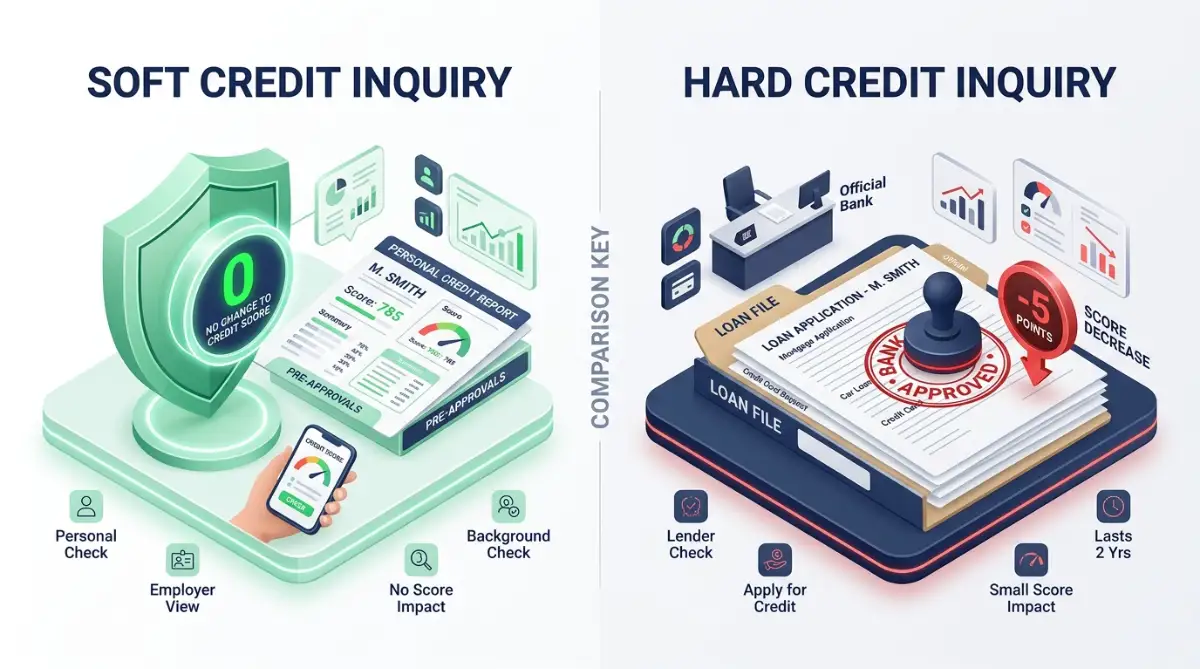
The Science and Logic Behind the Point Drop
You might be wondering why a hard inquiry drops your score in the first place. It often feels like a punishment for simply shopping around. But from a mathematical perspective, it is all about statistical risk.
Even if you just want airline miles, the computer algorithm only sees that you are actively seeking more debt. If you ask three different banks for a loan on the exact same day, the system assumes you might be desperate for cash. Therefore, it lowers your score slightly to warn other lenders that you are currently a higher risk.
This drop is entirely temporary. The algorithm knows that if you continue to pay your bills on time over the next few months, the risk fades away.
My Personal Realization About Credit Management
My biggest mistake was assuming that every single time a bank looked at my name, it was recorded as a negative event. I used to be terrified of using free financial monitoring apps because I thought they were quietly draining my points every time I logged in. Once I learned that checking my own file is categorized as a safe, soft inquiry, everything changed. I started checking my numbers weekly, which actually helped me spot a fraudulent charge before it caused serious damage.
Watch this quick explanation to see exactly how these inquiries impact your overall profile:
The Gentle Approach: Understanding Soft Checks
Let's look deeper into the soft inquiry. This is essentially a routine background check. It happens much more often than you probably realize, and it is completely harmless to your numbers.
When you receive a letter in the mail saying you are "pre-approved" for a credit card, a bank has already performed a soft pull on your file. They purchased a list of consumers who meet their basic criteria. Because you did not actively ask them for money, the credit bureaus do not penalize you.
Similarly, when you apply for a new job, your future employer might want to see how you handle responsibility. They will request a modified version of your report. This is purely for informational purposes. You are not asking the employer for a loan, so the action is treated as a soft peek.
Expert Insight:
"Consumers should never hesitate to review their own financial reports. Regular monitoring is the absolute best defense against identity theft and reporting errors. Since checking your own file is a soft inquiry, you can look at it every single day without losing a fraction of a point."
The Official Request: Understanding Hard Checks
A hard inquiry is serious business. It only happens when you officially submit an application asking a lender for money. You are taking a direct action to increase your potential debt load.
When you sit at a car dealership and sign a paper allowing them to find you financing, you are triggering a hard pull. When you apply for a mortgage to buy a house, or when you request a new student loan, these are all recorded as hard inquiries.
Because this type of check tells the financial world that you are actively seeking new credit, it gets stamped permanently onto your file for up to 24 months. Other banks will be able to see exactly who you applied with and when.
Myth vs Reality
- The Myth: Checking your own credit score will ruin your financial standing and make lenders reject you.
- The Reality: Checking your own score is always a soft inquiry. It has zero negative impact. In fact, people who check their reports regularly tend to have healthier financial profiles because they catch errors early.
It is highly important to understand that not all hard inquiries are treated exactly the same. The scoring models have built-in exceptions for people who are simply trying to find the best interest rates. If you are shopping for a mortgage or a car loan, the algorithm expects you to check with a few different banks.
We will cover exactly how to use this "rate-shopping" exception to your advantage without damaging your file in the next section.
Mastering the Art of Strategic Applications
Earlier, we talked about a special rule that helps people who are simply looking for the best interest rates. This is known as the rate-shopping exception, and it is a massive advantage if you know how to use it properly.
When you want to buy a house or a car, lenders completely understand that you need to compare different offers. The mathematical scoring formula is actually smart enough to recognize this normal human behavior. Instead of punishing you for being a responsible shopper, the algorithm groups multiple requests for the exact same type of loan into one single event.
Usually, you have a specific window of about 14 to 45 days to do all of your shopping. During this time, you can apply with five different auto lenders or mortgage brokers, and it will only count against your profile as one single hard inquiry. You can learn exactly how this timeframe works by reading the official guidelines from the Consumer Financial Protection Bureau (CFPB).
However, you need to be highly careful here. This special grouping rule only works for specific things like mortgages, student loans, and auto loans. It absolutely does not work for regular credit cards. If you apply for five different reward cards in one week, you will get hit with five separate penalties.
Here is a quick look at how different credit scoring models treat multiple loan inquiries:
The Pro-Level Monitoring Strategy
Many experts suggest checking your numbers at least once a month using a free, safe service. Because this is always a soft pull, it costs you absolutely nothing but five minutes of your time.
By keeping a close eye on your file, you can spot strange activity immediately. If you see a hard check from a bank you do not recognize, someone might be trying to open an account in your name. Catching this early can save you months of headaches and legal phone calls.
Here is a quick Do's and Don'ts list to keep your financial profile in great shape:
- Do review your own file regularly using safe monitoring apps.
- Do complete all your mortgage or car loan shopping within a tight two-week window to be safe.
- Don't apply for new lines of money just to get a free gift at a store.
- Don't close your old, perfectly good accounts right after opening a new one, as this confuses the algorithm.
If you already have too many accidental inquiries on your record, you might feel a bit discouraged. In that case, you should definitely learn how to fix a damaged credit score without falling for scams to slowly rebuild your foundation.

The Hidden Traps That Secretly Drain Your Points
Understanding the rules is only half the battle. We also need to talk about the common mistakes that catch ordinary people completely off guard. These small, innocent decisions can sometimes cause lasting damage to your financial reputation.
Picture this exact scenario: you are standing at the checkout counter of your favorite clothing store. You have a cart full of items. The friendly cashier offers you a massive discount on your entire purchase today if you just sign up for their store loyalty card. It sounds like an amazing deal, right?
This is one of the most dangerous traps people fall into. Store cards almost always trigger an immediate hard pull. Doing this at three different stores during the holiday season can seriously drag down your numbers. The temporary discount you get today is rarely worth the long-term damage to your overall borrowing power.
Another major pitfall is the emotional "revenge application." Let's say you apply for a new rewards card and get denied. The natural human reaction is to feel slightly offended. You might think, "Fine, I will just apply with a different bank right now."
This is a terrible idea. When you rapidly submit multiple applications back-to-back across different banks, the computer algorithm flags your profile for desperation. It looks like you are panicking for cash. Instead of mindlessly applying for new lines of money, you might just need a better strategy to handle the bills you already have. For example, learning how to destroy high-interest credit card debt fast is much more effective than opening yet another account.

The Danger of Ignoring the Fine Print
Sometimes, we accidentally give companies permission to run a hard check without even realizing it. This often happens when you sign up for new utilities, switch cell phone providers, or try to rent a car without a standard deposit.
Many people blindly click "I Agree" on digital contracts. Buried deep in those terms of service is a clause allowing the company to thoroughly review your financial background. Always ask the representative directly: "Will this result in a hard or soft inquiry?"
Make them answer you clearly. If they cannot give you a straight answer, you should hesitate before signing any paperwork. For deeper insights on how new applications affect your risk level, you can review the official scoring models provided by myFICO, which explain exactly how these actions are weighed mathematically.
My 10-Second Script at Checkout Counters & Utility Desks:
Whenever an agent asks for your Social Security Number or ID, say: "I am happy to provide my details for identity verification, but only if this runs as a soft inquiry. Please confirm if your system triggers a hard pull." If they cannot give you a firm answer on the spot, ask for an alternative verification option or choose a manual deposit instead of taking an accidental hit to your score.
Your Financial Health Blueprint for Tomorrow
Taking control of your financial reputation does not have to be scary or confusing. The system is built on a set of predictable rules. Once you know how the game is played, you can easily stop making the mistakes that cost you points.
The most important takeaway is this: you should never be afraid to check your own status. Soft inquiries are your best friend. They are the safe, gentle way to keep track of your progress and protect yourself from fraud.
Your action plan for tomorrow is quite simple. First, find a trusted app or service and check your current numbers. You have a legal right to see what lenders see. You can even claim your official reports at no cost by following the guidelines set by the Federal Trade Commission (FTC).
Next, review your recent activity. Look for any hard checks you do not remember authorizing. If you find one, you have the right to dispute it directly with the bureaus. Finally, put a freeze on any unnecessary applications. Save those valuable hard pulls for the moments you truly need them, like buying a home or securing a safe vehicle for your family.
When I finally understood the clear boundary between a hard and soft pull, my entire financial anxiety melted away. I stopped avoiding my bank apps and started treating my numbers like a fun game I could actually win. By making careful, informed decisions, you can easily protect your score and unlock the best financial opportunities life has to offer.
What Everyone Else is Asking Right Now
Do soft inquiries show up for lenders to see?
No, soft inquiries are completely invisible to anyone except you. When a bank or a lender pulls your official report, they will only see the hard inquiries left by other institutions. You never have to worry about looking at your own file too often.
How long does a hard pull actually hurt my score?
While a hard inquiry stays physically written on your report for up to 24 months, the actual point drop fades much faster. In most modern scoring models, the mathematical penalty only affects your overall number for about 12 months.
Can I remove a hard inquiry if I get denied for the loan?
Unfortunately, you cannot remove a hard inquiry simply because you were denied. The inquiry records the fact that you asked for money, regardless of the outcome. You can only successfully dispute and remove inquiries that were made without your legal permission.
Is getting pre-approved for a mortgage a hard or soft pull?
Getting a basic pre-qualification online is usually a soft pull, meant to give you a rough estimate of what you can afford. However, getting an official, guaranteed pre-approval letter for a real estate agent almost always requires a hard pull.
Disclaimer: The information provided in this article is for educational and informational purposes only. It does not constitute formal financial, legal, or professional advice. Always consult with a certified financial planner or credit counselor before making major changes to your personal finance strategy.