
The Hidden Enemy Glowing on Your Screen
You wake up, check your phone, and instantly bathe your face in artificial light. Throughout the day, you stare at a computer monitor for work, only to unwind later by scrolling through social media or watching TV.
This is the daily reality for almost all of us. But while we worry about UV rays when stepping outside, we often ignore the glowing threat right in front of our eyes.
High-Energy Visible (HEV) light, commonly known as blue light, silently penetrates your skin hour after hour. Over time, you might notice your skin looking unusually tired, dull, or slightly darker. You wonder why your face lacks its natural glow, even though you rarely spend time in the hot sun.
A few months ago, I looked in the mirror after an 8-hour work shift and barely recognized myself. My skin looked so tired, pale, and blotchy, even though I hadn't been out in the sun at all. It took me weeks of confusion to realize that my own laptop screen was slowly stealing my skin's healthy glow.
The frustrating part is how hard it can be to find clear answers. People actively search for ways to reverse this dullness, but they often stumble into a maze of conflicting advice.
Here is why finding a real solution feels so impossible and how bad information makes things worse:
- Confusing Skincare Labels: Many products claim to offer full protection, but they actually only block standard UV rays. They completely miss the deep-penetrating blue light from your devices.
- The Indoor Sunscreen Myth: You might hear that regular chemical sunscreen works indoors. In reality, most chemical sunscreens do absolutely nothing to stop HEV light from damaging your cells.
- Ignoring the Root Cause: People spend heavily on expensive brightening creams to fix dark spots. However, they fail to block the screens that are actively causing those spots in the first place.
- Over-Exfoliation Disasters: Desperate to get their glow back, many individuals scrub their faces aggressively. This destroys the natural skin barrier and allows blue light to penetrate even deeper.
Living with this constant, hidden damage takes a heavy toll on your daily confidence. It is not just about vanity; it is about how you feel when you look in the mirror every morning.
Here is how this silent skin damage silently ruins your mental peace:
- The Zoom Fatigue Anxiety: Seeing your own reflection during online meetings can be stressful. You constantly notice the dark circles and uneven texture, making you feel self-conscious while you try to speak.
- Fear of Premature Aging: Nobody wants to look older than they actually are. Watching fine lines appear around your eyes from constant screen squinting and light exposure causes deep daily stress.
- Wasted Effort Frustration: It is deeply discouraging to follow a strict nighttime skincare routine, only to see zero results. You feel like you are fighting a losing battle against your own lifestyle.
- Social Withdrawal: When your skin feels dull and tired, your desire to go out and meet people drops. You start relying on heavy makeup just to feel normal, which traps you in an exhausting cycle.
We spend so much time connected to our digital lives. Protecting our skin from that connection should not feel like an impossible puzzle.
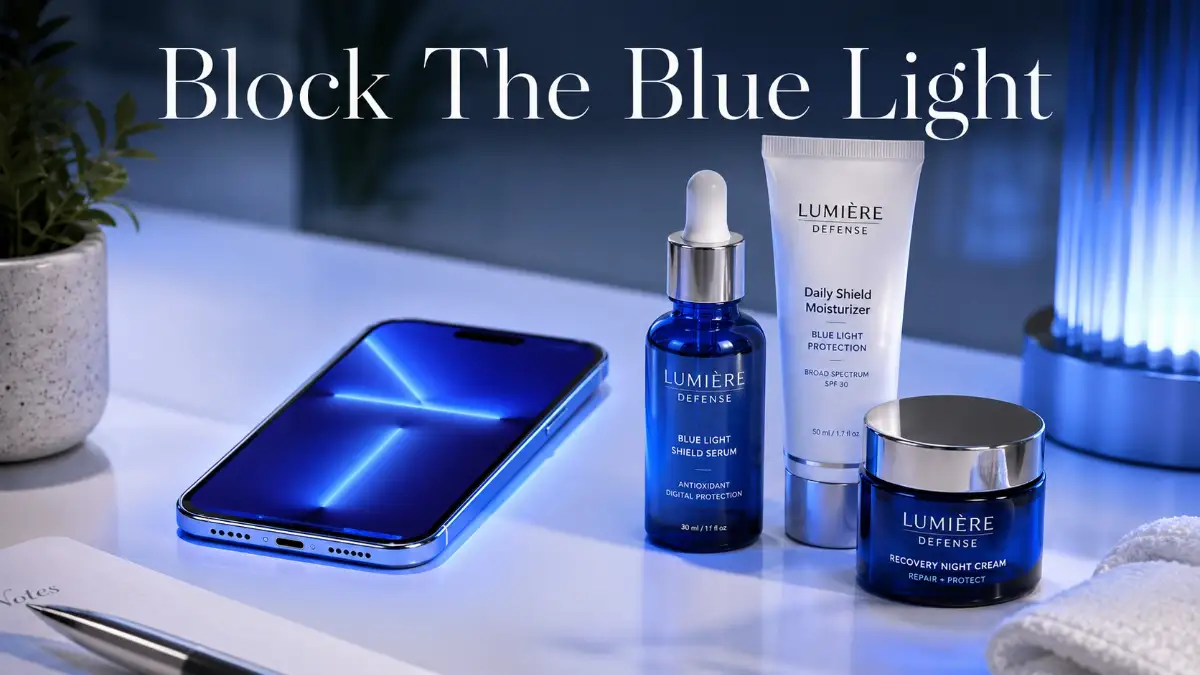
How to Defend Your Face Against Digital Aging
Now that we understand the hidden damage, it is time to take complete control of your skin health. You do not have to throw your phone away or quit your computer job.
Instead, you just need a smart, science-backed defense strategy. Think of your skin as a beautiful house. Right now, the doors are wide open, letting the blue light walk right in.
We are going to build a solid fence, install a strong security system, and fix the damage inside. Here are three highly effective, practical steps you can easily start using today.
1. Build a Powerful Antioxidant Shield
To truly protect your skin, you must first understand how blue light actually causes harm. When HEV light hits your face, it creates tiny, unstable molecules called free radicals.
These free radicals act like little wrecking balls. They bounce around inside your skin cells, breaking down the collagen and elastin that keep your face firm and smooth.
This process is called oxidative stress. If you have ever watched a sliced apple turn brown after sitting on the kitchen counter, you have witnessed oxidative stress in action. Your skin essentially goes through a similar, albeit slower, "rusting" process when exposed to hours of screen time.
The most effective way to neutralize these wrecking balls is by using antioxidants. Antioxidants are like tiny superheroes that sacrifice themselves to satisfy the free radicals.
By applying an antioxidant serum every morning, you give your skin an invisible shield. When the blue light hits, the antioxidants take the punch so your healthy skin cells do not have to.
How to apply this in your real life:
Start your morning routine with a high-quality Vitamin C serum. Vitamin C is one of the most thoroughly researched and proven antioxidants available today. After washing your face and patting it dry, gently massage a few drops of Vitamin C into your skin. Let it absorb fully for about two minutes.
Do not just stop at Vitamin C. Look for products containing Niacinamide (Vitamin B3) or Vitamin E. Niacinamide is incredibly effective at fighting the specific type of hyperpigmentation and redness caused by blue light.
When you combine Vitamin C and Vitamin E together, they actually boost each other's fighting power. Think of it as a tag-team wrestling match against digital aging. Make this your non-negotiable morning habit. Even if you are working from home and never step outside, applying your antioxidant serum is your first line of defense against the glowing screen on your desk.
2. Switch to Iron Oxide Mineral Protection
You probably already know that wearing sunscreen is a good daily habit. But here is a very important fact that most people miss entirely.
Standard chemical sunscreens—the ones that absorb into your skin and turn clear—do not block blue light. They are designed specifically to absorb invisible UV rays from the sun.
Here is a big mistake I made for over a year: I kept slathering on expensive clear sunscreens while sitting at my desk, thinking I was totally safe. Once I switched to a simple tinted mineral formula with iron oxide, the dark spots around my cheeks finally stopped showing up.
Blue light, on the other hand, is visible light. To block visible light, you need a physical, visible barrier on your skin. This is where mineral sunscreens enter the picture. Specifically, you need a mineral product that contains Zinc Oxide, Titanium Dioxide, and most importantly, Iron Oxides.
Iron oxide is the game-changer here. It is the mineral ingredient used to give tinted sunscreens and foundations their skin-matching color. Science shows that iron oxide acts like a literal wall against HEV light.
Imagine you are trying to sleep in a room with a bright streetlamp outside. A chemical sunscreen is like a sheer, transparent curtain. It might block a little heat, but the bright light still shines right through. A tinted mineral sunscreen with iron oxide is like installing thick, blackout curtains. The light simply hits the barrier and bounces off, keeping the room completely dark and protected.
Want to see how blue light actually affects your skin and how tinted mineral sunscreen stops it in real-time? Check out this quick, eye-opening video before reading the rest of our daily defense steps below!
How to easily apply this daily step:
Swap your regular morning moisturizer or chemical SPF for a tinted mineral sunscreen. Do not worry about it looking like heavy makeup.
Today’s tinted SPFs blend smoothly and give your skin a very natural, healthy glow. When you buy one, turn the bottle around and check the active ingredients list. You want to see Zinc Oxide (usually around 10% to 20%) and Iron Oxides clearly listed. Apply a generous, even layer over your face and neck as the absolute final step of your morning skincare routine.
If you are a man or someone who completely avoids tinted products out of preference, look for 100% mineral sunscreens that use non-nano Zinc Oxide. While they might leave a slight white cast initially, they still offer a much stronger physical bounce-back effect against screen light than clear chemical gels.
Reapply this physical shield if you find yourself sweating or washing your face halfway through your workday. As long as that physical mineral layer sits on your skin, the blue light cannot reach your healthy cells below.
3. Optimize Your Tech Devices and Daily Environment
Skincare products are highly effective, but they are only half of the solution. The other half is stopping the problem at its actual source: your electronic devices.
We often forget that we have complete control over how much blue light our devices emit. You can drastically lower your daily exposure without spending any money on new gadgets.
By making a few smart tweaks to your digital environment, you instantly reduce the workload on your skin. It is like turning down the water pressure on a leaking pipe before you try to fix it.
Your screens do not need to be blindingly bright to be useful. In fact, lowering the harshness of your screen will instantly protect your eyes from fatigue while simultaneously saving your skin.
Simple tech adjustments you can make right now:
First, pick up your smartphone and go straight to the display settings. Turn on the "Night Shift" or "Eye Comfort Shield" feature.
Most people think this setting is only for bedtime. However, you can easily schedule it to stay on all day long. This simple switch changes the color temperature of your screen from a harsh, icy blue to a softer, warmer yellow.
Next, do the exact same thing on your work laptop or desktop monitor. Both Windows and Mac operating systems have built-in night light features. If you want an extra layer of permanent security, purchase a physical blue light screen protector. These are thin, transparent films that you stick directly over your phone screen or computer monitor.
They physically filter out a large percentage of HEV light before it ever travels through the air toward your face. Furthermore, always practice the "arm's length" rule when working. Blue light scatters and weakens over a distance. If you hold your phone just six inches from your nose, your skin absorbs a massive, concentrated dose of light.
By simply pushing your laptop back so it is at least an arm's length away, you drastically reduce the intensity of the light hitting your skin barrier. Combine these simple tech habits with your new morning skincare routine, and you will create an incredibly strong defense system against digital aging.
Next-Level Strategies for Total Digital Skin Defense
Now that you have built your morning defense system, it is time to look at the bigger picture. True skin health goes far beyond what you put on your face right after waking up.
Leading medical professionals are discovering exactly how screens change our skin structure. For example, recent reports from Healthline on how blue light affects the skin show that device screens actively trigger collagen breakdown over time.
This means your skin loses its natural bounce and firmness just by sitting in front of a computer. Similarly, experts at the Cleveland Clinic explain that dietary antioxidants are necessary to fight off these free radicals from the inside out.
Protecting your skin requires a steady, 24-hour approach. You need to defend your face during the day and repair the hidden damage while you sleep.
Let us walk through a few advanced, highly effective habits you can add to your routine right now.
Maximize Your Deep Nighttime Repair Cycle
Your skin does its heaviest lifting while you are asleep. During the day, your skin is busy fighting off light, pollution, and dirt.
At night, it switches into full repair mode. Think of your body like a busy office building.
During the day, people are walking around and creating a mess. At night, the janitorial team comes in to clean the floors and fix the broken lights.
If you do not help this nighttime cleanup crew, your skin will wake up looking tired and dull. To support this process, you need ingredients that actively repair cellular damage.
Look for night creams containing peptides or ceramides. These ingredients act like building blocks, patching up the microscopic holes created by your phone screen.
If you want a powerful anti-aging boost, consider adding a gentle retinol or bakuchiol serum a few nights a week. These help speed up cell turnover, pushing fresh, healthy skin to the surface faster.
Build an Inside-Out Dietary Shield
What you eat directly changes how your skin reacts to light exposure. You can actually build an internal sunscreen by eating specific colorful foods.
Certain vegetables contain high levels of Lycopene and Beta-carotene. These natural compounds travel through your bloodstream and settle in your skin cells.
Once there, they act like tiny sponges that absorb and neutralize light damage. Tomatoes, sweet potatoes, and carrots are packed with these protective nutrients.
Try to include a handful of dark, leafy greens like spinach or kale in your daily meals. These greens are loaded with Lutein, an antioxidant famous for protecting both your eyes and your skin from HEV light.
You do not need an extreme diet to see real results. Just adding a small side salad or a piece of dark chocolate to your lunch gives your skin an amazing fighting chance.
Stop the "Screen Squint" Wrinkle Effect
Blue light does not just cause dark spots; it also creates physical wrinkles. When your eyes feel tired from harsh screen glare, you naturally start to squint.
You might not even realize you are doing it. Over hours, days, and months, this constant squinting creates deep crow’s feet around your eyes.
The easiest way to stop this is by wearing blue light blocking glasses. These glasses filter the light before it hits your eyes, keeping your eye muscles completely relaxed.
When your eyes relax, the delicate skin around them stays smooth and flat. It is a very simple fix that saves you from spending money on expensive eye creams later.
Do Not Forget Your Neck and Hands
People spend all their time and money protecting their face, completely ignoring the rest of their body. Your neck and hands are actually exposed to screens just as much as your face.
Think about how you hold your phone while scrolling on the couch. The screen is usually pointed right at your chin and neck.
When you type on a keyboard, your hands are resting directly under the glow of your laptop monitor. If you have high-performance laptops running hot near your hands, the combination of heat and light dries out your skin incredibly fast.
Whenever you apply your protective morning serums and mineral sunscreen, always bring the product down to your neck. Take the leftover cream on your palms and rub it onto the backs of your hands.
The Biggest Digital Skincare Traps to Avoid
Even with the best intentions, many people accidentally ruin their own skincare progress. They follow general advice without understanding how blue light changes the rules.
If you make these common errors, you will waste your expensive products and leave your skin vulnerable. Here are the five biggest traps you must avoid to keep your face looking healthy and youthful.
1. Trusting the Wrong Type of Sunscreen
This is the most common mistake people make every single morning. They assume that if a bottle says "SPF 50," they are fully protected from everything.
As we covered earlier, clear chemical sunscreens only filter invisible UV rays. They let visible blue light pass right through like a ghost passing through a wall.
If you are applying your sunscreen incorrectly or using the wrong formula, your screen time will continue to cause dark spots. Always check the label for Iron Oxides or thick mineral barriers if you sit at a desk all day.
2. Bringing Glowing Screens into Bed
Taking your phone to bed is terrible for your sleep, but it is equally destructive to your skin. Your brain relies on darkness to produce melatonin, the hormone that makes you sleepy.
Interestingly, melatonin is also one of the most powerful natural antioxidants your body makes. It plays a massive role in healing your skin overnight.
When you stare at a bright screen before bed, your brain thinks it is still daytime. Your melatonin production drops, completely ruining your deep sleep and your skin's repair cycle.
If you want to reduce dark circles naturally, the absolute best thing you can do is leave your phone in another room at night. Read a physical book instead, and let your body heal itself properly.
3. Skipping the Evening Double Cleanse
After sitting inside all day, you might think your face is perfectly clean. You did not sweat in the sun, so splashing water on your face should be enough, right?
This is a huge mistake. Mineral sunscreens, natural skin oils, and indoor dust form a sticky layer on your face by the evening.
If you do not wash this off properly, your expensive night creams will just sit on top of the dirt. They will never absorb into your skin to do their repairing work.
Use an oil-based cleanser first to melt away the sunscreen, followed by a gentle water-based wash. This double cleansing method guarantees a clean canvas for your nighttime repair products.
4. Over-Exfoliating to Chase a Quick Glow
When skin looks dull from screen damage, people panic. They buy harsh scrubs and strong chemical peeling acids hoping to scrape off the dullness.
Doing this actually destroys your skin's natural moisture barrier. Your moisture barrier is the outer layer of oils and cells that keeps hydration in and bad things out.
When you scrub it away, your skin becomes red, angry, and completely defenseless against HEV light. Instead of scrubbing, focus on adding intense hydration and gentle antioxidants.
5. Ignoring Device Brightness Settings
You can buy the most expensive skincare in the world, but it will not matter if your screen is set to maximum brightness. Your monitor should not look like a flashlight aiming at your face.
Many people leave their brightness at 100% simply because they never bothered to change it. This blasts your face with unnecessary, concentrated energy all day long.
Turn your brightness down to 50% or lower, especially in a softly lit room. Your eyes will immediately feel less strained, and your skin will take much less daily damage.
Reclaiming Your Natural, Healthy Glow
Protecting your skin from digital screens does not have to be a complicated, stressful chore. You do not need a twenty-step routine to see amazing changes in the mirror.
It simply comes down to understanding your environment and making smarter daily choices. By making small adjustments, you take back control over how your skin ages.
You can enjoy your modern digital life without sacrificing your youthful complexion. Let us quickly review your new, simple action plan so you can start immediately.
Your Simple Daily Action Plan:
- Morning Shield: Apply your Vitamin C serum first, let it dry, and finish with a tinted mineral sunscreen containing iron oxide.
- Tech Adjustments: Turn on the "Night Shift" filter on all your screens and lower the overall brightness.
- Distance Control: Keep your phone at least an arm's length away to drastically reduce light intensity.
- Evening Repair: Double cleanse your face to remove the day's mineral block, then apply a nourishing peptide or ceramide night cream.
- Sleep Hygiene: Keep all glowing devices out of your bedroom to protect your natural melatonin production.
The best time to start protecting your skin was yesterday. The second best time is right now. Take a moment today to check your sunscreen label and adjust your phone settings. Your future self will thank you every time you look in the mirror and see a bright, healthy, and protected face.
Taking care of your skin does not mean giving up your favorite devices or quitting your online job. Just make these simple tweaks today, and you will love the healthy, glowing reflection smiling back at you in the mirror every morning!
Disclaimer: The information provided in this article, Defend Your Glow: Proven Ways to Prevent Blue Light Damage on Your Skin, is for educational and informational purposes only. It is not intended as medical or dermatological advice. Always consult with a qualified dermatologist or skincare professional before starting any new skincare routine or product.