
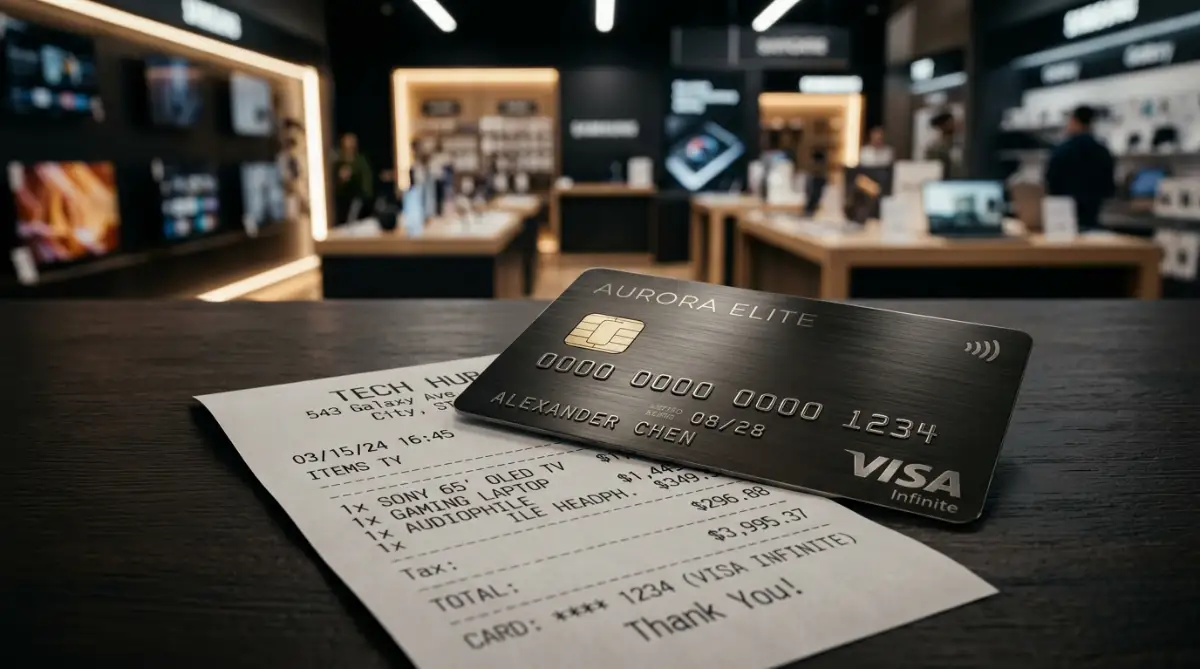
The Electronics Aisle Guilt Trip: Why Retailers Push Protection Plans
You're standing at the checkout counter holding a brand-new OLED TV.
The cashier taps the screen and asks if you want to add a three-year protection plan for an extra $150. Suddenly, doubt creeps in.
What if the screen goes black? What if the internal speakers blow out?
They prey on this exact fear. It's retail psychology at its absolute finest.
But here's the thing. You probably don't need it.
If you're holding a premium rewards card in your wallet, you already have a built-in safety net.
It's that simple.
Retailers push these extended warranties because they are massive profit engines. The margins on a television or a laptop are surprisingly thin. The real money is made on the accessories and the protection plans.
They train their staff to make you feel vulnerable. They make it sound like your expensive new gadget is guaranteed to break the second the manufacturer's coverage ends.
Don't let the pressure get to you.
When you understand how your existing financial tools work, you can politely decline that extra $150 fee with total confidence. You're already covered.
The Purchase Protection Quick Summary
Short on time? Here is exactly why you should skip the retail up-sell and trust your premium card:
- It's Completely Free: You don't pay extra at checkout. The coverage is baked into your card's annual fee.
- Automatic Activation: Just put the entire purchase on the eligible card. No separate registration required.
- Double The Coverage: Most premium cards automatically extend the original manufacturer's warranty by an additional year.
- Accidental Damage Shield: Many cards offer 90 to 120 days of theft and accidental damage protection. Store warranties rarely cover you if you drop the item yourself.
- Cash Over Repairs: If an item breaks, card issuers often just refund your original purchase price instead of forcing you to use a slow third-party repair shop.
The Hidden Mechanics of Card-Based Protection
To really understand why skipping the store warranty makes sense, we need to break down the exact mechanics of what your card actually does.
There are two completely different benefits at play here. Most people confuse them.
First, there's Purchase Protection. Second, there's the Extended Warranty benefit.
They serve two completely different purposes in the lifecycle of your new product. Let's look closely at how they function in the real world.
Imagine you buy a brand-new smartphone. You walk out of the store, trip on the curb, and completely shatter the screen.
A standard store warranty won't help you here. They cover mechanical failures, not clumsiness. Unless you bought an ultra-expensive "accidental damage" tier, you're out of luck.
This is where Purchase Protection steps in.
Most premium cards offer this safety net for the first 90 to 120 days after you buy something. If the item is damaged, stolen, or sometimes even lost, the card issuer reimburses you.
Think about it. That immediate risk window is completely covered for free.
Now, let's fast forward two years. Your smartphone's battery stops holding a charge, or the camera module fails.
The original one-year manufacturer warranty is long gone.
This is where the Extended Warranty benefit kicks in. Your card provider automatically matches the original warranty, usually adding one full extra year of coverage.
You didn't have to fill out forms at the store. You didn't have to pay a monthly fee. You just used the right piece of metal to pay for it.
Breaking Down the Math: Card vs. Store
Let's look at the actual numbers. Comparing these two options side-by-side reveals exactly where your money goes.

When you look at that breakdown, the choice becomes obvious.
Why pay $200 for a retail plan when your credit card gives you similar, and often better, coverage for free?
Over the course of a lifetime, the average person buys dozens of expensive electronics. Laptops, tablets, refrigerators, washing machines.
If you buy a store warranty for every single one of those items, you're throwing away thousands of dollars.
That money could easily cover the annual fee of a premium travel or rewards card for a decade.
Pro Tip: Always take a clear photo of your receipt and the item's serial number the moment you open the box. Store it in a dedicated cloud folder. If you ever need to file a claim with your card issuer, this five-second habit saves you hours of digging through trash.
The Reality of Filing a Claim
Now, we need to address the elephant in the room. The claim process.
Retailers love to claim that their warranties offer "peace of mind." They promise you can just walk into the store and get a replacement.
That's rarely the reality.
If you actually read the fine print of a store warranty, you'll find deductibles, shipping fees, and "lemon clauses."
Often, they force you to send your laptop away to a third-party repair facility. You might be without your computer for four weeks, only to get it back with a refurbished, low-quality screen.
Credit card claim processes aren't entirely perfect either. They require paperwork.
You'll need the original receipt, the credit card statement showing the purchase, and sometimes a repair estimate from a certified technician.
It sounds annoying. But the payout is usually much cleaner.
Instead of dealing with shady repairs, the benefit administrator often cuts you a check for the entire original purchase price.
They don't want the hassle of managing repairs either.
If your $1,200 laptop dies in year two, they frequently just send you $1,200. You can take that cash and buy a brand-new, upgraded model.
It's a massive advantage over retail repair programs.
Want to see exactly how these claims work in the real world? Check out this detailed breakdown of the credit card claim process.
Of course, not every single purchase qualifies.
There are strict exclusions you need to know about. Motorized vehicles, computer software, and items bought for resale usually aren't covered.
You also need to ensure the card account remains open and in good standing. If you cancel the card, you lose the extended coverage attached to those past purchases.
You must read your specific benefits guide.
Every bank handles these perks differently. A premium travel card might offer $10,000 per claim, while a basic cash-back card might limit you to $500.
Don't guess. Know exactly what's in your wallet before you make a big purchase.
The Advanced Claim Strategy & Network Playbooks
Filing a successful claim isn't just about throwing receipts at a wall and hoping they stick. You need a specific strategy.
Not all credit card networks process these requests the same way. The logo on the bottom right corner of your card dictates exactly who you'll deal with when disaster strikes.
If you don't understand the rules of your specific network, you risk getting your claim rejected on a technicality.
Here's how the major players actually handle your broken electronics.
The American Express Ecosystem
Amex is famous in the travel world, but their retail protection is arguably their best-kept secret.
Unlike most competitors, they handle claims almost entirely in-house. You aren't usually bounced around to random third-party insurance administrators.
Because they manage it internally, the process is incredibly streamlined.
For items under a certain dollar amount, they often approve claims within a few days without requiring you to mail the broken item anywhere. You fill out a digital form, upload your original receipt, and wait for the statement credit.
It's fast, efficient, and heavily favors the consumer.
The Visa Signature & Infinite Network
If you hold a premium Visa, your benefits are likely administered by an outside company called Card Benefit Services.
They are sticklers for paperwork. You can't just tell them your laptop screen cracked.
They usually require a written diagnostic report from an authorized repair facility. You have to prove the item is actually damaged and get a formal estimate for how much the repair will cost.
This takes extra legwork on your end.
The Mastercard World Elite Process
Mastercard uses similar third-party administrators, often companies like Broadspire.
Their biggest hurdle is strict timeframes. They require you to initiate the claim within a very tight window after the damage occurs. Usually, it's around 60 days.
If you wait three months to report your broken washing machine, they'll deny the claim instantly.
The Diagnostic Quote Script (Your Secret Weapon)
When dealing with Visa or Mastercard, getting the right documentation from a repair shop is the hardest part. The bank wants a specific statement on official letterhead.
If the repair shop just writes "Screen broken," the bank might bounce it back.
You need the technician to be explicit. Hand this script to the Geek Squad agent or local repair tech when you drop off your device.
Diagnostic Request Script:
"Hi, I'm filing a purchase protection claim with my bank. Can you please print an official repair estimate on company letterhead? The document needs to explicitly state the exact cause of the failure, whether it's economically viable to repair, and the total cost of replacement parts versus buying a new unit."
Do's vs. Don'ts of Filing Claims
Navigating the paperwork requires a bit of precision. Here is exactly what you should and shouldn't do when an item breaks.
The Expensive Pitfalls and Fine Print Traps
Retailers and banks both have fine print. While the credit card route is vastly superior, there are still hidden traps that can wipe out your coverage.
A lot of smart shoppers lose out on hundreds of dollars because they make one tiny mistake at the checkout counter.
Understanding these loopholes separates the financial experts from the amateurs.
The Split-Tender Disaster
This is the most common reason claims get rejected.
Let's say you're buying a $1,000 camera. You have a $200 gift card, so you use that fi