
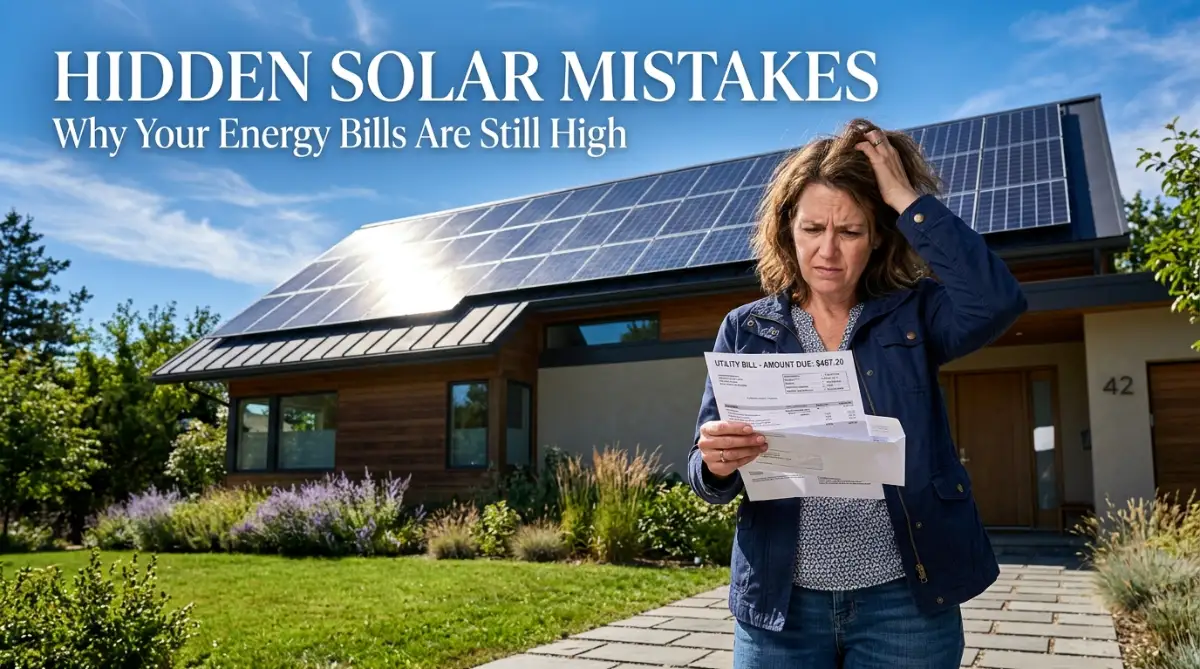
So you finally signed that solar contract. You honestly thought your energy bills were dead forever.
Then the first envelope arrived.
Your heart dropped when you saw the actual numbers. It's frustrating, and you're definitely not alone in feeling cheated. Here's exactly why your expensive rooftop system isn't delivering, and how to fix those hidden leaks today.
Quick Summary:
-
The Shadow Trap: Even a tiny chimney shadow can kill 50% of your power if you don't use microinverters.
-
Heat Damage: Baking your panels flush against the roof destroys their efficiency on hot days.
-
The Appliance Shift: Running heavy appliances at night means you're buying back your own power at a premium markup.
-
Hidden Leaks: Cheap wiring and corroded connectors silently burn off your generated electricity before it hits the breaker.
The Hidden Reality of Going Green
I still remember the day my solar system was finally turned on. I stood in my front yard, looking proudly at my roof, thinking I had just solved my energy problems forever. I imagined my next electricity bill would be zero, or maybe the power company would even send me a check. But when that first envelope arrived in the mail a month later, my heart completely sank. The bill was barely a few dollars less than what I used to pay before the installation. I felt totally cheated, confused, and overwhelmed by a massive sense of regret.
The mental peace you thought you were buying completely vanishes. You start constantly checking your phone app, obsessing over every cloud that passes by the sun. You yell at your kids for leaving the lights on, even though the whole point of going solar was to stop worrying about things like that.
The worst part is the feeling of absolute helplessness. The solar company tells you the system is functioning perfectly, but your bank account tells a very different story. You realize there is a massive gap between the marketing promises and your actual reality.
The truth is, solar energy works beautifully, but only when it is set up with absolute precision. A few unseen errors during the planning and mounting phases will quietly steal your expected output. Small oversights, which most installation crews completely ignore to save time, become long-term financial drains for you.
The "Set and Forget" Illusion
Most people assume solar is magic. You plug it in and never think about it again.
That's a very expensive mistake.
Your energy consumption habits didn't magically adapt when the panels went up. If you're still blasting the AC after the sun goes down, you're missing the entire point of the system.
Look, generating free power is only half the battle. Storing and timing your usage is what actually puts cash back in your pocket. It's a behavioral shift, not just a hardware upgrade.
Fixing the Silent Leaks in Your Solar Setup
You do not have to live with a poorly performing energy system. By understanding the mechanics of how your setup actually gathers and processes sunlight, you can easily identify where your power is leaking. Let us break down the exact technical traps that ruin your output and explore how to fix them right now.
The Garden Hose Effect on Your Roof
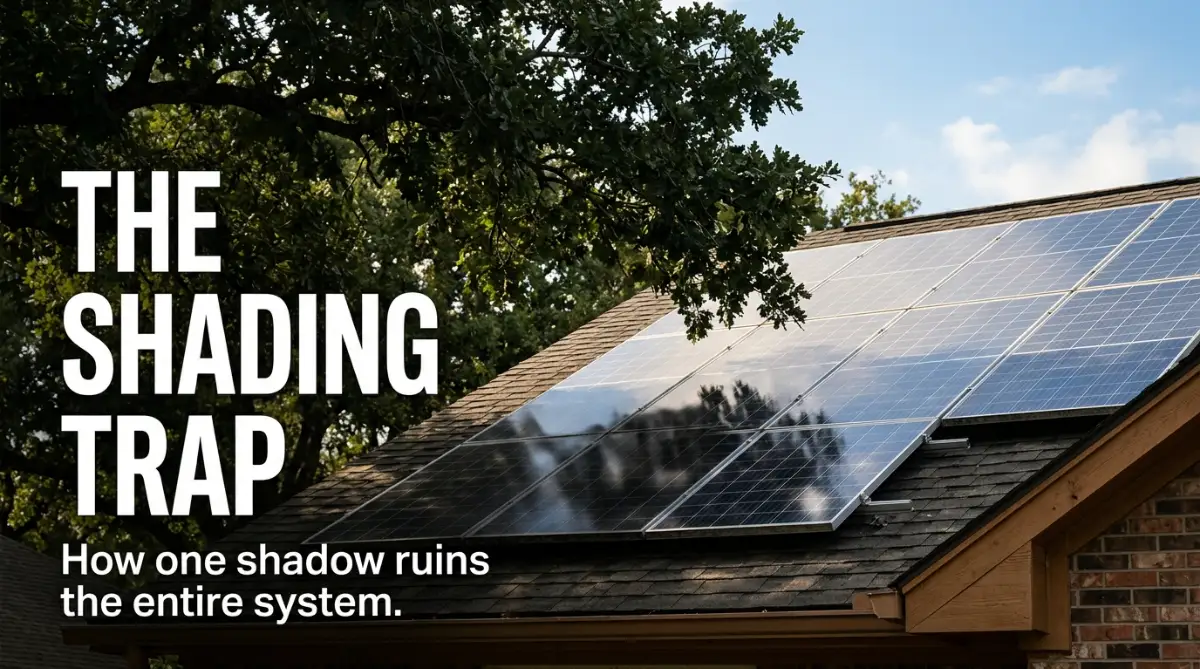
One of the most common reasons your system underperforms is something experts call partial shading. Many homeowners think that if a tree branch covers just one single panel, only that specific panel will stop working. This is a massive misunderstanding of how standard wiring actually operates.
Most budget-friendly setups use something called a string inverter. In this setup, all your panels are wired together in a single chain, acting exactly like an old set of holiday lights. If a chimney shadow falls across just one corner of a single panel, the output of the entire chain drops to match that weakest link.
Think of it like a garden hose carrying water. If you step on the hose, the water flow stops for the entire length of the pipe, not just at the spot you stepped on. A small shadow from a neighbor's roof line can easily cut your total daily production in half without you even noticing.
How to solve this today:
If you have shading issues, you need to ask your installer about Microinverters or DC Optimizers. These tiny devices are attached directly under each individual panel. They allow every single panel to operate completely independently from the others.
If a bird drops something on one panel, or a morning shadow covers another, the rest of your roof will continue to generate maximum power. Upgrading your inverters is the fastest way to instantly recover lost electricity.
Here's a quick breakdown of what solar salesmen won't tell you about setup myths.
| Common Belief | The Harsh Reality | Financial Impact |
|---|---|---|
| Bigger Panels = More Power | If the inverter is undersized, extra panel power is clipped and wasted completely. | High |
| Hot Sunny Days are Best | Extreme heat throttles electronics. Panels actually perform better on cool, bright spring days. | Medium |
Getting the Sun's Path Completely Wrong
You would be amazed at how many companies slap panels onto a roof without properly calculating the true path of the sun. Just because a roof looks empty and spacious does not mean it is the right place for capturing sunlight. Pointing your panels in the wrong direction is like trying to catch rain with an upside-down bucket.
In the northern hemisphere, your panels should ideally face true south to absorb the most intense midday rays. However, many rushed installers simply follow the existing angle of your house, even if it points east or west. While east and west setups can still gather light, they will produce significantly less overall power than a true south-facing array.
Bold Introductory Text: Want to visually understand exactly how roof angles destroy your power production? Watch this incredible breakdown to see how a simple compass mistake can cost you thousands in lost energy.
Roof pitch, which is the steepness of your roof, also plays a massive role in your daily production. If your roof is too flat, the morning and afternoon sun will simply bounce off the glass instead of absorbing into the cells. If your roof is too steep, the high summer sun will completely miss the optimal angle.
Don't let aggressive installers pressure you into cheap racking systems. If you live in a hurricane or high-wind zone, ensuring your mounts have specialized wind-deflectors will save your roof from being ripped apart during severe weather.
The Bottleneck of Undersized Inverters
Your panels collect Direct Current (DC) power from the sun, but your home appliances run on Alternating Current (AC) power. The inverter is the magical box on your wall that translates the DC power into AC power. However, this box can easily become the biggest bottleneck in your entire house.
Many companies try to save money by giving you an inverter that is slightly too small for your total panel capacity. This creates a serious problem known as power clipping. On a bright, cloudless afternoon, your panels might produce way more juice than the inverter can actually translate.
When this happens, the extra electricity is simply thrown away and lost into thin air. You are essentially paying for high-performance panels but capping their maximum speed. You are generating free power, but your house is refusing to let it inside.
I learned this lesson the extremely hard way during my first summer with solar. My app showed my power production hitting a perfectly flat line right at noon every single day, completely capping out. I realized my installer had given me a cheap, undersized inverter that literally blocked my system from reaching its full potential, costing me hundreds in lost summer energy.
A Quick Breakdown: String vs. Micro Inverters
To make things easier to understand, let us look at exactly how the two main types of inverters compare. Making the wrong choice here is often the root cause of high utility bills.
Ignoring the Reality of Temperature Coefficients
There is a huge scientific misconception that hotter days equal better solar production. People assume that baking summer heat is the best time for gathering energy. In reality, intense heat is actually the natural enemy of electronic efficiency.
Solar panels love bright light, but they absolutely hate high temperatures. Every single panel comes with a specific "temperature coefficient" rating. This number tells you exactly how much efficiency the panel loses for every degree it gets hotter than a standard mild day.
If your installer places the panels directly flat against the roof shingles, there is zero airflow underneath. The dark roof absorbs massive amounts of heat, baking the electronics from below. On a scorching August afternoon, a poorly ventilated system can lose up to twenty percent of its total generating capacity.
To prevent this, panels must be mounted with enough gap between the glass and the roof structure. This allows a natural cooling breeze to flow underneath, keeping the internal wiring at a healthy operating temperature. Always double-check that your installation crew is not mounting the racking system too tight against the shingles.
Changing Habits: The Load Mismatch Trap
Sometimes, the installation is technically perfect, but the savings still refuse to show up. This usually happens because of a massive shift in human psychology after the system is turned on. We call this the "free electricity illusion."
Homeowners often start leaving the air conditioning running all day, assuming the sun is covering the cost. The problem is that solar energy is largely a "use it or lose it" system unless you have an expensive battery bank attached. If your panels are generating peak power at 1 PM, but nobody is home to use it, that electricity is sent back to the grid.
Myth vs. Reality: The Truth About Solar Credits
The Myth: People believe that whatever excess power they send to the grid during the day can be bought back for free at