
The Big Bitcoin Dilemma: Convenience or Complete Control?
You want exposure to digital gold.
But the path to getting there isn't exactly straightforward anymore.
We've got two completely different worlds colliding right now. On one side, traditional finance is making it easier than ever to add digital assets to your portfolio. On the other side, the original crypto purists are screaming that you shouldn't trust anyone but yourself.
It's confusing. And quite frankly, it's a little intimidating.
Here's the thing. There isn't a single "perfect" way to buy Bitcoin. The right choice depends entirely on your personality, your technical comfort level, and what you actually want to achieve with your money.
Some people want the easy route. They want to open an app, click a button, and see their investment sitting right next to their index funds.
Others want pure, unadulterated control. They want to hold their own keys and know that no bank or government can touch their assets.
Both approaches have massive benefits. Both have hidden risks.
If you make the wrong choice based on your lifestyle, you could end up paying unnecessary fees. Or worse, you could accidentally lock yourself out of your own life savings.
We don't want that to happen.
So, let's strip away the complex jargon and look at exactly what you're signing up for with both options.
The Bitcoin Spot ETF vs. Direct Ownership Quick Summary
Don't have time to read the whole breakdown right now? Here's what you need to know:
- The Spot ETF Route: Perfect for traditional investors. You buy shares through a normal brokerage account. You don't have to worry about passwords, hackers, or losing your digital keys.
- The Catch with ETFs: You don't actually own the underlying Bitcoin. You pay annual management fees, and you can only trade during normal stock market hours.
- The Direct Ownership Route: Perfect for those who value total financial freedom. You hold the actual asset in a digital wallet. You can send it, spend it, or trade it 24/7.
- The Catch with Direct Ownership: Total responsibility. If you lose your security backup phrase, your money is gone forever. There is no customer service hotline to save you.
- The Final Verdict: Choose ETFs for tax-advantaged retirement accounts and peace of mind. Choose direct ownership if you want complete control and immunity from the traditional banking system.
Breaking Down the Wall Street Approach: What Is a Spot ETF?
Think about how you buy gold.
You could go to a dealer, buy a physical gold bar, carry it home, and lock it in a massive heavy safe.
Or, you could just buy shares of a gold trust on the stock market. A trusted company holds the gold in an ultra-secure vault, and they issue shares representing that gold.
A Bitcoin Spot Exchange-Traded Fund works exactly the same way.
Large financial institutions buy actual, physical Bitcoin. They store it with highly regulated custodians using enterprise-grade security. Then, they issue shares on the traditional stock market that track the exact price of that Bitcoin.
When you buy a share, you're buying a tiny slice of that massive institutional pie.
This completely removes the technical friction from the process.
You don't need to create an account on a sketchy crypto exchange. You don't need to learn how blockchain transfers work.
You just log into your normal brokerage account. You search for the ticker symbol. You click buy.
It's that simple.
For many people, this is a massive relief. The learning curve for crypto can be brutal. Figuring out network fees, wallet addresses, and cold storage devices takes serious time and effort.
With an ETF, you completely bypass the technical headache.
Plus, there's a huge tax advantage in many countries. Because these are traditional financial products, you can often hold them in tax-advantaged retirement accounts. That's something you simply can't do easily with a personal crypto wallet.
But you do trade something away for this convenience.
You're paying a management fee. Usually, it's a small percentage, but over decades, those fees eat into your total returns.
Also, you're bound by traditional market hours. Crypto trades 24/7. If the market crashes on a Saturday night, direct owners can sell instantly. ETF holders have to sit and sweat until the market opens on Monday morning.
Going Old School: The Reality of Direct Crypto Ownership
Now, let's talk about holding the asset yourself.
In the crypto world, there's a famous saying: "Not your keys, not your coins."
When you own an ETF, you own an IOU from a Wall Street firm. When you buy crypto directly and hold it in your own wallet, you are your own bank.
There is no middleman.
You buy the asset on an exchange, and then you transfer it to a software wallet on your phone or a hardware wallet (which looks a lot like a USB drive).
Once it's in your possession, nobody can freeze your account. Nobody can tell you what you can or can't do with your money.
If you want to send money to someone on the other side of the planet at 3 AM on a Sunday, you can do it in minutes.
That level of financial freedom is incredibly powerful.
But it comes with a terrifying level of responsibility.
When you set up a private wallet, you're given a "seed phrase." This is usually a list of 12 to 24 random words. This phrase is the master password to your money.
If you forget your wallet password, you can use this seed phrase to recover your funds.
But if you lose the seed phrase, and your hardware breaks? Your money is gone.
Forever.
There's no reset password button. There's no CEO to email.
People have lost millions of dollars simply because they threw away a piece of paper or forgot where they hid their backup.
You also have to think about personal security. How do you protect that seed phrase from fire, floods, or theft? Are you comfortable managing that level of physical security in your own home?
For tech-savvy individuals, this isn't a problem. They enjoy the process of securing their own wealth.
But for someone who just wants to invest a few thousand dollars and forget about it for ten years? Direct ownership can cause a lot of unnecessary anxiety.
Head-to-Head Comparison: The Core Differences
Let's look at exactly how these two methods stack up against each other across the most important categories.
Pro Tip for Portfolio Strategy:
You don't have to choose just one path. Many smart investors use a hybrid approach. They put their long-term, "do not touch" investments into an ETF inside their retirement accounts for tax benefits. Then, they keep a smaller amount of direct crypto in a personal wallet to learn the technology and maintain some liquid digital cash.
Here's a great visual breakdown of how institutional crypto custody actually works behind the scenes.
We've covered the basics of how these two systems operate.
But understanding the mechanics is only half the battle.
To make the right choice, you need to understand what happens when things go wrong. How do these methods hold up during a market crisis, a hack, or a major life event?
We need to look closely at the hidden risks that no one tells you about until it's too late.

Advanced Execution: How to Buy Without Losing Your Shirt
We know the theory now.
But theory doesn't protect your hard-earned money when you're actually clicking the "buy" button. Execution is everything.
Let's talk about the exact playbooks for your specific devices and platforms. Because buying on a smartphone app is very different from managing physical hardware on a messy desk. If you mess up the execution phase, the underlying asset won't matter.
Platform-Specific Playbook: Traditional Brokerage Apps (iOS/Android & Web)
If you're going the ETF route, you're likely using a heavy hitter like Charles Schwab, Fidelity, or Vanguard.
These platforms are built for absolute stability. But their mobile apps can sometimes hide the actual costs of a trade behind default settings designed for speed, not precision.
Never use a basic "Market Order" on a mobile brokerage app.
A market order just buys the asset at whatever the current asking price is at that exact millisecond. During times of high market volatility, that price can spike drastically for a fraction of a second. You could end up paying way more than you intended because of something called "slippage."
Always switch the order type to a "Limit Order" in your app settings.
This tells the broker you'll only buy at a specific price or better. It's a simple toggle on your phone screen, but it saves you from getting burned by sudden algorithmic price swings.
Platform-Specific Playbook: Direct Crypto Custody (Desktop vs. Mobile)
If you're taking total control, you need a hardware wallet.
Brands like Trezor or Ledger are the gold standard for this. But setting them up requires a specific workflow to stay safe. A hardware wallet is just a piece of plastic and metal until you program it correctly.
Don't set up your hardware wallet using your everyday smartphone.
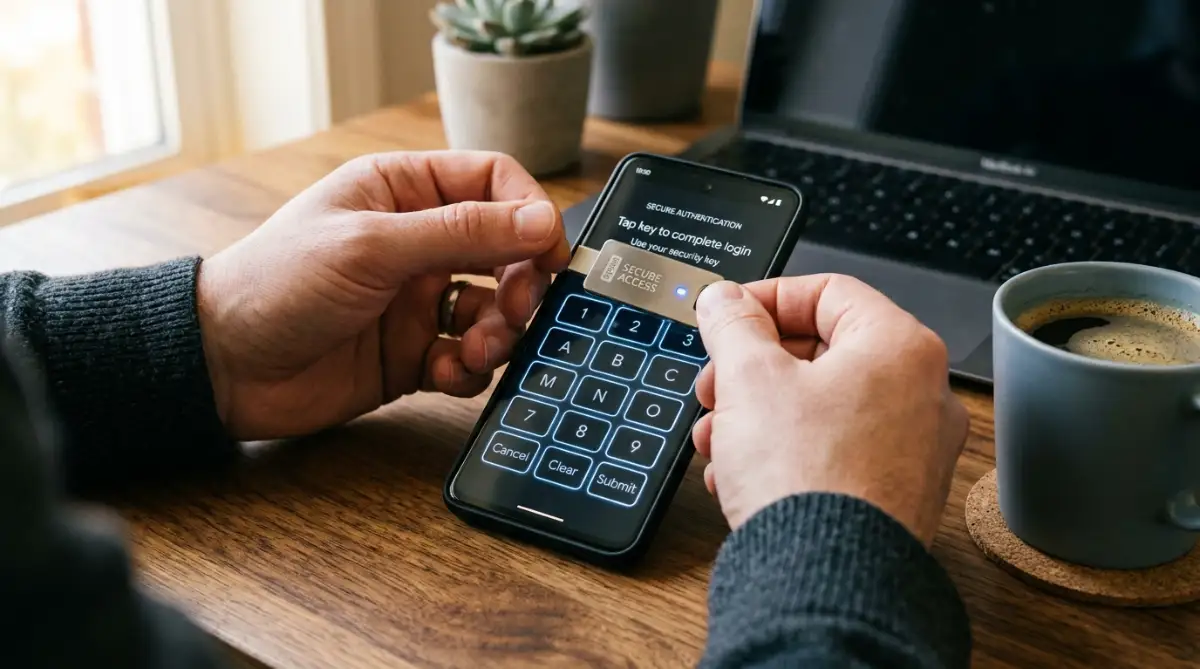
Phones are highly susceptible to malicious apps and background screen-recording malware. Instead, use a clean, dedicated desktop or laptop. Plug the device in, download the official software directly from the manufacturer, and write your seed phrase on the physical paper provided.
Never type that phrase into any digital keyboard.
Before you even think about moving a large sum of your savings, you need to practice. Send ten bucks to the wallet. Then, purposely wipe the wallet completely and try to recover it using your paper backup.
If you successfully recover the ten bucks, you know your backup works flawlessly. If you fail? You only lost the price of a cheap lunch. It's the ultimate stress test.
The Pre-Purchase Digital Hygiene Checklist
Before you start diversifying your portfolio with digital assets, you have to secure your environment.
Hackers rarely break the blockchain network. They break your personal computer.
Run through this quick digital deep clean checklist before moving any funds:
- Update your OS: Ensure your Windows or MacOS is on the absolute latest version to patch vulnerabilities.
- Kill browser extensions: Disable all unnecessary chrome extensions immediately. They can read your screen data and steal passwords.
- Secure your email: Upgrade your primary email (Gmail/Outlook) with an authenticator app. SMS text verification is easily hacked through SIM swapping.
- Run a deep malware sweep: Use a trusted, premium scanner to check for hidden keyloggers on your hard drive.
- Check the URL twice: Bookmark your exchange or brokerage site. Never search for it on Google and click a sponsored ad, as those are often fake phishing sites.
It takes maybe twenty minutes.
But it saves you from a lifetime of regret. The National Institute of Standards and Technology (NIST) has clearly stated that poor credential management is the leading cause of digital financial theft.
You don't want to be a statistic.
The Ironclad Rules of Buying
The Silent Traps That Wipe Out Beginner Investors
The financial world is full of invisible landmines.
And the folks selling these products aren't exactly incentivized to point them out to you. Let's look at the absolute worst traps people fall into when trying to get exposure to this asset class.
First, there's the "Not Actually Your Coins" illusion with modern fintech platforms.
A lot of popular payment apps offer a shiny button that says "Buy Bitcoin." It feels incredibly convenient. But if you read the fine print, you'll realize you can't actually withdraw that asset to your own wallet.
You're just betting on the price movement inside their walled garden.
If you want true direct ownership, make sure the platform allows external network withdrawals. If they don't, you're trapped. You don't own the asset; you just own a digital receipt on their private server.
Then there's the silent killer: ETF tracking error and expense drag.
A 0.25% management fee sounds incredibly low at first glance. It looks like pennies on a spreadsheet.
But compound that over a twenty-year retirement horizon. That tiny fee eats a massive, painful hole in your total long-term returns. You also have to deal with "tracking error," where the ETF price occasionally drifts away from the actual real-time price of Bitcoin due to market inefficiencies.
You have to factor this in when deciding between holding a physical asset for free versus paying a Wall Street firm for convenience.
Finally, there's the emotional trap of panic selling.
Crypto is notoriously volatile. We routinely see 20% drops on a random Tuesday afternoon.
If you're watching the charts every hour on your phone, your brain will scream at you to sell and cut your losses. This is why having a solid, automated