

Stop Chasing Cheap Attention (The Real B2B Problem)
You've spent hours crafting the perfect social media post. You hit publish, and suddenly, the notifications start rolling in. Hundreds of likes. Dozens of comments.
Your dopamine spikes. You think you've finally cracked the code.
But then a week goes by. You check your inbox, your calendar, and your CRM. Nothing. Not a single qualified meeting booked. Just a bunch of noise from people who will never actually buy your premium services.
Here's the harsh truth most marketers won't tell you.
Going viral is the absolute worst thing that can happen to a B2B company selling high-ticket services. When you cast a massive net designed to entertain the masses, you actively repel the serious decision-makers. They don't want entertainment. They want a specific solution to an expensive problem.
We've seen brilliant agency owners and consultants burn out because they're playing the wrong game. They're trying to act like consumer influencers when they should be acting like trusted industry advisors.
If you're selling a $10,000 or $50,000 service, your strategy needs a massive shift. You don't need a hundred thousand followers. You just need a few hundred of the exact right people paying close attention.
The B2B High-Ticket Strategy Quick Summary
- Forget the algorithm: Focus purely on buyer psychology, not what gets the most superficial engagement.
- Embrace the "Silent Buyer": Understand that high-level executives rarely like or comment, but they watch everything you post.
- Narrow your positioning: Speak directly to a highly specific pain point that only premium clients experience.
- Build an authority funnel: Use social media as the top of your funnel to drive targeted traffic to deep, value-heavy assets.
- Optimize for trust, not reach: Stop creating bite-sized hacks and start publishing deep, analytical case studies.
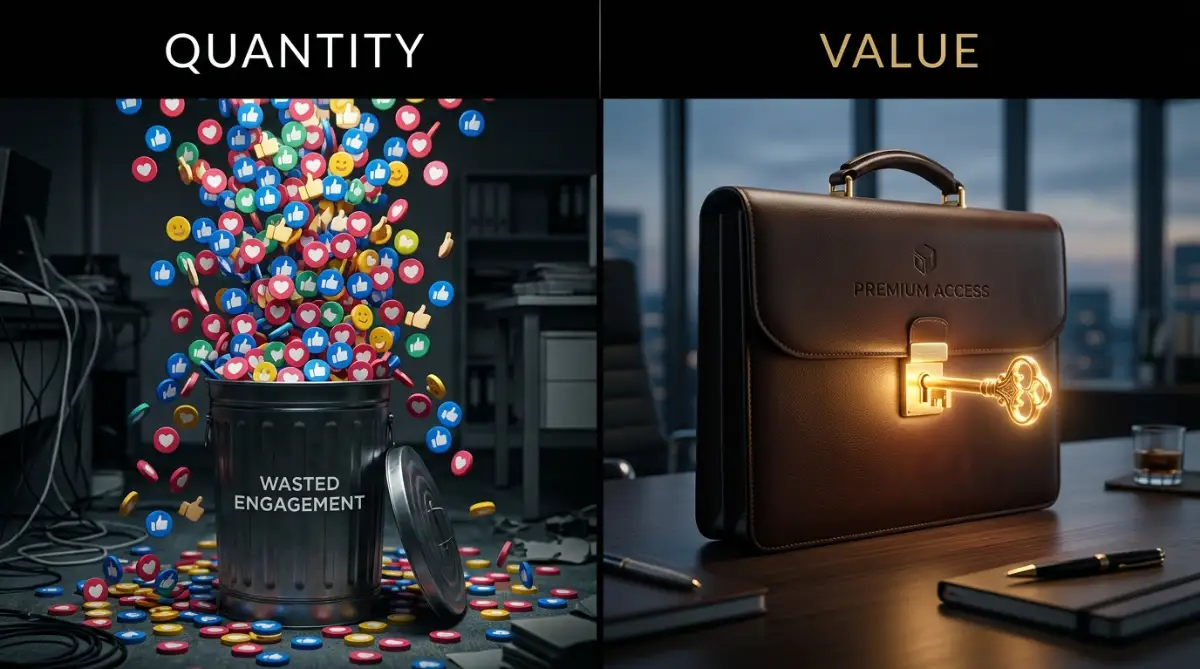
Shifting from Vanity Metrics to Value-Driven Authority
We need to completely rewire how you view social media performance. Right now, the platforms are designed to make you feel bad if a post only gets ten likes.
But think about it logically.
If those ten likes include a CEO of a mid-market tech firm, a VP of Sales at a logistics company, and a marketing director with a massive budget, that post was wildly successful. You've just placed your expertise directly in front of buyers who can dramatically change your revenue.
It's time to stop measuring your success by vanity metrics.
When you chase high engagement, you naturally water down your message. You start posting generic motivational quotes or broad industry news. Sure, people hit the like button because it's easy and safe. But nobody wires you fifty grand because you posted a nice quote about teamwork.
To attract high-ticket leads, your content must be uncomfortably specific. It should actually bore the average person while deeply fascinating your ideal buyer.
Why Broad Content Ruins Your Premium Positioning
Imagine you're the founder of a SaaS company dealing with massive server architecture issues. Your platform is crashing, and it's costing you thousands of dollars an hour.
You go online looking for a consultant.
You find two profiles. Consultant A has 50,000 followers and posts generic advice like "5 Tips for Better Coding" and funny memes about office coffee. Consultant B has 800 followers, but their last three posts are highly technical breakdowns of how to scale server architecture specifically for SaaS companies handling high traffic loads.
Who are you hiring to fix your expensive problem?
It's not even a competition. You're hiring Consultant B, and you won't even argue about their premium pricing.
This is exactly how your potential high-ticket clients view you. When you try to appeal to everyone, you become the generic, low-value option in their minds. You strip away the specialized expertise that justifies a high price tag.
The Silent Buyer Phenomenon in B2B
This is perhaps the biggest secret in B2B social selling. The people with the real money and the actual decision-making power almost never engage publicly.
They are silent buyers.
A CEO doesn't have the time to sit around leaving thoughtful comments on LinkedIn or Twitter. Moreover, they often don't want their competitors or their own employees to know what problems they are currently researching. If they are looking for a consultant to help with massive employee turnover, they aren't going to publicly comment on a post about it.
They read your post, check out your profile, click the link to your website, and bookmark your contact page. All completely in the shadows.
If you base your entire content strategy on the immediate feedback loop of likes and comments, you'll completely miss the silent buyers. You'll stop posting the deep, analytical content they crave because it doesn't get enough engagement.
Don't fall into this trap. Keep producing heavy, value-dense material. Trust that the right people are reading it in the background.
Pro Tip: Want to know if silent buyers are actually watching? Track your profile views and website clicks, not your post likes. If your profile views are going up and the job titles of those viewers match your ideal client, your strategy is working perfectly. Keep going.
How B2B Buyers Actually Make Purchasing Decisions
Designing Your Profile for the "One Percent"
Before you even think about publishing another post, we need to fix your actual social media profile. Your profile isn't a resume. It's a highly targeted landing page.
Most B2B professionals make the mistake of listing their job history and a vague description of their company. This is a massive missed opportunity. When a high-ticket prospect discovers your content and clicks your name, you have about three seconds to convince them you can solve their specific problem.
Your headline needs to be completely ruthless in its clarity.
Instead of writing "Digital Marketing Expert | CEO at GrowthAgency", you need to state exactly who you help and the financial outcome you deliver. Something like, "We help B2B SaaS companies reduce customer churn by 15% using data-driven retention systems."
Now, when that SaaS founder clicks your profile, they instantly know they are in the right place.
Your featured section shouldn't just be a link to your generic homepage. It needs to point directly to your most valuable asset. This could be a comprehensive case study, a detailed whitepaper, or a video breakdown of your proprietary process.
You're essentially setting up a digital mousetrap. The content grabs their attention, the profile confirms your expertise, and the featured link pulls them off the social platform and into your controlled sales environment.
It's that simple. But simple doesn't mean easy. It requires discipline to ignore the noise and focus entirely on the quality of the specific minds you're trying to reach.
Executing the High-Ticket Playbook Across Platforms
So your profile is finally optimized to capture high-value attention. Now we need to talk about distribution.
Where you post is just as important as what you post.
Different platforms require entirely different psychological approaches. You can't just copy and paste the same caption across LinkedIn, X (formerly Twitter), and YouTube. That's a rookie mistake.
Your buyers use these platforms in completely different states of mind. Let's break down exactly how to approach the big three for premium B2B sales.
LinkedIn: The Digital Boardroom
LinkedIn is your primary hunting ground for high-ticket deals. But most people use it like a giant networking event where everyone is shouting at once.
You need to treat it like a digital boardroom.
Stop sending blind connection requests with automated pitch slaps. It instantly destroys your credibility. Instead, you need to use a highly targeted account-based approach.
Curate a list of 50 dream clients. Don't pitch them. Just start engaging with their content thoughtfully. When they post an article, leave a comment that actually adds value to their premise.
When you do this consistently, you trigger the law of reciprocity. They will check your profile. And because you optimized it in the previous step, they'll see exactly how you can help them.
X (Twitter): The Fast-Paced Industry Watercooler
X is much faster and highly conversational. It's not the place for long, stuffy corporate announcements.
It's the perfect place to build rapid authority by sharing raw, unfiltered industry observations.
To win here, you need to use private lists. Create a private Twitter list of decision-makers in your target industry. Spend 15 minutes a day exclusively engaging with that specific feed. Ignore the trending topics. Ignore the viral outrage.
Just be consistently helpful and insightful in the replies of your target buyers. According to demographic data from the Pew Research Center, a significant portion of high-earning, educated professionals actively use this platform to consume news and industry trends.
Be the person they see making smart observations every single day.
YouTube: The Ultimate Trust Engine
If you sell complex, expensive services, YouTube is your best friend.
Text and images can build interest, but video builds deep, unshakeable trust. When a prospect watches you explain a complex concept on video for 15 minutes, they feel like they know you.
Don't worry about subscriber counts here.
You aren't trying to become a professional YouTuber. You're building an evergreen video library for your sales pipeline. Create highly specific videos like "How We Solved [Specific Problem] for [Specific Type of Company]."
When you get on a discovery call, your prospect will already trust your expertise because they've watched your deep-dive content.
The High-Ticket Damage Control Template
Even with the best strategy, premium leads sometimes go cold. A decision-maker gets busy, budgets get frozen, or they simply forget to reply.
Most salespeople panic and send the dreaded "Just checking in!" message. Never do this. It's annoying and adds zero value.
Instead, use this "Value-Led Revival" template to restart a stalled conversation.
The "Value-Led Revival" Message:
"Hi [Name],
I know things get incredibly busy on your end. We were analyzing some new data on [Specific problem you discussed] this morning, and it immediately made me think of your situation at [Company Name].
I put together a quick 3-minute loom video breaking down a potential workaround for you. No pressure to reply, just wanted to send this over in case it's helpful right now.
Link: [Insert Video Link]"
Here's why this works. You aren't asking for their time. You're giving them something highly customized for free. It completely resets the dynamic and usually results in an immediate, apologetic reply.
Do's vs. Don'ts for B2B Social Selling
You need strict rules of engagement to keep your strategy on track. Keep this checklist handy before you hit publish.